

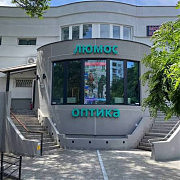
The “Lumіos” optics network traces its history back to 2007, when a small, cozy optics store, then called “Lіnza,” opened in Odesa at the intersection of B. Khmelnytskyi and Vatutin streets.
Time passed. Customer trust in the optics grew, and the optics itself grew. Observing the vision of a large number of patients, identifying and understanding their needs, and a sincere desire to provide more opportunities for quality ophthalmological care to those who chose us led to the transformation of “Lіnza,” an optics with one diagnostic doctor’s office, into “Lumіos” – a network of modern optics – in 2017. Why “Lumіos”? Lumіos means Light, it’s the beginning, what makes it possible to see; only through light, as a physical phenomenon, does life have the ability to see and manifest. We want to become the link between Light and People in ophthalmology.
Protect Your Vision From a Young Age
Our task is to teach people to be conscious of their health and to protect their vision from childhood to old age. We choose prevention as the main direction of our activity.
A specialization in the recent past and a direction successfully developed at “Lumіos” is the diagnosis and treatment of refractive errors of various degrees: myopia, hyperopia, astigmatism, and their complications – amblyopia and strabismus. In our optics stores, we offer all types of existing modern correction: glasses of various complexities, soft contact lenses, rigid night lenses, scleral lenses. Vision training rooms are available.
The expansion of the diagnostic base and the addition of modern technologies – optical coherence tomography (OCT) of all parts of the eye, angiography, biometry, ultrasound scanning – allow for the diagnosis of initial changes in the visual organ at a preclinical level, i.e., when the person themselves has no complaints. These include diseases such as glaucoma, macular degeneration, retinal dystrophy, diabetic retinopathy, optic nerve diseases, and others, which, if not detected in time, can lead to vision loss. During such an examination, all significant eye parameters and minimal changes will be recorded, based on which the ophthalmologist will develop a strategy for observation, treatment, and recommendations, and will be able to accurately assess the dynamics in the future.
The data from such an examination will be useful for assessing the health status of patients for general practitioners and doctors of related specialties – neurologists, endocrinologists, gynecologists, cardiologists.
We Learn and Teach
At “Lumіos,” we constantly care about the professional growth of the entire team. Today, “Lumіos” offers comprehensive support and service to our clients of all ages and their families on all vision-related issues: diagnostics, correction, treatment, and regular check-ups, excluding surgical treatment.
We bring a new culture through explanations, conveying professional information, and debunking myths. According to the latest data from the World Health Organization (WHO), there are at least 2.2 billion cases of vision impairment or blindness worldwide, with over 1 billion of them being the result of a lack of prevention or treatment. This is a very large number, as vision is quality of life. According to the same data from the World Health Organization, three-quarters of blindness cases worldwide can be prevented. And it all starts with visiting a qualified ophthalmologist who uses modern diagnostic capabilities in their work. Check your vision and the vision of your loved ones, preserving it for many years to come.
About Vision and Correction
We want you to think about the role of the visual system. To this day, science does not know exactly how we see, but the data we have gives us confidence in only one thing: the eyes only transmit information, and we see thanks to the brain. In the eyes, there is a small area of the retina called the macula, where a perfectly clear image of the objects we are looking at must fall. Only in this case will vision be 100%. Some people, whose eye shape and size, as well as their parts, are optically correct and proportional, have 100% vision and see a clear picture. But some people, and there are more than 70% of them, have deviations in eye optics, namely: hyperopia, myopia, and astigmatism. Note: this is not a disease. It is related to the incorrect shape and size of the eyes and their parts. And it is almost always present from birth. In all such cases, when the eye optics are incorrectly formed, the image on the retina simply cannot be accurate and clear, and the person sees everything blurry.

How can this be corrected? A clear picture can be achieved by correcting the congenital defect only with the help of additional correction. The missing optics must be added to the existing vision of the eyes. Then the retina of the eyes will receive a clear image and transmit it to the brain without distortion. Vision correction methods and tools include: glasses; soft contact lenses; rigid night lenses; scleral lenses. All of them are selected individually. They correct the defect in eye optics. They make vision clear and, most importantly, allow the eyes to work correctly in a tension-relaxation mode. Refractive surgeries pursue the same goal of correcting incorrect eye optics: laser vision correction; phakic lenses; refractive lens exchange. This is the same as correction methods, only in a different form. But the main difference here is that glasses and lenses can be put on, taken off, changed if something is wrong, but surgery is the correction of eye optics through intervention, and there is no going back if something goes wrong. And here it is important to understand not only the risks, but that’s not what we’re talking about now.
The value of professional correction fitting lies in the fact that the fitting is carried out within the framework of diagnostics with mandatory intraocular pressure measurement, examination of all structures and parts of the eyes from the cornea to the retina, and thanks to such an examination, diseases or future vision threats are detected, thus making it possible to prevent problems.
And although we live in a world of accessible information, doctors very often encounter complications due to people seeking medical help too late and wasting time. One of the reasons for late visits is the non-use of corrective measures.
“Lumіos” optics works precisely to prevent, slow down, and avert the danger that could deprive you of the ability to see this world and live brightly.
Children. Letter charts are not enough
Most vision problems in children remain unnoticed in the early stages. Often, parents only notice them when learning or playing becomes difficult for the child, or even worse, when the eye starts to turn. We still encounter a lack of understanding from parents that a doctor does not need to check a child with a letter chart to know if their vision is okay or, conversely, if there are problems that need urgent attention.
For diagnosing children under three years of age, by which age vision problems must be detected to avoid complications such as amblyopia and strabismus, we have all the necessary equipment. We conduct vision diagnostics for older children at “Lumіos” using modern approaches, and we have all the necessary tests and equipment. There are two equipped rooms for vision training and development.
An important point: in addition to congenital pathology, according to statistics, vision deteriorates in 30-40% of all children during school age due to myopia, which can appear in absolutely any child. Therefore, we conduct functional status checks for all children, including healthy ones.
Vision Disease Prevention: What You Need to Know
Most eye diseases and functional disorders are easier to prevent than to treat.
Basic principles of prevention:
– Regular check-ups for children at least once a year, for adults – once every 1-2 years;
– Adequate visual loads – adherence to visual regimen, breaks during screen work, proper lighting;
– Timely correction – updating glasses or contact lenses, monitoring the correspondence of correction to the current vision status;
– Functional vision support – accommodation training, binocular vision development, orthoptic and hardware treatment as needed;
– Lifestyle: sufficient time spent outdoors (especially for children), balanced nutrition, monitoring of overall health status.
A modern approach to vision is comprehensive. Today, vision is considered not in isolation, but as part of a single system “eyes – brain – body.” That is why effective assistance includes: accurate diagnostics, individual correction, prevention and support, and patient education on vision care.
In conclusion. Vision is a lifelong investment. For a child, it is the foundation for development and a successful future. For an adult, it is quality of life, work capacity, and self-confidence. Modern possibilities allow for maintaining and supporting vision at a high level, but only with a timely and conscious approach.
We are waiting for you at “Lumіos” clinics: B. Khmelnytskyi St., 1/3, Korolyov St., 56a.
Appointments can be made by phone: 048-777-78-80, 067-981-10-59.











