

The first solar eclipse of this year took place on February seventeenth. It was annular. Such an exotic appearance is explained by the fact that the Moon was in apogee during the eclipse, i.e., at its maximum distance from Earth, and therefore did not completely cover the solar disk.
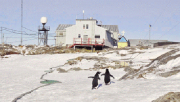
It is noteworthy that the solar eclipse was seen by… penguins, as the main phase of this natural phenomenon was observed in Antarctica and its adjacent territories, particularly in the extreme south of Chile, Argentina, the African continent, and Madagascar.
Among the main spectators of the solar eclipse were the polar explorers of the Ukrainian Vernadsky Antarctic Station. 30 years ago, this station (then named Faraday) was transferred to Ukraine by Great Britain for just one pound sterling. The transfer of the station to our state was explained by the fact that Ukraine had specialists who had already worked at Antarctic stations. Another contender, South Korea, did not have such experience.
During the solar eclipse, the implementation of an international program to study the effects of this natural phenomenon across the globe began. Ukraine, Latvia, and Finland are participating in the project. For observations, the “URAN” radio telescope system of the Institute of Radio Astronomy of the National Academy of Sciences of Ukraine (including the “URAN-4” radio telescope at the Odesa Observatory in Mayaky) and the magnetometer network of the Institute of Geophysics of the National Academy of Sciences of Ukraine, including a magnetometer in Antarctica, will be used.
Researchers are eagerly awaiting the solar eclipse that will occur on August 12. This will be a total solar eclipse. The maximum phase will pass over Greenland, Iceland, Spain, and the island of Ibiza. Partial phases will be visible over most of Europe, Canada, North Africa, and the Far East.
However, Odesa residents will also be able to see solar eclipses: for the upcoming Saturday, February 21, the Odesa Planetarium on the territory of the astronomical observatory of ONU in T. G. Shevchenko Park has planned a program dedicated to the mysteries of solar and lunar eclipses. The session begins at 17:30.











