

The very geographical location of Crete — at the crossroads of trade routes between East and West — has shaped the amazing diversity of its culture for millennia. Here, features of Egypt and Asia Minor, the Balkans and Arabia intertwined. In these conditions of constant exchange and contact, not isolation, a world of mixed religions, traditions, and knowledge was born. It is no coincidence that this civilization put forward the idea of harmonious societal development without violence and wars. This is what the myths and legends of Minoan Crete primarily tell us.
The Idea of an Open World
I first set foot on Crete in the last century. Back then, I was most struck by the very fact that a highly developed civilization existed three and a half thousand years ago, capable of building such a grandiose palace in Knossos. I walked its ancient corridors and listened with admiration to the stories about Zeus — the ruler of Olympus, about the Phoenician princess Europa, about Minos, about the half-man, half-bull Minotaur, about his conqueror Theseus and the brave Ariadne, about the wise Daedalus and his audacious son Icarus.
At that time, all these stories seemed like mere fairy tales that the ancient Greeks used to entertain children. But over the years, returning to Crete with various groups and traveling the island again and again, I gradually realized: these legends are not at all fabrications for amusement. They were a reflection of the ancient people’s understanding of the world order, of how society and relationships between people and gods should be structured.
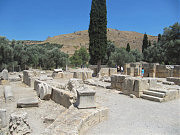
Even then, during my first acquaintance with Knossos, I was surprised by the absence of fortified walls around the palace. Especially in contrast to Genoa, Naples, Civitavecchia, or Malta, where powerful fortifications, designed to protect against enemies, are the main dominant feature. Crete offered a different path to security: not walls, but trade; not defense, but diplomacy; not enmity, but cultural exchange. Rulers changed — Minoans, Greeks, Romans, Byzantines, Venetians, Ottomans — but the very idea of an open world proved remarkably viable. It existed until a powerful volcanic eruption on Santorini destroyed the Minoan kingdom.
Even the palace frescoes — bulls, labyrinths, goddesses, youths and maidens leaping over animals — speak of the Minoans’ worldview. It is a striving to find order amidst chaos, to gain freedom within destiny, to build a dialogue with the world, not a war against it.
Good Always Triumphs in the End
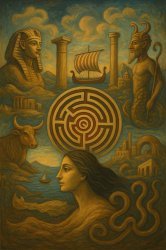
A recent trip to the island allowed me to see not only the Palace of Knossos again but also mythological sites associated with ancient gods and heroes. Listening to the guide, I suddenly felt how millennia-old stories remarkably naturally echoed our reality — with Russia’s aggression against Ukraine.
The starting point for these reflections was a trip to the mountains, to the cave where, according to legend, Zeus was born.
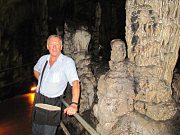
The size of the cave is hard to imagine until you take a few steps down a steep wooden ladder. The bottom is almost invisible — only the faint illumination of stalagmites shows the way into the semi-darkness. Stone columns of bizarre shapes stand like priests of an unknown temple, and the drops of water falling from the vaults enhance the sense of ancient mystery.
Here, in the harsh mountains, Rhea, Zeus’s mother, fled to save the newborn from the wrath of his father, the titan Cronus. Cronus, fearing a prophecy about his overthrow, devoured all his children. Rhea, to save the infant, substituted him with a stone wrapped in swaddling clothes, which Cronus swallowed. And she left Zeus himself under the protection of mountain spirits and a goat nurse.
Did Rhea know that she had given birth to the future ruler of the world? I think she suspected. Otherwise, why would she have summoned warriors who, striking their shields with spears, drowned out the baby’s cries?
When I shouted into the depths of the cave, the echo rolled for a long time along its stone walls. And I thought: how strong must have been the voice of the little god if a whole guard was needed to hide him from Cronus!
When Zeus grew up, he began a war with his father. Eventually, Cronus regurgitated his swallowed children, and his adult brothers and sisters emerged into the world: Hestia, Demeter, Hera, Hades, and Poseidon. The great battle between the Olympians and the Titans lasted ten years, in which the heroes were helped by Cyclopes and hundred-armed giants.
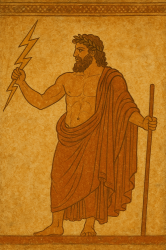
The Cyclopes gave the gods weapons: Zeus — lightning bolts, Poseidon — a trident, Hades — a helmet of invisibility. The Olympians won, and Cronus was overthrown into Tartarus — the abyss of world darkness. Thus began the era of the Olympian gods, and Zeus became a symbol of cosmic order, law, and justice.
Listening to this story, I involuntarily transferred it to the events of recent years. Cronus and his titans are today’s Russia, led by Putin, a symbol of an archaic world based on fear, violence, and total suppression. It is the image of any power that fears the future.
The modern Zeus is Ukraine — a country fighting the new against the old, for the right of the whole world to develop towards justice, freedom, and responsibility. If we follow the logic of the ancient myth, this battle is inevitable and will continue for several more years.
According to the myth, Zeus had allies. So do we, with countries of the West becoming our allies, as well as republics of the former USSR, which were once “swallowed” and are kept by Russia in its sphere of influence. The Baltic states have already freed themselves and become reliable allies in the struggle of the Ukrainian Zeus against the Russian Cronus. In the future, other countries will do the same, following the example of Ukraine, where reason, justice, and freedom are being established.
…And Zeus Seduced the Phoenician Princess
This tree itself was not impressive in size. Around it grew much more massive trees with wide crowns, which seemed more fitting for the legend of Zeus and Europa. But the Greeks know best: perhaps this very tree is an ancient long-liver, and they see something special in the bends of its branches. This is evidenced by a plaque on the tree.
Under the scorching sun, amidst the scorched grass, it was hard to believe that it was here, among these hills with the ruins of ancient temples, that one of humanity’s most beautiful legends was born.
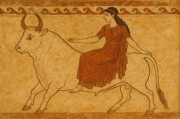
According to legend, Europa, daughter of the Phoenician king, was once walking along the seashore. Zeus saw the girl and was struck by her beauty. To approach the princess, he took the form of a magnificent white bull with gentle eyes and golden horns. Europa approached the animal without fear, stroked it, and, trusting him, sat on its back. At that very moment, the bull rushed into the sea and swam through the waves, taking her to Crete. There he revealed his divine form, and Europa, amazed by Zeus’s majesty, became his beloved. Three sons were born from their union, including Minos, the future great king of Crete.
Just one legend — but what depth of meaning! It intertwined East and West, sea and land, man and god. Europa, daughter of Asia, taken to another shore, became a symbol of the birth of a new civilization that combined the wisdom of the East and the freedom of the West. It was this myth that gave its name to an entire continent. Europa is not just a woman abducted by a god; she is a symbol of the birth of a new world, an ideal of unity, beauty, and harmony.
Touching the trunk of the tree, I thought about how important it is to be in the right place at the right time to meet your snow-white bull with golden horns. Sometimes fate, like Zeus, carries us into the unknown — to where something amazing and bright begins, which we never even suspected.
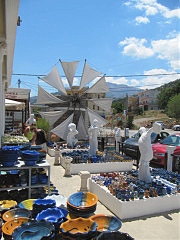
On the way back to the hotel, we stopped at a tavern for lunch. There we bought souvenirs in memory of Crete, its legends, and myths. When prolonged power outages began in Odesa, we had to light candles. In their flickering light, the faces of ancient gods and heroes seemed to come alive and remind us that good will surely triumph.
This is how the idea of rethinking the myths and legends created on the island in the Mediterranean Sea was born.











