

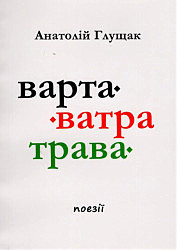
A collection from the long-suffering Odesa. An attractive publication that suggests the author is a linguistic gourmet: “Varta. Vatra. Trava.” Of course, with a conscious element of play. And play, as is known, if it is not self-sufficient, is a functional component of poetry.
The publication has a subtitle: “A Book of Dedications, Calls, Confessions.” A pre-anniversary collection, we learn, by the poet Anatoliy Hlushchak. It includes both new poems and poems from previous books.
Ukrainian poetry of Odesa, given the peculiarities and traditions of this city, should long ago have become an object of interest for literary scholars, critics, and scientists. For who doesn’t know that “Odesa-mother” was and remains a stepmother to Ukrainian poets. Which could not but affect their work. Among the vivid illustrations is the language of Borys Necherda. I will allow myself to quote an excerpt from my reflections on his poetics: “He created his ‘Necherda-esque’ language. And just as the Russian language of Odesa residents Babel, Olesha, Bagrytsky differed from the Russian language of Bunin, so Necherda’s language differs, say, from the language of the city dweller Korotych. And when he, carried away by Drach’s stylizations, turned to folklore, he did not fit into the system of its coordinates.
From the point of view of an orthodox linguist, this is an incorrect language: a calque from Russian, shifted accents, strained stylistics. All of this is present. But at the same time, this awkward, even strained language is also a reformist language. It expanded the possibilities of the Ukrainian word on a ground sown with stones. Both literally and metaphorically. Necherda knew how to write about the main thing. Roughly, clumsily, pedaling on a dislocated line, but without peasant sentimentality and tenderness.”
In this sense, the poetry of Anatoliy Hlushchak also provides food for thought. The poet himself emphasizes the importance of the linguistic aspect in his linguistic laboratory: “How could I, in Odesa, rhyme poems without them.”
“Without them” – without the dictionaries of linguists, whose names are mentioned in the motto of one of the poems: V. Dubrivsky, S. Ivanitsky, F. Shumlyansky, O. Iziumov, A. Nikovsky, A. Krymsky.
This is a guard post.
This is a mighty camp of ambassadors.
The state begins
With coats of arms and dictionaries.
Not a prison-secret
A repressed shelf,—
Already half a cupboard of dictionaries.
This is a national sanctuary,
This is a square of Ukrainian words.
Language as a support, as a means of existence and survival in a Russified city – this motif will be repeated in other poems of the collection.
I don’t know another poet for whom a single word has become an object of poetry. For Hlushchak, it is the word “kresh,” which, it turns out, is not found in any dictionary. Not even in the eleven-volume explanatory dictionary.
In “Dictionary Kinship,” we read: “My kinship is Dictionaries, my Fatherland is the Word.”
I recall the winged phrase of Nobel laureate Saint-John Perse: “My Fatherland is the French language.”
Hlushchak has a diptych “Necherda’s Non-Format,” a bold attempt to comprehend this extraordinary and complex figure. A non-linear, grandiose comprehension, but in all the interconnectedness of contradictions inherent in a living person. Not without humor and the aforementioned play. Because it is difficult to imagine the poet as a saint.
Whom to compare Necherda with,
All his sorrows and needs?!
And whose poems to choose for competition
On the Ukrainian contemporary literature exchange?
We couldn’t keep up with Necherda,
With his thoughts and gait,—
He was not usually the same:
Sometimes a recluse, sometimes a bitter rake,
Sometimes Mamai, sometimes a quasi-samurai.
God’s gift was in Necherda,
Like silver and gold in ore.
An accident occurred at the mine!
The future will preserve the ingots of poems.
It remains to summarize that A. Hlushchak’s linguistic variations are something more than the use of forgotten words. It is also the originality of his syntax.
Poems as independence of thought. Poems as character. Poems that we write and that write us, which we do not notice, and this is something to ponder, leaning over this economical, imaginatively published booklet with a wonderful portrait of its author.
I did not accidentally mention character. Because it is indeed destiny. And this destiny can be read: “In the struggle for change, are you a fighter or a shirker?” “Have no mercy for duplicity.” “Do not allow yourself to kneel!”
We are dealing with a character not inclined to conformism and compromise. With a character with a strict imperative towards himself. And this also inspires trust in the author’s writing.
Digging for truth is a challenge to superficiality and banality. In the search for it, one may overlook the not always justified stylistic complexity, the simplification of certain lines.
“What is time?” asks the poet and reflects:
What a question! Hamlet-style,
Yet a synonym for the creation of the world.
A sieve filled with seconds
Or an incomprehensible depth of abstractions?
A biblical tablet? Perhaps, the news of the day?
The irreversibility of everyday dawn?
A mournful remembrance of what is lost
Or an endless stubble – after labor?
Great minds have not grasped the essence,
Time is sharp-toothed – the ancients complained.
But eternal reflections are not in vain –
We finally guess: time is us!
Poetry is a worldview dominant. A poet cannot help but be concerned about the imperfection of reality. Not to torment oneself with doubts about its improvement.
Fate, sinfully sad,
How to live on in the world?
To be consumed by inconsolable grief,
To wait for manna from heaven.
To curse fatal progress
To lay a cornerstone!?
To pray perfidiously,
Where the palace has been destroyed,
So that a prophet would beg
And a clairvoyant would play the fool!?
Among the problems facing poets, whose fate has been war and Achilles’ heel statehood, the most painful is to be heard. Book print runs are meager, most of them do not reach bookstores.
Therefore, it is not superfluous to remind. Anatoliy Hlushchak is a poet, translator, journalist. Author of many books. Laureate of awards named after P. Kulish, V. Mysyk, K. Paustovsky. Compiler of anthologies “Polish Literary Stained Glass,” “Anthology of Ukrainian Maritime Poetry,” “Steppe Pectoral.”











