

We live in a real time dimension. But thanks to great poets, we are able to penetrate time, to know our heroic past and reliably connect it with the complex present for the sake of a dreamed-of future.
Such thoughts come to mind when reading the historical drama “Judgment Day,” created by one of the patriarchs of modern Ukrainian literature, Stanislav Stryzhenyuk. And not only because this work is dedicated to documentary landmark events of the national history of the 18th century and its central figures. It is also significant that the author himself successfully argues with time: God has already given him the 94th year, and in six months – a jubilee!
The historical events near Poltava in 1709, the relationship between Ukrainian Hetman Ivan Mazepa and the Muscovite Tsar Peter, year after year, decade after decade, and century after century, have invariably attracted the deepest attention of specialists and the general reading public. The confrontation between Mazepa and Peter highlights not only the history of two peoples but also the fundamental difference in their confessional morality.
In fact, it was the spiritual principle, which was absorbed with mother’s milk and gained strength from “the age of young fingernails,” that distinguished the mentally freedom-loving Ukrainian Cossacks, who knew the price of proud happiness, from the “aggressively obedient majority,” as accurately defined by Yu. M. Afanasyev, a slave community of Muscovites, whose ultimate dream was to seize the overseer’s whip. And why not: what does a mankurt dream of but dull and boundless power over a mankurt relative?
And this rift in people’s mentality, which is essentially tectonic, determined the clearly formulated imperative at the turn of the 20th-21st centuries: “Ukraine is not Russia.” This is where the different views, different aspirations, and different vectors of development of the two peoples originate. And the further, the more this was felt both in historical science and in the works of leading masters of prose, poetry, and then – in the coryphaei of other genres of artistic creation of the two countries.
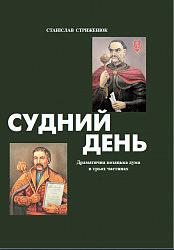
It is in this perspective, albeit somewhat unexpectedly, that Stanislav Stryzhenyuk’s presentation of the material is relevant to how it is presented in recognized classical examples of great literature.
Paradoxically, it is not Pushkin’s “Poltava” but “Boris Godunov” that is timely to mention here. The heroes, the Tsar and his entourage, purely internal palace intrigues, the fugitive Grishka Otrepyev-the Impostor, who again tries to become Tsar – constitute the essence of everything that happens “in the swamps.” And the people? And the people, according to the brilliant summary of the author, are silent!
In “Judgment Day,” the central character – Hetman Ivan Mazepa – exists and acts not in the background, but directly in the thick of the most prominent figures who emerged from the people and were concerned with the same dream-thought: Pylyp Orlyk, Chechil, Kobzar, scribe Kochubei, Motrya, the Gypsy woman. And Ivan Mazepa’s main opponent – Tsar Peter – in these cases communicates only with Menshikov, who tries with all his might to “promote himself” as a particularly significant person: again – a field marshal, after all…
Well-known facts: the Baturyn tragedy, the events around Poltava, the restless expanses on the banks of the Dnieper, Dniester, Danube, Southern Bug. Everything is boiling, seething, and exploding. It was so, there’s no escaping it. Voynarovsky, Iskra, Samoylovich, Hamaliya, and many other Cossack officers operate in this historical arena. The characters are diverse, ambiguous, not at all poster-like and one-dimensional. And among them and between them, and together with them and above them – like a refrain, a song arises:
Legends wander
In the rustling of the steppe,
Like kobzars, from town to village.
And the sincere thought of Cossack Mazepa
Found in our campaigns as a song.
And he did not let the legend rest,
Like an untethered horse in the grass.
This, Iskra, was the chronicle of my life,
Like a crossroads, of an unseen day.
Not being a politician, a political scientist, or even a professional historian, without even a hint of claiming to be the ultimate truth – I will not risk dotting the i’s. But I would like to share my personal feelings about the specifics of purely artistic mastery in “Judgment Day.”
The amazing musicality of the Ukrainian language is well-known, which each time gives a uniquely fresh and organic breath to the works of true domestic classics. Such language is inherent in all of Stanislav Stryzhenyuk’s work, but in “Judgment Day,” the poet’s deep work on the word is particularly striking. It is no coincidence that the first part of the trilogy, based on the results of a closed competition, was awarded the first prize in the “Plays” nomination of the all-Ukrainian competition “Coronation of the Word” (the other parts had not yet been written at that time). The author was awarded the competition’s “Golden Pen” and a special award from “Ukraina” magazine for “Best Historical and Patriotic Work.”
The hetman smiled a little sadly,
Saying, take the gypsy at dawn…
The campaign is difficult, but here’s a fortune teller for you.
The kobzars sang thoughts yesterday…
Or:
Mazepa sought order in his thoughts,
Adding wings to heavenly thoughts:
“How will future generations see us,
In this land among foreign graves?”
Agree: the depth of each line is such that Stanislav Stryzhenyuk’s drama already takes on clear, indisputable outlines of an epic. National. In many ways tragic.
Truly – “Judgment Day”!
Returning to the origins, Stanislav Stryzhenyuk convincingly proves with his poetic lines: literature, when it is true, penetrates time and reaches hearts.











