

In June-July 2025, there were two significant dates related to our city and the national liberation movement in Ukraine. These are the 120th anniversary of the mutiny of sailors on the battleship “Potemkin” and the 150th anniversary of the birth of one of the leaders of this mutiny – Oleksandr Kovalenko, the only officer who remained with the crew until the end, and after 1917 returned to Ukraine and worked in the maritime department of the UNR.
Oleksandr was born on July 27 (August 8, new style), 1875, in the town of Romny, Poltava Governorate (now Sumy Oblast). At the age of 12, his parents sent their son to the local real school, where he studied alongside Stepan Timoshenko, a future renowned mathematician and mechanic. In his memoirs “On the Verge of Two Ages,” Oleksandr Mykhailovych recalls that at the school, as in all other schools, official pan-Russian patriotism was cultivated, with the motto “Autocracy, Orthodoxy, and Nationality” (understandably, Russian).
The young man’s first encounter with Great Russian chauvinism occurred after a teacher’s remark: “What kind of outrageous jargon are you speaking?!” In response, Oleksandr passionately lectured the educator on Kotlyarevsky and Shevchenko, on Ukrainian oral folk art, after which the teacher simply fled the classroom.
After graduating from school, in the autumn of 1895, Oleksandr Kovalenko enrolled in the Kharkiv Polytechnic Institute. Here he met Yuriy Kollard, who “was constantly imbued with the Ukrainian spirit.” At the end of 1897, Oleksandr Kovalenko, along with Kollard, joined a clandestine Ukrainian circle led by Dmytro Antonovych, son of the Kyiv historian Volodymyr Antonovych. This circle, sometimes called the “Kharkiv Hromada,” had no clearly defined program. Its participants held different views on Ukraine’s future, ranging from autonomist to independence-oriented.
In 1899, student protests swept across the empire. In Kharkiv, from the beginning of the year until the summer holidays, mass student gatherings, demonstrations, and strikes did not cease. Many members of the “Kharkiv Hromada” led these protests. In the spring, Kollard was arrested and exiled from Kharkiv to Kobeliaky. Some, including Oleksandr Kovalenko, were expelled from the institute and ordered to leave Kharkiv within 24 hours.
Activity in the “Hromada” required increasing tension and caution. The idea of founding a political party, more suitable for conducting propaganda, including illegal propaganda, among peasants and workers, naturally arose. The founding meeting of the Revolutionary Ukrainian Party (RUP) was convened on January 29, 1900.
The following year, while working on statistical projects in Lohvytsia, Oleksandr learned that studies at the polytechnic institute had been suspended indefinitely again due to student unrest. Oleksandr Mykhailovych, along with his mother, decided to go to Sevastopol. There, his RUP comrade Levko Matsiyevych was working on the construction of the cruiser “Ochakov.” When Kovalenko and Matsiyevych met, they gathered trusted individuals and founded a circle for propaganda of the Ukrainian liberation movement. Matsiyevych’s sister, who frequently visited Sevastopol, brought underground literature.
Meanwhile, Oleksandr Kovalenko found employment as a naval engineer in the Black Sea Fleet. “Good pay, a handsome uniform, he himself was young, handsome, and also sang with a melodious tenor. He could have had great success in life, could have made a brilliant career – just sit quietly and faithfully serve the ‘Tsar and Fatherland.’ But instead of flocking to the ruling class and seeking patronage, he paid more attention to the sailors, who were mostly from Ukraine,” recalled Borys Martos about him.
When the 1905 revolution broke out, it also engulfed Oleksandr Kovalenko. He participated in the activities of the Officers’ Union and gave speeches at rallies in Sevastopol. Later, an event occurred that marked a qualitatively new stage in the development of the 1905-1907 revolution, and Oleksandr Kovalenko’s role in it was exceptional.
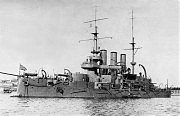
In June 1905, the battleship “Prince Potemkin-Tavrichesky” made its first training voyage. Engineer Oleksandr Kovalenko was serving on this ship. The events on the battleship are well-known even from Soviet history textbooks. However, those textbooks do not mention the origin of the vast majority of the crew of the rebellious ship.
Oleksandr Kovalenko received the proposal to lead the “Potemkin” crew from Panas Matyushenko, who assured the officer that not only the revolutionary group (committee) of the mutiny initiators but also the entire ship’s crew desired it.
Through his good treatment of the sailors, Kovalenko earned their love, in contrast to other officers whom the sailors hated. In the first days of the mutiny, he slept fully clothed and patrolled the entire ship at night, checking for order. Perhaps under his influence, the arrested officers from the “Potemkin” and “Georgiy Pobedonosets” were sent ashore to Odesa. During the bombardment of Odesa, he stood on the command bridge next to Matyushenko. Incidentally, on the eve of the shelling, the red flag was raised over the battleship not as a symbol of revolution, but as a warning signal for firing practice. Thanks to director Eisenstein, the red flag became a myth, just like the shooting of Odesa residents on the Potemkin Stairs.
A dramatic moment arrived: an squadron approached – 12 warships with 150 guns and 48 torpedo boats. The admiral had orders: to arrest the rebels or sink them along with the ship. The “Potemkin” hoisted the battle flag and steamed at full speed with guns trained towards the squadron. But confusion and disarray began on board. Meanwhile, it was necessary to show full combat readiness, and perhaps even engage in battle. At this decisive moment, Kovalenko stood on the stairs leading from the lower deck to the upper and commanded: “All to your posts! Gunners to the cannons!” The sailors, hearing the command, immediately took their places.
Oleksandr Mykhailovych recalls the moment: when the battleship “Georgiy Pobedonosets” joined them, he saw Ukraine freed from age-old oppression, and behind it, the Caucasus, Poland, and Finland. But the betrayal by the boatswains and petty officers of the “Georgiy Pobedonosets” caused great demoralization among the “Potemkin” sailors. Most of them were carried away by the revolutionary uprising, but upon failure, they quickly cooled down and lost hope. The opposition used this mood and demanded to sail to Romania. The revolutionaries had to agree because fuel and food supplies were running out, and hopes of spreading the revolution to the entire fleet had not materialized.
They approached Constanța (Romania), and after negotiations with the Romanians, 54 sailors returned to Sevastopol on the “Potemkin,” while Kovalenko and the majority remained in Romania. Later, some of the “Potemkin” sailors went to North and South America.
After the defeat of the mutiny, Oleksandr Mykhailovych lived in Switzerland and France, taught mathematics in secondary school, and became the author of two textbooks. In 1915-1916, together with V. Stepankivsky, he published the journal L’Ukraine in Lausanne. While living in Paris, he founded a Ukrainian community with V. Vynnychenko. Oleksandr Mykhailovych became one of the most prominent figures in the Ukrainian political emigration, participating in the preparation of Ukrainian publications abroad. He mastered several European languages and studied scientific literature.
When the Ukrainian Revolution began, Oleksandr Mykhailovych returned to Ukraine. He was appointed Director of the Department of Maritime Education in the Ministry of Maritime Affairs. He held this position during the Hetmanate of P. Skoropadsky, but not for long. Kovalenko was dispatched to the south, where, thanks to his efforts, over 29 ships of the Black Sea Fleet raised the Ukrainian flag, including the former “Potemkin,” which was renamed “Fighter for Freedom” in the Ukrainian fleet. During the Directory period, Kovalenko, along with a delegation, was sent to Iași and Odesa for negotiations with representatives of the Entente. Thus began his diplomatic service. In 1919, after fulfilling diplomatic assignments in Romania, he was appointed by the Directory first as consul in Istanbul, and then as the 1st Secretary of the Ukrainian Diplomatic Mission in Paris. In 1920, he participated in the Assembly of the League of Nations as secretary of the Ukrainian delegation.
In 1922, Oleksandr Kovalenko, along with his mother, moved to Czechoslovakia at the invitation of the Ukrainian Economic Academy (UEA). Here he taught higher mathematics and strength of materials, becoming an associate professor of theoretical and applied mechanics. The publishing house at UEA printed 4 of his textbooks on higher mathematics and applied mechanics. This was a colossal contribution to the development of Ukrainian and world scientific literature of that time.
After the liquidation of the Ukrainian Economic Academy, its professors founded the Ukrainian Technical and Economic Institute in 1932, which included 87 Ukrainian scientists, including Professor O.M. Kovalenko. In 1936, UTGI published another of his textbooks, “Fundamentals of Higher Mathematics.” Yevhen Chykalenko resided in Poděbrady for a long time; Oleksandr Mykhailovych had a good relationship with him and many mutual acquaintances.
In 1945, O. Kovalenko moved to Germany, and then to Switzerland, where he lived until his death. He lived by taking care of the building that housed the International Organization for Standardization. Later, friends managed to secure him a pension of 250 Swiss francs (the subsistence minimum). For almost his entire life, he had to live very modestly: whether as a student in Kharkiv or as an associate professor in Poděbrady with his elderly mother.
…On the eve of his death, he was still reading newspapers and talking about his literary plans, but in the morning, he was found in his armchair, detached from all worries. This happened in Geneva on October 18, 1963.
In addition to his scientific publications, Oleksandr Mykhailovych also left behind memoirs about the mutiny on the battleship “Potemkin,” published under the pseudonym Zhurbenko, and in 1939, his memoirs “From the Past” were published.











