

Before me lies a miraculously preserved entrance ticket to an event called “Rose Festival,” which took place on June 4, 1889. Such festivities were held annually in June, primarily in Alexandrovsky Park (now T. G. Shevchenko Park).
Thanks to old newspapers, we can learn in detail how this festival unfolded in that particular year.
So, the “Odessky Listok” of June 5 (17 according to the new style) reported: “The usual ‘Rose Festival,’ organized by the Odessa branch of the Imperial Horticultural Society for the benefit of the school of horticulture and gardening founded by the branch, attracted a large crowd to Alexandrovsky Park yesterday. The entire park was elegantly decorated with flags. The seaside alley looked particularly impressive, at the end of which, in a temporary pavilion, was an exhibition of artistic horticultural works. At the entrance to the exhibition, a triumphal arch was erected, decorated with flags and greenery. All this looked beautiful, especially in the evening when the illumination was lit. The lighting of the alleys with multi-colored Bengal lights completed the beauty of the scene. During the festivities, three orchestras played, including the orchestra of the First Black Sea Crew, specially brought from Mykolaiv for this celebration.
But if the festivities can be called successful in all respects, the exhibition of artistic horticultural works evoked far less impressive feelings. It was not distinguished by either the quantity or the artistic merit of the exhibits. Among others, the basket of ferns and rosebuds exhibited by Mr. Stapelberg drew attention with its comparative elegance. Stapelberg was awarded the first prize – a small gold medal. The gardener of Baron Maas, Tulchianov, was awarded the second prize – a large silver medal, also for a basket of flowers. The owner of the garden establishment Neyland and gardeners Kreiter, Wassermann, Pavitsky, Partikh, Grigoriev, and Knodel were awarded silver medals, and several individuals received bronze medals. The expert commission consisted of Messrs. Somov, Dunin, Fremel, and Stecker. In the evening, all exhibited works were sold at auction. The festivities ended before 11 p.m. In terms of finances, the result of the festival will likely be less satisfactory than last year, but otherwise, this year’s “Rose Festival” was significantly more successful, if only because there were no disturbances that occurred last year.”
What disturbances were referred to? The issues of “Odessky Listok” from June 1888 will answer this question.
It turned out that in that year, many visitors did not receive the expected surprise gifts. The public was very dissatisfied with this. And therefore, before the announcement of the award results, the attendees of this event… rushed at the exhibited items and took almost all of them.
The newspaper note stated: “It is difficult to explain the reason for such a disgraceful behavior of the public, but it seems to us that the original distribution of surprises and sale of bouquets, which we noted yesterday, contributed to this.”
Such things happened in our city… But this incident was most likely an exception to the rule. For example, local historian Rostislav Alexandrov (O. Yu. Rozenbaum) noted in his book “Kut Katerininskoy”: “In June 1893, at the suggestion of Marazli, a ‘Rose Festival’ was held at his dacha, which, as they said, had never been seen before in Odesa.”
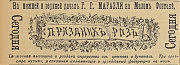
The choice of this location for the festival was not accidental. The dacha (and the park on it) of the mayor was considered the best in Maloe Fontan. As early as 1889, Grigory Grigorievich built a greenhouse here, on which he spent thirty thousand rubles. With great difficulty, the greenhouse has survived to this day. This is the only thing left of the once luxurious Marazli dacha.
Odesa journalists even dubbed that year’s event a “monster festival.” The mayor of Odesa, P. O. Zelenoy, with his wife and children, attended the event. They were met by the deputy mayor, Professor V. M. Ligin, who was then the chairman of the Odessa branch of the horticultural society.
This time too, the festival passed without incident. And the highest award – the small gold medal – was awarded to Georg Werkmeister for his magnificent rose collection, consisting of over 300 varieties.
It should be noted that, in addition to the “Rose Festival,” “Flower Battles” were also held in Odesa. This “fearsome” name referred to competitions between owners of horse-drawn carriages decorated with flowers. But that is another story.











