

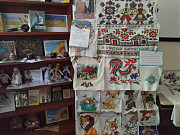
On a May morning, I visited City Library No. 7 named after Ivan Gaidaienko, located on Vladyslav Buvalkin Street. The head of the library, Natalia Slyaguzova, was preparing exhibits for Vyshyvanka Day. She mentioned that among the presented works were embroideries by a girl named Valeria, who creates them in an unusual way. This sparked my interest. The head of the library provided contact numbers. The next day, it turned out that the girl’s family lives outside the city. But this did not become a reason to cancel the meeting: we had to go.
The village of Buyalyk in the Velykobuyalyk community greeted us with rain and blooming lilac. Soon, I reached the house where the family lived. The hostess, Polina Trokhymivna Khrystova, met me at the gate. We went into a warm, tidy house. Beautiful pictures hung on the walls in large frames. These were puzzles assembled by the girl Lera. She is Polina Khrystova’s granddaughter. But Valeria calls her mother. From a large room, the girl’s joyful voice could be heard. Amidst the chirping of a small flock of amadines, I greeted the hostess’s husband, Serhiy Porfiryovych Shevchenko. (Polina Khrystova’s first husband passed away 25 years ago). We went into the living room. Here too, on the walls, were puzzle-pictures assembled by Lera. The girl greeted us cheerfully and continued her embroidery. And we began our conversation.
It turned out that Polina was born in November 1937 in the Dnipropetrovsk region and studied at the Dnipropetrovsk Technical School of Agricultural Electrification. By assignment, she ended up in Odesa. On August 17, 1959, she started working. Soon, she was transferred to the village of Buyalyk. She got married. She gave birth to a son. She worked for 38 years – from a switching fitter to a dispatcher for the Ivanivka power grid.
Serhiy Porfiryovych quietly joined the conversation:
— And you know, we met back in 1959. It happened in Dnipropetrovsk at the train station. For some reason, that’s where I ended up then. I was studying at the Zaporizhzhia Veterinary Technical School. She was also at a technical school, just in Dnipro. And that day, she was meeting her mother from the region. I liked the girl immediately. I approached her. A conversation began. Then there were a few meetings. I even invited her to a restaurant. True, she ate almost nothing there. Later, we went to the cinema once. After that, I came to her with a bouquet of flowers. And no one was home except her. I was embarrassed to come in. I left the flowers at the door and left. Soon, I found out she had left. That’s how we parted. Each went their own way. Created their own families. It so happened that years later my wife passed away. And she had a husband. We were alone for a long time. I decided to look for her. And I found her. We’ve been together since 2007. “First love,” the man smiles warmly. And when we were alone for a moment, the gray-haired man answered my question: “I have a disabled son myself. And Valeria is like a daughter to me.”
— Lera was born on December 1, 1982, — says Polina Trokhymivna. — Unfortunately, the birth of my son’s wife was difficult. The newborn’s central nervous system was affected. A severe form. Due to family circumstances with Valeria’s parents, the girl came under my guardianship. At 45, everything fell on my shoulders. And I started treating Lera. Until she was three, she was bedridden. At three to four years old, the girl, holding onto a stroller, could stand on her feet a little. And I continued to work. I took the girl with me to work. The management did not forbid it, they were accommodating. Even when inspectors came from Odesa, they would say: “Go put the child down, and then we’ll discuss work matters.” Time flies, the girl grows, the baby carriage gets heavier, a bag of food in hand, and two kilometers on foot to the site. And so for eight years. I took her for treatment everywhere: Kyiv, Kharkiv, Yevpatoria, Dnipro, Moldova. Countless times in Odesa. In 1991, we went to Krakow. There they said it was too late to do anything for the girl due to her age. More hospitals, injections, procedures, and persistence. But I had to retire.
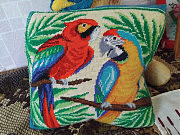
Regarding embroidery. Around five or six years old, Valeria started buying puzzles. She mastered them very quickly. She assembled them in her own way. She would assemble a row. Move it. Then assemble another. Until she finished the work. She would take it apart. And assemble it again. There were so many works that I suggested she try embroidery. I sometimes did it myself. Around 1991, the girl mastered cross-stitch on canvas. Lera has no formal education. We learned letters and numbers independently. I taught her exercises on an abacus. At work, I taught her mathematics. We tried writing. It didn’t work out. Her hands are always in fists. Valeria cannot speak. But she understands everything. She is clever, calm, and smiling. She even helped with potato harvesting in the garden once. — Of course, dressing, combing, etc., are all on me. I don’t know where I get the strength, but it’s running out, — smiles mother Polina. — As for food, her favorite dish is borscht. She’s not very fond of sweets. She eats everything I cook. After eating, she goes to embroidery. She doesn’t have one favorite theme. She takes on what she likes. And what she can do. She can finish one work quickly, and another might take months. Once, around 2008-2009, in the Poltava region, we met a woman who suggested buying a laptop to help the girl develop. We bought one. I’m not good with computers. But Valeria mastered it without outside help. She figured out how it works. With its help, she finds what interests her, something for embroidery. She can listen to a movie on half the screen and assemble puzzles on the other. She uses Viber. She knows Facebook. She sends holiday cards and greetings to relatives. (By the way, Polina Trokhymivna has nine great-grandchildren and six grandchildren. And five close relatives are defending the country from the enemy — author.) The girl independently mastered half-cross stitch. In 2024, she decorated two pillowcases with embroidered butterflies and parrots using this technique. She doesn’t have many embroidered works. It’s difficult work. Even if it’s done with cross-stitch or half-cross stitch. Any embroiderer will tell you that.
Our meeting came to an end. During the conversation, I accidentally learned that Valeria reads books. She can’t fall asleep without them. If she likes a book, or anything at all, she expresses her pleasure with the word “Ah!”. An incredible fate. An incredible life. While I was having coffee, Lera asked for my phone number and sent photos of her embroideries to my Viber page. Amadines flutter around the room. And peace and kindness reign in the house. Not a single complaint about life was heard from the hospitable family. Only mother Polina mentioned some computer malfunction. And Valeria herself was simply amazing. The fact is that she performs work with the computer mouse, assembling puzzle pictures, and embroidering using only one leg.
Upon returning to the city, I remotely helped to figure out the keyboard on Lera’s laptop. We wrote down the sequence of actions. She understood everything. And ten minutes later, for the first time in her native language, she wrote: “Love life the way it is.”
P.S. On May 14, 2025, an exhibition of embroidery works by craftswomen took place at the Odesa Library No. 7. Among the works, Valeria Khrystova’s embroideries were presented for the first time. Her works were brought to Odesa by a caring woman, an embroiderer, and a friend of the family, Natalia Lebedeva.











