

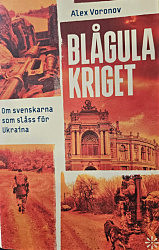
The book “Blue-Yellow War” tells about them. Let me decipher the title – historically, our flag and the Swedish flag have the same colors. “Blue-Yellow War” has already been published in Sweden, and its Ukrainian translation is currently being prepared.
And I learned about the book from its author, Swedish journalist Alex Voronov. I met him at a training workshop held in Odesa as part of the Swedish-Ukrainian project “Ukraine’s Media Ecosystem.” The training was conducted by the public organization “Human Rights Platform” in cooperation with the Swedish organization Global Reporting.
Alex Voronov was one of the invited speakers. I immediately noticed my colleague from Sweden. Tanned skin, a clearly non-Scandinavian surname, speaks Ukrainian and Russian well.
And when we met, when the conversation started – frank, heartfelt, I was once again surprised by the twists and turns of fate that a person’s life can hold. Alex Voronov is a good confirmation of what was said above.
He is Swedish, Ukrainian, and East African. Alex’s father is from Uganda, and he himself was born in… Odesa! And he has been living in Sweden for 40 years, a citizen of this country.
— Yes, my father studied at a military academy, — says Alex Voronov. — My mother studied at a naval academy. I was born in 1975. My father got involved in politics and was a staunch opponent of the then Ugandan regime. After the hijacking of a passenger plane in 1976, it became clear – especially to those Ugandans who were abroad – that dark times had come at home. My father concluded that it was dangerous to return home. And he asked for political asylum in Sweden. My mother was expelled from the Komsomol for her connections with a foreigner, and she was denied a visa, as sailors used to say. But she still managed to get an education and graduate from the Institute of Communications. Just in case, I was sent to relatives in the city of Velikiye Luki. And as soon as my mother finished her studies, we immediately went to Sweden.
— So what do you remember about Odesa at that time? — I ask.
— I admit: I remember practically nothing, — says Alex Voronov. — But my mother always told me: Odesa is your second home. And I keep this feeling in my soul. We have always linked our family’s future with Odesa. As for memories of my hometown, these are my parents’ memories. And, walking around Odesa, I recreate them. Here is the Opera House – it was here that my parents had their first date. Kytoboyna Street – this is where we lived, rented a room in a private house. And much, much more.
— And where does such an exotic surname come from?
— Voronov is my maternal grandfather’s surname.
Alex got into journalism thanks to his participation in politics. While studying at an economics university, he joined the liberal party and became a member of the youth organization. In Sweden, my interlocutor says, every newspaper has a comments section. Journalists working there write opinion columns on pressing social issues. Traditionally, comments sections lean towards one party idea or another. Alex Voronov, who was just starting his career, worked in the liberal party’s development program and, incidentally, led two projects in Ukraine. He met journalists from one of the newspapers. And they suggested: “In the summer, all full-time employees go on vacation – wouldn’t you like to try your hand?”
Alex agreed. He tried. He liked it. And now, for a quarter of a century, Alex Voronov has been in journalism, and today he is considered one of the most authoritative specialists in his creative format.
— The war in Ukraine: what is being said about it in Sweden? — this was my next question.
— I’ll say right away that in Sweden, they understand that the war unleashed by Russia began in 2014, — replies Alex Voronov. — Regarding Crimea, the position is unequivocal: it is an occupation, an annexation. There was no such clear understanding regarding Donbas. Many in Sweden thought that the separatism there was some kind of internal political movement in Ukraine, which was undoubtedly fueled by Russia. February 24, 2022, put everything in its place.
Ten days before the start of the war, Alex was in Ukraine again. He was visiting his godmother Natalia in Irpin. According to the Swedish journalist, the premonition of war was palpable even for him, a foreigner. But still, he couldn’t believe in the worst. And then his godmother instilled fear. For some reason, she was convinced that the war would start any day now. And the first battlefield would be the airfield in Hostomel. That’s exactly what happened in the end… And Alex rescued Natalia in early March, taking her out of burning Ukraine.
At the same time, an interesting offer came from a newspaper. They said, “Let’s create a special column about Ukraine in the comments section just for you.” You know this country well – so write about the war. “I was waiting for exactly this offer,” admits Alex. He quit his previous job because he understood that the war would be long. He worked in this special position for two years. Currently, Alex Voronov is officially a freelancer for an information bureau that prepares materials for the comments sections of more than thirty newspapers. The journalist works in various areas: he writes columns, reports, and comments about the war in Ukraine, and records podcasts. Alex Voronov’s materials are gladly published because they are written by a journalist who sees the war with his own eyes.
— I spend a lot of time in Ukraine, — says Alex Voronov. — My task is to ensure that the war in Ukraine remains in the focus of Swedish public attention.
One of the results of his trips to the front was the book “Blue-Yellow War.” The book has three main characters. The first is a military medic. The guy studied at a military academy. When the war in Ukraine began, he dropped out of his studies and came to help. He joined the Hospitallers. He spent a year and a half at the front. He has now returned home and decided to continue his education. This hero’s name is not in the book, only his call sign – Sven.
The second character is Oliver Mets. Once his family emigrated from Estonia for religious reasons. Oliver served in peacekeeping contingents in Kosovo and Macedonia. He realized that Ukraine needed help fighting the enemy back in 2014. According to the hero, he has no doubt that Russia is an existential enemy that, no matter how peaceful it may seem, still thinks only of a war of annihilation. According to Oliver, he thought the war would start with Russian aggression against the Baltic states. But Ukraine became the battlefield. So, it needs to be helped.
Another heroine of the book “Blue-Yellow War” is a volunteer named Tilda Addenbrook. In Sweden, the girl worked as a salesperson. Once she met people who were helping Ukrainian refugees in Poland. The fact is that in the first days of the war, government agencies in many European countries were literally paralyzed. Therefore, almost all the work of receiving refugees and escorting them to EU countries fell on the shoulders of ordinary and caring Europeans. The organization where Tilda worked helped over two thousand Ukrainian citizens move to Sweden. Then the volunteer was involved in transporting humanitarian aid to Lviv. In principle, Tilda is still doing the same thing. Only now she is literally on the front lines. First, she lived in Kharkiv, and now she has moved to Kramatorsk.
The book “Blue-Yellow War” was released in November 2023. According to Alex, now, during its translation into Ukrainian, the text will be corrected and supplemented. New characters will probably appear. The Swedish journalist understands the historical value of his work: what he has written is a document of our time. When Alex Voronov’s book “Blue-Yellow War” is released in Ukraine, our newspaper will definitely inform you.
… He readily accepted the invitation to come to his hometown for a training workshop. And he found that Odesa had come alive compared to the first months of the war. “There is an illusion of normal life,” Alex shares his impressions. He really wanted to meet Ukrainian colleagues who work in wartime conditions but talk not only about the war. After all, according to Alex Voronov, such journalists contribute to Ukraine’s fight and belief in victory.











