

In the March 20th issue, “Vechirnya Odesa” announced this event: a unique event “Resistance Through Culture — From Marseille to Odesa,” initiated by Mr. Alexis Nuselovici, Honorary Professor of General and Comparative Literature at Aix-Marseille University. The Office “Odesa — UNESCO City of Literature” acted as a co-organizer. The event was supported by the municipalities of Marseille and Odesa, the municipalities of the 4th and 5th arrondissements of Marseille, Alliance francaise d’Odessa, the Association “France-Ukraine Provence Brotherhood,” the “Workshop of Artists in Exile,” and the Place Publique movement.
The meeting was held online via the Zoom platform, connecting Hyperion Space in Marseille and Odesa Art School No. 1 named after E.G. Gillels, where the participants were located.
— It was two hours of fantastic creative collaboration, two hours of communication in the language of art: poetry, music, and dance, — summarizes the event “Resistance Through Culture — From Marseille to Odesa” Maya Dimerli, head of the Office “Odesa — UNESCO City of Literature,” who was recently recognized as a laureate of the editorial competition “People of Action.” — Two hours that once again proved that the power of culture can worthily resist barbarism called war.
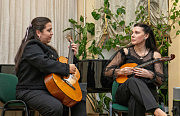
In the part of the event that took place in Odesa, musical compositions were performed by teachers and students of Art School No. 1 named after Emil Gillels, and Odesa poets Ihor Bozhko, Vladyslava Ilinska, Maria Galina, Oleksandr Khint, and Anna Streminiska read their poetic works. Kateryna Kharchenko read poems by French poets of the resistance period translated into Ukrainian.
And the highlight was the performance by choreographer and dancer Tetiana Proskuryakova of the Dnipro Opera and Ballet Theatre, who presented improvisational dances to poems by French and Ukrainian poets. The war caught her in France on tour. As the ballerina noted, combining dance and poetry turned out to be not difficult, because these art forms have one soul. The musical rhythm of a poem allows for improvisation. In Dnipro, Tetiana Proskuryakova has already staged a mini-performance on the theme of war, combining poetry and dance. In Marseille, the ballerina collaborates with the “Workshop of Artists in Exile.” According to Tetiana, in this city, called the “French Odesa,” demonstrations of Ukrainians take place every Saturday in the old port area, thanks to which local residents know the truth about the war in Ukraine.
The fact that the French fully support Ukrainians was evidenced by the speeches of the organizers of the event “Resistance Through Culture — From Marseille to Odesa.”
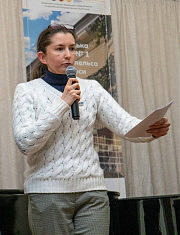
Thus, Alexis Nuselovici, in his opening remarks, noted that “…in 2022, Putin attacked the Ukrainian people. But he also attacked Ukrainian culture, and he attacked culture as such. Dictators hate culture. Because culture is memory, because culture is permanence, because it is hope. Culture is the enemy of fascism, and fascism fears it. Therefore, it can fight it.”
Jean-Marc Coppola, Deputy Mayor of Marseille, responsible for culture for all, creativity, cultural heritage, and cinema: “Today, as the world is experiencing the greatest upheavals, when war, when injustice strikes everywhere, at the gates of our continent, in Ukraine, in this city of Odesa, which is our twin city, we share a deep conviction: culture is a weapon of resistance and freedom… In the poems of Desnos, Eluard, or René Char, the spirit of French resistance continues to live. Sentinels of hope, they wrote in the dark night, in pain and fear, to illuminate the path to freedom.
And today their voices will mingle with the voices of Ukrainian poets, this poetry born of suffering and anxiety, but carrying the leaven of the dignity and independence of a people who only ask for respect and to be heard.”
David Sanchez, President of the Association “France-Ukraine Provence Brotherhood”: “Odesa and Marseille share a Mediterranean soul, an openness to the world that has made our cities places of meeting, trade, and exchange of ideas. We are united by this spirit of freedom, diversity, and resistance when history has forced us to do so. At a time when Ukraine is under attack by war, we have a duty of solidarity and remembrance. A duty to remind that culture is a weapon of resistance. For before cannons and rockets, before destruction and terror, culture remains a bastion against oblivion, a light that illuminates the future. While Russia seeks to erase and deny Ukrainian identity, it is vital to preserve and spread it through music, theater, and cinema, which continue to live despite the war and constant bombings.”
Laurent Kermer, member of the Association “Marseille-Odesa” and Ambassador of the city of Odesa in France: “Three years after the start of this full-scale aggressive war, we know how fragile and uncertain the future can seem. But in the face of violence, in the face of barbarism, we have a powerful weapon: culture. Through poetry, music, and dance, we affirm our humanity, our commitment to freedom, democracy, and dignity.”
Sarah Horog, Director of the Marseille branch of the “Workshop of Artists in Exile”: “The gathering of artists in exile and not in exile demonstrates solidarity with Ukraine, which is dear to my heart. The performance by artists from Iran, Germany, France, and other countries was also symbolically important.” The “Workshop of Artists in Exile” aims to identify artists in exile from all countries, support them according to their situation and needs, provide them with workspaces, and establish connections with professional networks (French and European) to provide them with the means to develop their practice and restructure.”
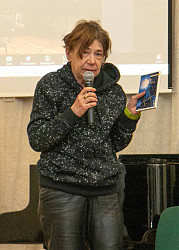
Pierre Rayman, Vice-President and co-founder of the movement “For Ukraine, for their freedom and ours!”, and co-organizer of the meeting “Resistance Through Culture — From Marseille to Odesa”: “Since February 2022, and indeed since 2014, Russia has been pursuing a systematic policy of cultural erasure that is deeply negating. This is not simple opportunistic looting, but a planned activity at the highest level of the Russian state.
Putin expressed this directly: ‘For us, Ukraine is an integral part of our history, our culture, and our spiritual space.’ This statement is not just an opinion, it is the ideological basis of state policy. This policy in the cultural sphere takes three complementary forms. Firstly, the Russian authorities have created a full legislative arsenal to ‘legalize’ the theft of cultural heritage. Secondly, the Russification of heritage. Thirdly, the deliberate destruction of what cannot be Russified.
What we are observing is an attempt at cultural genocide. The goal is not only to appropriate artistic treasures but also to erase any trace of a distinct Ukrainian cultural identity. That is why resistance through culture is not an addition to the soul, but a vital necessity for Ukraine and, which is the core of this wonderful event, an urgent need for Europe.
In this situation, our responsibility is threefold. Firstly, to document these crimes. Secondly, to support international awareness. Finally, by all means, to support contemporary Ukrainian cultural production. This is the best response to denial: to show that Ukrainian culture is not only alive but also dynamic and creative.”
After the event concluded, Alexis Nuselovici answered a few questions:
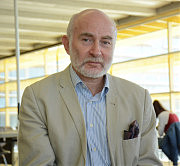
— Please tell us about the initiative “Resistance Through Culture — From Marseille to Odesa”: when did it arise, who was its author, what are its goals, who are its participants?
— “Resistance Through Culture — From Marseille to Odesa” is part of a series of events that I have been organizing since February 2022. As a founding member of the association “For Ukraine, for their freedom and ours!” and a professor of comparative literature at Aix-Marseille University, I have organized various events at my faculty: so-called “solidarity seminars” titled “Literature Against War” (7 weekly sessions from March 2022), a colloquium titled “Culture Against War, or Ukraine, a Reality in Dark Flesh,” a pan-European event titled “Forum Europe — Ukraine: Culture and Resistance” (February 24, 2023), a colloquium titled “Ukraine 2024. Dignity and Resistance” (April 8, 2024) on the occasion of the awarding of an honorary doctorate to philosopher Kostyantyn Sigov by Aix-Marseille University. All these events involved Ukrainian scholars. As Vice-Dean responsible for research, I also organized the reception of several Ukrainian women scholars who were refugees in France at my university.
Placing support for Ukraine under the banner of culture is my guiding principle, stemming from a simple observation: Putin, by attacking Ukraine, is attacking Ukrainian culture and culture in general.
The existing twinning between the cities of Marseille and Odesa prompted me this time to localize cultural resistance and find artists to participate in a direct event between the two cities, connected via Zoom. To honor and comment on the event, speeches were also delivered by the heads of partner associations and institutions in both cities, as well as two Ukrainian philosophers, Mr. Kostyantyn Sigov and Ms. Inna Holubovych.
— How did Marseille and France in general react to the news of Russia’s invasion of Ukraine?
— It is necessary to distinguish between the positions of the French government and French public opinion. Since the invasion, public opinion has been alarmed and has expressed its sympathy for the Ukrainian people, while acknowledging a certain lack of awareness of the situation. 2014 was a long time ago, and even Maidan or the annexation of Crimea had only limited resonance outside certain circles. The French population discovered the forgotten reality of war, was horrified by Bucha or Mariupol, and realized the geographical and cultural proximity of Ukraine. Their solidarity manifested in numerous humanitarian shipments and a generous practice of hospitality towards Ukrainian refugees, whether in terms of accommodation, administrative assistance, or various forms of support. This solidarity continues to this day.
The French government immediately condemned the aggression, took measures of material support, including military aid, to Ukraine, and actively participated in European initiatives, particularly in the waves of sanctions against Russia. However, while supporting Kyiv, there may have been a certain restraint towards Putin (“not to humiliate Russia”), as well as a claim to be able to mediate between Ukraine and Russia. However, this position gradually disappeared, and the turning point was Trump’s assumption of the US presidency, which accelerated the French government’s assertion of full support for Ukraine, radicalizing its proposals both politically and militarily.
— Are there many Ukrainians in Marseille now? How many have managed to integrate into French society?
— I obtained this data from Mr. Laurent Kermer, Ambassador of the city of Odesa in France. It is estimated that in the summer of 2023, there were about 11,000 Ukrainian refugees in the Provence-Alpes-Côte d’Azur (PACA) region, with a concentration in Nice and Marseille. Numerous initiatives by the city of Marseille, French public services, or associations have been implemented to facilitate the integration of Ukrainian refugees into Marseille society.
From March to June 2022, the Corsica Linea ferry “Mediterranee” was provided to accommodate up to 900 people, thus becoming the largest reception center for Ukrainian refugees in France. Today, most refugees are learning French, have enrolled their children in school, are working, or are looking for work.
— Tell us how the “Resistance Through Culture” initiative was prepared this year. How were the participants selected?
— Three organizations played a special role in the development and implementation of the event. The “Workshop of Artists in Exile” in Marseille, represented by its director Sarah Horog, contributed to the artistic direction and ensured the participation of Ukrainian and other artists registered in its programs, on a voluntary basis. The Office “Odesa — UNESCO City of Literature,” represented by its head Maya Dimerli, provided the artistic part in Odesa, selecting 6 Odesa poets who read their poems. Finally, Art School No. 1 named after Emil Gillels, in addition to providing the venue for the event, selected artists, dancers, and musicians who presented several performances.
— What art forms were prioritized?
— Since the event was held for an audience, the artistic performances had to be stage-oriented. Hence the choice of three genres: music, dance, and reading. For the latter, the choice of poetry was due to two reasons: the importance of poetry in Ukrainian culture and the ability of a poem to convey the seriousness and truth of phenomena such as war or resistance. It is important to note that the French poems dated from the period of French resistance to the German occupation during World War II, while the Ukrainian poems were from the contemporary resistance, and all texts, thanks to this dialogue, contributed to rethinking the concept of cultural resistance.
During rehearsals, a special form emerged: the improvisation of a dancer to the reading of a poem. This little-common form, due to its originality, is a form of resistance, as it differs from ordinary and classical artistic practices. To some extent, a solo dance takes the poem beyond its own linguistic territory and thus symbolizes the connection between Marseille and Odesa, which was even more evident when the Ukrainian ballerina Tetiana Proskuryakova danced to Robert Desnos’s French poem “This heart that hated war,” which I was reading.
— Will there be other events dedicated to Ukraine this year?
— The success of the first one, namely the satisfaction expressed by both the Odesa and Marseille audiences, has led to the planning of other events in cooperation between the two cities, thanks to the Office “Odesa — UNESCO City of Literature,” including literature seminars with the participation of writers and scholars, as well as an event on the occasion of “International Jazz Day,” supported by UNESCO.
— What other forms of cultural cooperation and support are possible between France and Ukraine, between Marseille and Odesa?
— In addition to music, dance, and literature, two other cultural areas could become a platform for joint events between the two cities: cinema and museum affairs. Regarding the latter, a project is under development on the initiative of the Office “Odesa — UNESCO City of Literature.”
It would also be possible in the school sphere to organize the reception of students from Alliance francaise d’Odessa in Marseille for a short-term stay for language practice and cultural familiarization.











