

On May 16, 1940, Lyudmila was born in the city of Sukhumi. Her mother, Oleksandra Semenivna Chub, was Ukrainian from Poltava region. Fearing repression, the Chub family had to move from Poltava region to Abkhazia in the late 1930s.
In 1947, Lyudmila entered the 1st grade of School No. 3 in the city of Gali and studied there for 11 years until graduation. Her school years left bright memories for life. When she was in the 7th grade, she became interested in artistic gymnastics. She really liked athletics, and soon she became part of the Abkhazian athletics team. Already in the 10th grade, she participated in the school student sports competition in the pentathlon in the city of Riga.
Her interests were not limited to school and sports. The girl enthusiastically read classics of domestic and foreign literature. By the end of school, she had read almost all the books available in the school library.
In 1958, she graduated from secondary school with honors and achieved the first rank in athletics. At the insistence of her mother and stepfather, Oleksiy Babenkov, she moved to their permanent residence in Odesa.
Her parents really wanted their daughter to enter the Odesa Institute of the Refrigeration Industry, but she dreamed of a pedagogical institute. Most of her relatives were medical professionals. They strongly advised her to enter medical school, but the girl did not give up. Finally, succumbing to her parents’ persuasion, Lyudmila entered the Institute of the Refrigeration Industry in 1959, studied for six months, and then transferred to the Odesa State University named after I. Mechnikov.
After graduating from university, the young teacher of geography, history, and physical education first worked in the village of Pryamobalka, Saratsky district, Odesa region, and then at Odesa Secondary School No. 98. In 1977, she was appointed director of this school. She got married. After some time, she moved to another city with her husband.
Returning to Odesa, which she had grown to love, after a short search, she found a position in her specialty: the position of organizer of extracurricular and out-of-school educational work at Secondary School No. 55.
In 1981, Secondary School No. 65 opened. The director of the new school, Ivan Rusev, offered Lyudmila Starykh the same position as at Secondary School No. 55 – deputy director of the school for extracurricular and out-of-school education.
Lyudmila Konstantinovna faced the question: where to start? First of all, it was necessary to develop the main directions of educational work, to introduce something of her own, new, that could distinguish the new school from its neighbors.
After consulting with the school director, deputy directors for educational work Nina Ippolitova and Valentina Turchaninova, Lyudmila Starykh set about creating a research club at the school.
In the 1980s, as a result of active research work, the school’s Museum of Partisan Glory was opened.
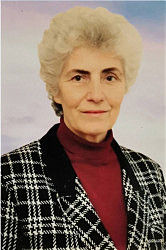
Since 2002, the school has been headed by Natalia Zavoyko. The museum’s activities and students’ research work under the guidance of L. Starykh continue. “She managed to teach her subject and work with the museum. The museum was her second breath, a captivating hobby. She was responsible, wise,” recalls her grandson Fedir about his grandmother’s work. “She didn’t offend anyone. Kind. We loved her very much,” adds a student from the 1970s, Larisa.
My acquaintance with the museum director took place through Nina Stamikosto (Gordienko). We both knew Yasha Gordienko’s sister for a long time. With the adoption of the decommunization law, Lyudmila Starykh worried about the fate of her school museum. And somehow she turned for consultation on symbolism. In turn, I called the Ukrainian Institute of National Remembrance. The head of the department, Ihor Karetnikov, provided a professional explanation. Soon, a hospitable meeting took place within the walls of the school museum. The slender, gray-haired, calm, balanced museum director gave a short tour. A huge number of exhibits, documents, and stories of soldiers and partisans of World War II were impressive. The brief overview turned into a multi-hour conversation. During the meeting, the director recalled the name of a little-known partisan from Odesa, Kostyantyn Chekhovych, born in 1919. She asked to find out anything about him. It so happened that in less than a month, I managed to find and talk to K. Chekhovych’s daughter in Odesa. “How did you find them!” Lyudmila Starykh wondered. Later, a meeting with the partisan’s relatives was organized at the school. A local publication in October 2021 published an article about the partisan, but it so happened that Lyudmila was not informed about it.
During that meeting, it became known that L. Starykh was the compiler of a book about veterans. I offered to donate a copy with her dedication to the Odesa State Scientific Library. Due to her modesty, the museum director refused. But she was eventually persuaded. This year, during a conversation with her grandson, I learned that this character trait had always been with her. Once, when entering the institute, Lyudmila hid her membership in the Georgian athletics team from the admissions committee, and the male athletes who were applying together were very surprised. “But you could have just not passed the competition!” they said. “For athletes of your caliber, there are great benefits in all universities.”
Once, L. Starykh announced her illness, and at the end of January 2025, she wrote: “I am in a very serious condition…”. It was at this time that the note about the mentioned partisan Chekhovych surfaced. Lyudmila Konstantinovna was outraged. Not because she didn’t know about it. But because, mentioning her and the museum, they put people who gave their lives fighting against the occupiers more than 80 years ago in the same row: Vasyl Avdeyev-Chornomorsky, Volodymyr Molodtsov, Yasha Gordienko, and… A. Fedorovich-Boyko, O. Sadovy. The museum director knew well that both of the latter were traitors to the partisan detachment. It was also known that Sadovy was liquidated by Ya. Gordienko, and Boyko was found and shot after the war.
“Where is this published? What was he trying to do? Ignorance of history? What to do?” she asked agitatedly. And added: “And the blunder with the ‘heroes’ is unforgivable.” I tried to calm her down. I proposed an algorithm of actions. “Oh, what a pity that she got sick.” She really wanted to correct this mistake. But she didn’t have time. Her grandson informed that on February 21, 2025, her heart stopped.
L. K. Starykh was the head of the museum from 1985. Many plans remained unrealized. By the way, there was a plan to prepare a joint work in April 2025 for the 100th anniversary of Yasha Gordienko’s birth. But… But the productive decades of her teaching work, the love of numerous students, and recognition remained.
In September 2010, by the order of the Odesa city mayor, for fruitful and dedicated work and a significant contribution to the socio-economic, scientific-technical, humanitarian, and cultural development of the city of Odesa, Starykh Lyudmila Konstantinovna, geography teacher, organizer of the Partisan Glory Museum of Secondary School No. 65 of the city of Odesa, was awarded the Honorary Badge of the Odesa City Mayor “Labor Glory.”
In 2016, the Partisan Glory Museum, under the leadership of L. Starykh, was awarded the title “Exemplary Museum.”
In December 2020, based on the results of a review competition, the Partisan Glory Museum (head – L.K. Starykh) of Odesa Secondary School No. 65 was recognized as the winner in the nomination “Best Military-Historical Museum in Educational Institutions” – it received a Diploma of the I degree.
In 2021, the founder and curator of the Partisan Glory Museum of School No. 65, Lyudmila Starykh, became a laureate of the B.F. Derevyanko Memorial Competition of the newspaper “Večernaya Odesa” “People of Action.”
A good and bright memory remains. The school museum remains. Generations of educated students and their numerous thanks remain. One of them: “I want to note the professionalism with a capital P of the geography teacher Lyudmila Konstantinovna Starykh.”
And her words remain: “I wish future generations great success!”











