

Until the second half of the 1940s, Shota Rustaveli Street, located in the Blizhniye Mlyny district, was called this. Today, residential buildings can only be seen on its left side, but it wasn’t always like this. In the 1980s, all old buildings on the right (even-numbered) side were demolished, and at the same time, the block of Skvortsov Street (modern Malovnichaya) and Novy Lane disappeared. All houses were demolished, except for one, on Kosovskaya Street and part of Aviatsionnaya Street. This entire territory was built up by the January Uprising Plant.
But let’s go back almost 200 years.
The street received its first name in honor of the owner of a windmill. Ya. Ya. Maystrovoy, the author of the toponymic guide “The History of Odesa in Street Names,” found out: as early as 1828, “the committee allocated plots for the construction of a mill in the fourth quarter to Yermolai Smirnov for №5 and to the townsman Vorobyov for №6. With Vorobyov’s consent, Smirnov built a large mill using plot №6…” The researcher also provides data that merchant E. Smirnov owned a house in this area. Later, his son Vladimir most likely owned real estate in Blizhniye Mlyny.
The current architectural ensemble of Blizhniye Mlyny was formed at the end of the 19th – beginning of the 20th centuries. These were mainly one-story, less often two-story houses.
Among the preserved structures, the former Blizhniye Mlyny city primary school №33, built according to the project of architect Yu.M. Dmitrenko in 1889, should be highlighted. It was located at the corner of Smirnovskaya and Molchanovskaya (Malovnichaya) streets. This was achieved through the efforts of a local resident, teacher O.L. Galafré, and with 15,000 rubles donated by G.G. Marazli. Later, this building housed the Grinevich and Simonyuk Club, then school №123, and in the second half of the 20th century, kindergarten №60.
The building of the former January Uprising factory-kitchen, built in the early 1930s in the constructivist style, also attracts attention. Later, a factory canteen operated on the first floor, a district polyclinic on the second, and a hospital on the third. In the late 1990s, the “Dipolos” bakery operated here.
Since Blizhniye Mlyny was located near the railway workshops (later the January Uprising Plant, “Krayan”), many workers lived on the streets of this district and directly on Smirnovskaya.
But, of course, it wasn’t just the working class that favored this area.
The future wife of poet S. Yesenin, and later the wife of director V. Meyerhold, actress Zinaida Reich, spent her childhood on Smirnovskaya Street.
She was born into the family of August (Nikolai) Andreyevich Reich, a townsman from Rostov, and Anna Ivanovna (née Viktorova), the daughter of a collegiate secretary. The girl was baptized in the Alekseevsky Church on Moldavanka. At that time, the family already had an older son, Vladimir.
It is known that Zinaida’s father owned a bicycle repair shop on Smirnovskaya in the Stavro house in the early 20th century. This house was located at the corner of Yevdokimovskaya Street (modern Ivana Funtova). In 1906, the Reich family was evicted to Bender under police surveillance due to the revolutionary views of the head of the family. Zinaida Reich’s further life is described in detail in various sources.
Aristarkh Kobtsev, a participant in the K.K. Kostandi Society of Artists, a member of the Union of Artists of the Ukrainian SSR, and a professor of painting at the Academy of Fine Arts (1941-1944), spent his entire life in this area. He was born in 1884 into the family of Aristarkh Fedotovich Kobtsev, a technical specialist at the main railway workshops of the Odesa Railway, and Maria Georgievna (née Melnikova), the daughter of an Odesa merchant. The boy was baptized in the Mikhailovsky Church on Moldavanka.
The family owned a house at Smirnovskaya, 12. When A.A. Kobtsev married Elena Artemievna Boyko, they moved to a nearby house at Molchanovskaya, 13. Interestingly, the artist’s sister, Zinaida, married the son of Odesa merchant Fyodor Ivanovich Martsin. This family owned a mill and houses on Borisovskaya (modern Raдужная) Street. Thus, the families of Blizhniye and Dalniye Mlyny became related.
Another famous artist lived on this street. According to the directory “Vseya Odesa” for 1912, Pavel Grigorievich Volokidin, who at that time taught at the gymnasiums of S.I. Vidinskaya (later V.I. Melnitskaya) and O.S. Belen-de-Balyu, rented an apartment in the Babetsky house at Smirnovskaya, 46.
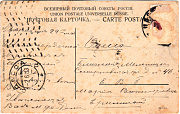
The brothers Vasily and Dmitry Nikolaevich Erymicho, who served in the chancellery of the Odesa city administration, also lived in this house. My archive contains a postcard sent in 1913 to Maria Viktorovna Erymicho at this address. It was most likely an apartment building. Its owner, a deputy of the Odesa City Duma, a member of the Mikhailovsky sanitary board, and a member of the society of property owners of outskirts and suburbs, Viktor Pavlovich Babetsky, also owned the house at Smirnovskaya, 23.
A little about other property owners on the street.
Maria Mikhailovna Shcherbakova, a Russian language teacher and supervisor at K.S. Alexandrova’s gymnasium, owned house №26, and Dmitry Mikhailovich Pulato, a singing teacher at the Tsarevich Alexei vocational school in Odesa, rented an apartment at Smirnovskaya, 15.
Evgeny Ivanovich Khomitsky (№30) served in the financial department of the city administration, and his father, Ivan Nikolaevich, was a deputy of the city Duma, head of the townspeople’s administration, and a member of the Mikhailovsky sanitary board.
Johann Christian Heppner (№52), a native of Riga and an hereditary honorary citizen, worked for the South-Western Railway. Petr Martinovich Dabizha (№13) worked at the telegraph office. Another deputy of the city Duma, Ivan Evgenievich Shaposhnikov, owned house №37 (preserved).
Alexei Ivanovich Didik, the owner of house №50, was engaged in the vegetable trade. According to the memoirs of one of his descendants, Alexei Ivanovich and Domnikia Mefodievna had five sons and three daughters.
There were probably no shops on Smirnovskaya. Only a wine cellar in house №26, run by Ivan Nikolaevich Kholitsky. During Soviet times, a grocery store opened at the corner of Efimov Street.
Many residents of Smirnovskaya remained to live here after the revolution (Didik, Ganneman, Dabizha). There were also those who emigrated. One of the current residents of house №39, which belonged to Nikolai Franzovich Mikhnevich, recalled that in the 1990s, descendants of the owner from Germany visited the courtyard. An old iron gate has been preserved in this house. In the arch of the passage, there is a sign prohibiting playing football in the courtyard – a testament to another era.
The “Krayan” plant has long been gone, but people who worked there still live here. In recent years, Shota Rustaveli Street has been asphalted, and streetlights have been installed. Unfortunately, after several Russian shelling attacks, a warehouse with food products was destroyed, and people died. The building of the former factory-kitchen and a high-rise residential building were also damaged. But, despite everything, people continue to live and work here.
This is a brief history of one of the streets of the ancient Blizhniye Mlyny.











