

I want to tell you about the fate of a wonderful person – Irina Konstantinovna Lyubimova – a doctor who dedicated her life to caring for those connected with the sea. About a tragic fate, about an enviable fate…
A word from Irina Konstantinovna Lyubimova: “I, Lyubimova Irina Konstantinovna (Yurevich), was born on February 28, 1932, in Moscow. My father was Yurevich Konstantin Feliksovich, an engineer. My mother was Averbukh Izabella Semenovna, a doctor, a candidate of sciences. When I was five and a half years old, in October-November 1937, my parents were arrested.
My father, after 17 years in Stalin’s concentration camps, miraculously survived and returned in 1954. My mother received a sentence of ’10 years without the right to correspondence’ under Article 58 and, as it later turned out, was shot in May 1938. My mother’s brother, Averbukh (Auerbach) Mikhail Semenovich, hid me with friends so that the authorities would not place me in an orphanage for ‘enemies of the people’.
In February 1938, my father’s sister, Yulia Feliksovna Yurevich, managed to illegally take me to Odessa, to the family of my grandmother Maria Vasilievna Yurevich, my father’s mother. Before the war, I finished two grades at School No. 36 in Odessa.
On June 22, 1941, I was 9 years old, and on this bright, sunny day, the terrible word ‘war’ was heard. From June to October 1941 – bombings, the terrifying sounds of air raid sirens, panic. We lived in cellars, bomb shelters, and catacombs. I remember October 16, 1941, very well. Deserted streets, leaflets being thrown from a passing truck. Through a loudspeaker, it was announced: ‘Brothers and sisters, the enemy is in Khlebnaya Harbor. We will return – Odessa was, is, and will be Soviet.’
And then, a few days later, our quiet Sadikovskaya Street in Moldavanka was filled with Romanian soldiers – they were assigning quarters, and at the same time, they were taking everything they could get their hands on. We were kicked out of our apartment, and we moved to live in the cellar; Romanian officers moved into our apartment. They said that this cellar used to be an entrance to the catacombs. There was no electricity or water, and a small homemade kerosene lamp was constantly burning. It was damp and scary in the cellar, and rats rustled at night. It got even worse in winter; the winter was very harsh. We had to go down to Balkovskaya Street for water, past Rozumovskaya. The road was icy and slippery. By the time I brought two small jugs of water, I was freezing, getting wet, and crying.
I was raised by my aunt, my father’s sister, Yurevich Yulia Feliksovna. There was nothing to eat, and to survive somehow, my aunt exchanged things for food: an incomplete bottle of ‘Red Moscow’ was exchanged for 1 kg of corn grits, a brooch I had left was exchanged for 2 kg of beans. My children’s sundress was exchanged for a jar of soy flour.
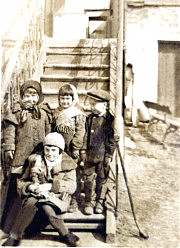
I remember a terrible day in winter when Romanian soldiers drove Jews out of all our courtyards on Sadikovskaya Street with their rifle butts. From house No. 35, an old man with gray hair and emaciated, on crutches, came out; he had no yellow star on his clothes. A Romanian soldier swung his rifle butt at him, swore, and pinned a star to his forehead with a safety pin… Blood flowed, covering his face, and the old man screamed terribly. I recoiled from the gate in horror; I will never be able to forget this.
From the house opposite, No. 40, my friend Innocka Vaisman and her brother Zhenya were put on a sled, and a column of people moved towards Rozumovskaya, and from there to the square where the parachute tower was (Khvorostina St.). On the way to the ghetto, Innocka and Zhenya froze to death. When the column passed our yard, one of our neighbors, Olga Ivanovna Ponomarenko, shouted to my aunt: “And I will report to the commandant’s office that another Jewish child is hiding here.”
The horror and despair of my aunt were hard to describe. That same night, my aunt packed me and some things, and we walked for a long time somewhere through the snow-covered streets. It was the longest walk of my life – to Chubayevka. We walked and walked, it seemed like the road would never end. And now, when you can get there by tram in 30-35 minutes, I can’t believe it’s so close.
My aunt begged her colleague Stefa Lebid to take me in for at least a while. I helped them as much as I could around the house. I carried water from the well, helped in the kitchen. They had a goat, which I was very afraid of. Chubayevka, Dmitrovka, Aleksandrovka, Blizhnie Mliny – I was passed from hand to hand like a relay. I was only allowed to go outside at night because searches and raids were conducted during the day. During the day, I sat in the shed behind a pile of firewood, which had a small recess made in it. Food was brought to me here. Then I lived for some time behind the wardrobe at my teacher Maria Ivanovna Korotunova’s. My birth certificate could not be presented because I was Jewish.
And then my aunt was advised to have me baptized in the church. After the baptism, I was issued a certificate in which my mother’s surname and name, Izabella Semenovna Averbukh, were changed to Paraskovia Semenovna Yurevich. This certificate saved my life. It was my only document, by which I lived through the entire occupation.
At the end of August 1942, I entered the 3rd grade of the Romanian gymnasium, where I later contracted a severe form of tropical malaria. I remember when the Germans were leaving Odessa, black clouds of smoke curled up from the burning elevator with grain in Khlebnaya Harbor. Then, after the occupiers left, a meager daily ration of black bread, smelling of smoke, was distributed from this burnt grain according to ration cards.
In 1944, my father was released from the GULAG (Siberia) and received eternal settlement in the Komi ASSR. In 1948, my father took me from Odessa to join him. In 1952, I returned to my hometown, transferring from the Krasnoyarsk Medical Institute to the Odesa Medical Institute. In 1954, my father was rehabilitated, and my mother was rehabilitated posthumously a little later…”
What Irina Konstantinovna said needs no comments or clarifications. There is more than enough here – betrayal, meanness, pain, and love. All of this is a testament to the times.
After graduating with honors in 1957 from the Odesa Medical Institute, Irina Konstantinovna was hired as a doctor at the Basin Hospital for Seafarers, and in 1965 she was transferred to the polyclinic of the Odesa Port as a therapist-occupational pathologist. She worked there for over 26 years – until her retirement in 1991, with a total work experience in the maritime industry of 33 years.
She remained in memory for countless good deeds. Thousands of port workers passed through her, and today her name is known to many. In the summer, from 1968 to 1988, she worked as a doctor at the Odesa Port’s pioneer camp “Yuny Moriak” at the 16th station of V. Fontan. A whole generation of port workers’ children grew up under her constant, attentive care.
In 1979, Irina Konstantinovna was hit by a car in a pedestrian crossing. The injury was very serious. Three months in the hospital, crutches, disability. But Irina Konstantinovna found the strength here too to overcome her health problems and return to work after rehabilitation.
Like no one else, she could encourage, convince that everything would be alright. She always found the main thing that allowed a person to maintain dignity and faith. She could pick up a stranger’s child – find an approach, the right words, and calm them down in minutes. When Irina Konstantinovna was asked how she was doing, she always replied, “Better than everyone!” This endless life optimism, love for people, dedication to her profession helped her to survive all life’s hardships, to live a not simple, but very eventful and beautiful life.
After retiring, Irina Konstantinovna devoted herself to a hobby that she pursued throughout her life when she had free time – embroidery. And here she achieved perfection; in 1995, her works were presented at a personal exhibition in the lobby of the Odesa city hall. “For me, embroidery is a release, a joy. To find your own and understand that every moment is unique – that’s what I would like to wish everyone, especially the port workers!”
And she raised a worthy son. Igor Anatolyevich Lyubimov is a well-known maritime specialist, founder and head of the diving service of the State Enterprise “Administration of Sea Ports of Ukraine,” founder of the Odesa underwater club “Poseidon,” a veteran of the Odesa Port, having worked there for over 45 years.
On December 10, 2020, Irina Konstantinovna passed away.
The pages of this amazing person’s life with a unique fate flash before my eyes again and again. A fate that makes us think once more about those who walked through life with a confident step, not looking back at the past, at the terrible losses of loved ones. And to pay tribute to the people who saved at least one human life.











