

Across the road from my hotel in Dahab is a Muslim mosque. Every morning around five, the call to the first prayer is heard from the loudspeakers on its roof. The mass Friday prayers near the hotel, where hundreds of city residents pray simultaneously in the mosque and on the adjacent road, are particularly impressive.
Naturally, I perceived Egypt as an entirely Muslim country, where believers of other religions constitute only a small percentage. However, I was mistaken.
One day, I saw a cross on the chest of a seller in a souvenir shop in Dahab. It didn’t resemble the usual amulet of the Orthodox Church, but I still inquired about the origin and symbolism of this cross from the Arab.
It turned out that my new acquaintance, named Ahmed Aziz, is a Christian and, in addition to his main occupation, also serves in the Coptic church on the outskirts of Dahab. He invited me to visit this church. A couple of days later, early in the morning, I was already standing at the indicated spot on the road, waiting for the bus to arrive.
The road to the temple led between the sea and the mountains and took about half an hour. We stopped a couple of hundred meters from the sea at a tourist complex called Happy Life. On this territory, intended for the happy life of tourists, was located the local church in the name of the Mother of God. It was built by the hotel owner. Externally, it was no different from other buildings. But already in the small vestibule, the character and purpose of these premises became clear.
Immediately beyond the threshold, a painting hung on the wall – the Mother of God with the infant Jesus; a little further stood, apparently, her own handmade figure made of wire and gauze. Nearby was a painting of the crucified Christ with various biblical symbols. On the opposite side, covering the entire wall, hung a portrait of Jesus Christ. The images of an angel, a cow, an eagle, and a lion in the corners of the painting caused surprise. Impressed by excursions to the temples of Luxor, I thought that these symbols might carry memories of the religion of the ancient Egyptians with their worship of sacred animals.
However, according to Ahmed, these are quite Christian symbols of the evangelists. They have their origin in biblical texts, where they are connected with the Revelation of John and the visions of the prophet Ezekiel. In the Revelation of John, the eagle represents John himself, the lion – Mark, the angel – Matthew, the cow – Luke.
The next door led directly into a large prayer hall. Apparently, the service had already begun. In the hall, several dozen Arabs stood and sat on benches of impressive size, attentively listening to the chants of boys standing at the microphone, led by their conductor. Compared to the usual chanting in the Orthodox Church, the singing voices here sounded more intense. The rhythm was set by the conductor of this choir, who periodically struck two small cymbals together, similar to those used in brass bands.
The structure and interior of the temple differed from Orthodox churches. There was no usual altar and iconostasis. Instead, there was a partition with two openings, draped with red carpets on the sides and one in the middle. On the partition were several paintings with the faces of angels in golden robes, and at the very top, under the ceiling, images of the twelve apostles. In Orthodox churches, we are accustomed to seeing attire that emphasizes their origin, age, and nationality. Here, however, the apostles looked more like dashing European young men without any religious symbolism. On other walls were depicted familiar biblical scenes from the life of Christ and his disciples.
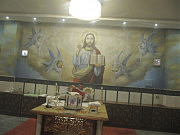
Behind the altar partition, another room was visible, in the middle of which stood a table with church utensils and candles. And on the wall behind it was a huge portrait of Jesus Christ with an angel, lions, an eagle, and a cow in the corners. The chief clergyman in black attire periodically came out with a prayer into the main hall and, swinging a censer, walked around the rows of seated and standing parishioners. The left side of the temple was for men, the right – for women.
After some time, all the ministers put on white cassocks with crosses of the Coptic Church on their chests and backs. The priest put on a headdress. On this Sunday, a liturgy was taking place, during which the entire earthly journey of Christ and the final days of his life were described. It lasted more than two hours. It was very colorful and solemn.
It is understandable that the service was conducted in Arabic, and from the actions of the Coptic priest and his assistants, episodes of the sacred act were periodically guessed: the recitation of the creed, the presentation of holy gifts, the recitation of the Lord’s Prayer, the elevation, communion, thanksgiving prayers, blessing…
However, differences were also striking. When the priest performed the rite of making the sign of the cross, he dipped his index finger into a chalice of consecrated wine and drew a cross on the eucharistic bread – a small flatbread with twelve crosses imprinted on it.
And at the invitation of the priest, I, along with local Christians, partook of communion and received a piece of the flatbread and a sip of sweet wine from his hands. Later, after the service, I found out that the Coptic Church is not part of the family of local Orthodox churches of the Byzantine tradition.
To comprehend the information I received from Ahmed, it is worth considering that the Coptic Church, at its creation, was much closer to the original sources. It was organized in Alexandria in 42 AD by the Apostle Mark, while the legalization of Christianity in the Roman Empire took place almost two centuries later.
After the service, all parishioners were invited to a traditional tea party – with flatbreads, cheese, and boiled beans. Then Ahmed told me about the Coptic Church and about himself.
Copts are one of the oldest Christian communities that adhere to Coptic Christianity. The name “Copts” comes from the Greek word Aigyptos, which means “Egypt.” They are descendants of the ancient Egyptians, and their history in Egypt spans about two thousand years. The parishioners of the Coptic Church in Egypt number about 8 million Egyptians, and they coexist peacefully with Muslims.
“It couldn’t be otherwise,” my new friend reacted. “Love is at the core of our religion. Therefore, we are opponents of any violence and war.”
“How did you become a Christian?” I ask.
“It’s the tradition of our family,” my interlocutor replied, surprised by the question. “My father and mother are parishioners of the Coptic Church, as are their parents, great-grandparents, great-great-grandparents, and distant ancestors. Christians – three brothers and a sister, my wife and two children. I am sure that in a few years my sons, like me in my time, will sing in the church choir and absorb Christian wisdom. It has been this way for many centuries and will continue in the future.”
During this narrative, I was already looking at Ahmed with different eyes. Before me sat not a modern Arab, but a Copt, in whose veins flowed the blood of the ancient Egyptians who created the highest civilization in human history and accepted the Christian faith almost two thousand years ago.











