

For many years now, after the sinking of the passenger liner “Admiral Nakhimov” of the Black Sea Shipping Company in 1986, I have been awaiting the approach of this tragic date – August 31st – with a sense of unease.
One thought comes to mind: what materials, memories, and photographs will be published this time? Who will speak out: relatives of the deceased or, conversely, of the rescued passengers or sailors? Perhaps it will be specialists among ship captains, teachers from maritime educational institutions where the art of navigation and management of modern vessels is taught? Or navigation experts? Who will address the events of almost forty years ago? And will they be able to add anything substantial to what is already known and has been said before? After all, there is nothing worse than repeatedly reading already well-known and repeatedly published material, especially if the author also tries to present it in their own interpretation.
I must note that if in the early years, perhaps even in the first decade after the disaster, memories of the direct participants of those tragic events were mainly published – those who managed to be rescued and survive or their loved ones and relatives – then later, various expert assessments and judgments were more often published.
Unfortunately, in my opinion, the published materials have not always been based on facts, and later, most often, they were presented by people not directly connected with the disaster itself. It reached the point where one of the maritime newspapers not so long ago published the “memoirs” of a specialist seconded from Odessa. He began by saying that he remembered the events related to the sinking of the “Admiral Nakhimov” from the time when he, along with other guests of one of the hotels in Novorossiysk, was urgently evacuated at three in the morning, freeing up space to accommodate the rescued passengers from the “Admiral Nakhimov”! Subsequently, this “storyteller” listed facts already repeatedly presented in newspapers in his own name…
However, if we follow the laws of logic, then both in the distant past and even more so now, facts that have never been voiced before are of interest, especially if they are directly related to the participants of that terrible disaster.
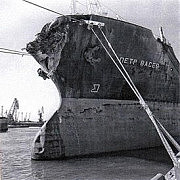
As is known, the court found the captains guilty of the incident and sentenced each of them to 15 years of imprisonment: the passenger vessel “Admiral Nakhimov” Captain Vadim Georgievich Markov and the bulker (cargo ship) “Pyotr Vasev” Captain Viktor Ivanovich Tkachenko.
To be frank: regarding Tkachenko, there was no question of why he was commanding a bulker on that fateful night. His entire service record as a sailor in the Black Sea Shipping Company provided the answer – he started sailing as a deckhand on dry cargo vessels, studied by correspondence, advanced up the career ladder: assistant captain, chief mate, and finally was appointed captain of the large bulker “Pyotr Vasev.” Viktor Tkachenko’s entire maritime service was on foreign-going dry cargo vessels of the Black Sea Shipping Company. Like all captains in the country at that period, he was approved for the position of captain by the USSR Minister of the Merchant Marine.
Regarding the path to the captain’s bridge of the passenger liner “Admiral Nakhimov” for Captain Vadim Markov, there is no such simple answer. He spent most of his maritime career in the Black Sea Shipping Company on large foreign-going passenger vessels. The last vessel he commanded and for which he was approved by the Odessa Regional Party Committee was the motor ship “Karelia.” Why and how did the captain of a large, prestigious, modern foreign-going passenger liner find himself on a passenger liner built in 1925, and moreover, a coastal (domestic) vessel, meaning it operated between ports of only one country, on that fateful night?
This question has not been raised in any open sources of information. To make it clear to the reader, I will try to explain. According to the rules of that time, captains of Soviet merchant ships had to undergo coordination and approval by party bodies before being appointed by order of the head of the Black Sea Shipping Company. Captain Markov was no exception to the general rule. And before his appointment, he was also approved by the Odessa Regional Party Committee for the position of captain of the m/s “Karelia” and worked on it for several years.
In 1985, a letter was sent to the Regional Party Committee from the Black Sea Shipping Company, signed by the acting head of the Black Sea Shipping Company, V.Z. Senko, and the deputy secretary of the Party Committee, V.D. Kachan, regarding Captain V.G. Markov of the m/s “Karelia.” It was reported that at the request of the prosecutor’s office (in connection with the ongoing investigation), he would not be assigned to the vessel for which he was approved, but would be used on coastal vessels, without going abroad.
V.M. Lukashevich, head of the Transport and Communications Department of the Odessa Regional Party Committee, gave his consent to this decision, without relieving V.G. Markov of his position as captain of the m/s “Karelia.” By order of the shipping company’s head, Vadim Georgievich was appointed captain of the passenger liner “Admiral Nakhimov” and began working in coastal navigation.
Six months later, as head of the sector of the Regional Party Committee’s Transport and Communications Department, I reported to Lukashevich that the investigation conducted by the prosecutor’s office regarding Captain Markov had been closed, and there were no obstacles to his return to his previous vessel, the “Karelia.” However, contrary to my expectations, the head of the department instructed to additionally coordinate the issue of V. Markov’s return to his previous job, not only with the prosecutor’s office but also with the transport police and other administrative bodies of the region.
Having gathered the necessary information, I reported to the head of the department that there were no objections from the administrative bodies against Captain Markov’s return to foreign-going vessels, including the m/s “Karelia.” To which Lukashevich sharply and unequivocally stated: “Markov will stay! On the ‘Nakhimov’!”
To my arguments that this decision violated the procedure for working with nomenklatura personnel in the Regional Party Committee, and if it could still be explained in connection with the prosecutor’s investigation, then after the restrictions were lifted, there were no such justifications, Lukashevich did not react. He remained unyielding.
Unfortunately, I saw no reasons for his decision then, and even less so later. I assume that perhaps he had a personal conflict with Markov at some point, as he did with some well-known captains in the Black Sea Shipping Company, for example, with the Hero of Socialist Labor Captain Kim Golubenko, and he remembered it. Perhaps, for some reason, it was necessary for the position of captain on the m/s “Karelia” to remain vacant (the vessel operated in the prestigious and very popular Caribbean region among Soviet and foreign tourists). In short, one can guess and speculate a lot, but these will only be assumptions.
Our last conversation with Lukashevich regarding Captain Markov took place in May-June 1986, I can’t say for sure now. And if not for the position taken by the head of the Transport and Communications Department, Lukashevich, Captain Markov would most likely have handed over his duties to another captain of the “Admiral Nakhimov” after some time, and would have gone to the m/s “Karelia,” where he had worked before.
But this did not happen. And on August 31, 1986, what happened, happened – the bulker “Pyotr Vasev” rammed the passenger liner “Admiral Nakhimov” in the open sea. The largest maritime disaster in the USSR occurred, resulting in the deaths of 423 people, both passengers and crew members of the vessel.
At the moment when the “Pyotr Vasev” delivered the fatal blow to the “Admiral Nakhimov,” after which it sank within minutes, Captain Markov was not on the ship’s bridge; the vessel was being navigated by the duty second mate. Captain Tkachenko was commanding his vessel and making all decisions personally. However, the court, considering the circumstances of the disaster, determined the same measure of punishment – each of the captains received 15 years of imprisonment.
In the time that has passed since 1986, questions have repeatedly arisen – what if Captain Markov had been on the bridge? What if Captain Tkachenko had made a different decision, not the one that led to the collision? What if the duty second mate of the “Admiral Nakhimov” had acted differently than established in court, would the collision have occurred or not? Unfortunately, all this is in the realm of reasoning and speculation; the collision of the vessels did occur.
In my opinion, in this situation, one should consider the following cause-and-effect relationship: if Captain Vadim Markov, after the prosecutor’s office lifted the restrictions on his foreign voyages, had handed over his duties to another captain of the “Admiral Nakhimov,” his personal fate as a sailor, as a person, would undoubtedly have turned out differently.
And all possible future issues regarding the operation of the “Admiral Nakhimov” after Markov handed over command of the vessel would have been the responsibility of the new captain. But since, due to the circumstances, Vadim Georgievich did not leave the vessel and did not hand over his duties and command, all questions were directed to him, and his fate as a captain turned out as it did.
As a veteran of the merchant marine and the Black Sea Shipping Company, young colleagues who started working after 1991 and later often ask me: what is the command-administrative system of management that existed in the country before? I think that the example considered clearly and vividly illustrates one of the negative aspects of this system – when one group of people made decisions, and another group was subsequently held responsible for those decisions.
The Black Sea Shipping Company, after sending a letter to the Regional Party Committee stating that Captain V.G. Markov would not work on the m/s “Karelia,” could not return him to this vessel on its own (without the consent of the Regional Party Committee). And they could not send another captain to replace V.G. Markov on the “Admiral Nakhimov.”
After the disaster and the sinking of the “Admiral Nakhimov,” the following were dismissed from their posts: Head of the Black Sea Shipping Company S.A. Lukyanchenko, Deputy Head of the Black Sea Shipping Company for Maritime Safety A.G. Tretyak, Head of the Maritime Safety Service V.T. Lyuty, Deputy Head of the Black Sea Shipping Company for Personnel Yu.P. Datsyuk, Head of the Passenger Fleet Personnel Department A.D. Malashenko, and many others; in total, dozens of managers and officials of the shipping company at various levels were held disciplinarily responsible.
USSR Minister of the Merchant Marine T.B. Guzhenko lost his position; his deputies, heads of the MMF’s Maritime Safety Department and Personnel Department were held disciplinarily responsible.
On August 31st, the day of the sinking of the “Admiral Nakhimov,” while paying tribute to the memory of the hundreds of people killed and missing, and acknowledging the courage and skill of the sailors who saved drowning and injured passengers and crew members in extreme conditions, one must always remember the serious lessons of this maritime disaster.











