

We were very, very much looking forward to meeting this person. And yet, he appeared somewhat unexpectedly. Probably because he arrived exactly at the appointed time – to the minute. Middle-aged, tall, with disheveled curls, glasses underneath. A very ordinary dark t-shirt, jeans. And a smile: typically Odesan, open and ironic.
Meet Ilya Kaminsky. Poet, literary critic, professor of literary creativity. However, he also has a law degree. Ilya Kaminsky was born in Odesa, on Degtyarnaya Street, and has lived in the USA since 1993. In 2014, he was nominated for the Nobel Prize in Literature – the first in the history of Odesan writers.
Ilya Kaminsky came to Odesa from Greece, where he conducted seminars at a summer school for young writers. He arrived on July 1st – on the tragic day of the missile attack on Sergeevka. But, understanding all the risks of staying in a frontline city that is constantly under threat of shelling, he did not cancel his visit, as he really wanted to visit his uncle, who had a severe case of coronavirus and subsequent complications.
Well, we, the “Vechyorka” staff, taking advantage of this opportunity, asked Ilya Kaminsky to visit us. First and foremost, to say a sincere thank you to this person, thanks to whom “Vechernyaya Odesa” is surviving during the war, continues to be published, and cautiously makes plans for the future, after victory…
I won’t hide it, there was a certain inner tremor from meeting this person. After all, you don’t talk to a poet nominated for the Nobel Prize every day. But Ilya Kaminsky immediately, in a typically Odesan way, parried with a slight irony. “A poet is unusual when he writes. But when he doesn’t write, he’s an ordinary person,” our guest clarified.
So, we began our conversation not with a discussion of events and trends in world literature, but with a mundane question: what did he find Odesa to be like during the war?
— The first impression is that there are far fewer people in the city, — Ilya Kaminsky had been visiting Odesa almost every year even before the war. — But at the same time, people are sitting in cafes, going to the market for groceries. They continue to live! And at the same time, the pain of waiting, the fear of waiting for terrible uncertainty, is clearly felt.

— What will I tell in America about Odesa? — Ilya Kaminsky asks again. — I’ll tell them that in my hometown, air raid sirens are constantly wailing. And people continue to live. I’ll tell them how many Odesans, having the opportunity to leave the war, stayed in the city to care for their elderly parents, for sick relatives. I’ll tell them how I asked my aunt why she didn’t leave war-torn Odesa. And she brought another handful of medicine for my uncle, whom she cares for so touchingly, and said: “This is my war.” Finally, I’ll tell them that Odesans are people who, when they want to cry, they smile. Whether it’s good or bad, I don’t know…
We Lived Happily During the War
And when they bombed other people’s houses, we
protested
but not enough, we opposed them but not
enough. I was
in my bed, around my bed America
was falling: invisible house by invisible house by invisible house.
I took a chair outside and watched the sun.
In the sixth month
of a disastrous reign in the house of money
in the street of money in the city of money in the country of money
our great country of money, we (forgive us)
lived happily during the war.
Ilya Kaminsky’s fate is a complex interplay of life’s twists and turns. At 4 years old, due to a medical error, he practically lost his hearing. Later, when he fell under the spell of creativity, silence, from his everyday reality, became the main metaphor explaining the full spectrum of emotional diversity of the surrounding world. “After all, war has its own silence, peaceful life has its own, the silence in the eyes of people in love is different from the silence in the smile of a mother looking at her child,” explains Ilya Kaminsky. In essence, silence acts as a precursor to something important that is about to happen in a moment. Or perhaps it is the most important thing in life? “Only silence makes us speak,” is convinced Ilya Kaminsky. And with the spoken word, life regains its movement…
Our guest’s silence, which has become his eternal companion, prompted him to encounter poetry. Ilya Kaminsky began writing poems in his teenage years. His first creative mentor was Lidiya Shcherbina, a literature teacher at School No. 107. “I remember how some people came to our class and asked: ‘Who wants to work for a newspaper?’ A forest of hands went up. And then the visitors clarified: ‘And who wants to work for free?’ Only I raised my hand,” Ilya smiles. So our guest has some experience working in Odesan journalism.
Ilya Kaminsky has sincere respect for “Vechernyaya Odesa.” “It is the voice of our city’s civil society,” noted our guest. And he added that the newspaper has gone through different periods in its history, but it has never lost its main asset – a sense of self-dignity. And Boris Fyodorovich Derevyanko, the first editor of “Vechernyaya Odesa,” who tragically died 25 years ago, is, in Ilya Kaminsky’s opinion, “an example of civic service.”
We Lived Happily During the War
And when they bombed other people’s houses, we
protested
but not enough, we opposed them but not
enough. I was
in my bed, around my bed America
was falling: invisible house by invisible house by invisible house.
I took a chair outside and watched the sun.
In the sixth month
of a disastrous reign in the house of money
in the street of money in the city of money in the country of money
our great country of money, we (forgive us)
lived happily during the war.
In the early 90s, Kaminsky attended a literary association led by the renowned Odesan poet Yuri Mikhailik, and also maintained a creative partnership with another famous poet from our city – Valentin Moroz.
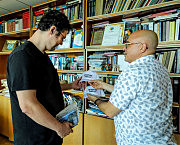
From that time, before leaving for the USA, Ilya remembers the crush of refugees at the “Privoz” bus station. The Transnistrian conflict was raging, people were fleeing the hostilities. Now, thirty years later, the journey from Chisinau, where Ilya flew from Greece, to Odesa, when the highway was clogged with trucks, and there were many people, mostly women, dragging huge bags, brought him back to the world of memories, but with one difference – the war had now reached his hometown.
In America, his creative work took a sharp turn. Ilya began writing poetry in English. By the way, he also writes prose in English. At the same time, Ilya Kaminsky does not consider himself an American writer. “I am an Odesan,” says our guest. The worldview inherent in him as a typical representative of the Southern Russian poetic school, expressed in English vocabulary, opens something new to the American reader. And this is the “zest” of Ilya Kaminsky’s work, literary critics believe.
As an example, I chose one of his most famous poems – “We Lived Happily During the War.” I honestly admitted to the author that I didn’t understand anything from this imagery. To which Ilya Kaminsky replied with a disarming smile: “And I didn’t understand it myself.” Then he corrected himself – the poem is about the feeling when consciousness plunges into a maelstrom of conflicting emotions. “When the Russians were bombing Mariupol, I was sitting in a cafe drinking coffee, and I felt my soul tearing apart,” admits Ilya Kaminsky.
The poem “We Lived Happily During the War” is part of the poetry collection “Republic of the Deaf.” Kaminsky’s creative works also include the poetry collection “Musica Humana.” And the poetry collection “Dancing in Odesa” brought the poet numerous literary awards and true fame. However, Ilya Kaminsky treats public recognition very calmly. That’s why the Nobel Prize nomination did not evoke a particularly enthusiastic reaction from him: “In fact, it’s something (i.e., the prize) that one shouldn’t dwell on too much. A writer’s job is to write.”
We talked about literature with Ilya Kaminsky with great enthusiasm. About Nabokov and Brodsky, about Dovlatov and Bulgakov, about Pasternak and Blok, about Bunin and Akhmatova. About contemporary Odesan writers: “There are very good writers, plus there is warmth in the relationships between creative people, which is very touching during wartime,” says Ilya Kaminsky. He firmly believes that the atmosphere of his hometown is simply made for creativity: “It’s good to write in Odesa.”
Ilya Kaminsky also shared a great idea, conceived together with another Odesan celebrity, writer, journalist, art researcher – the winner of the “Vechernyaya Odesa” “People of Action” competition for last year – Evgeny Demenko.
— This summer, we wanted to create a writers’ residency in Odesa, — Ilya Kaminsky says. — The plan was to invite 2-3 famous writers who would live in Odesa for at least a month. During this time, they would get to know the city, make friends with its people, establish creative connections with their Odesan colleagues, because the best way for writers to get acquainted is to start translating each other’s works. Alas, the war has postponed these plans… But we are not giving them up!
During his current visit to Odesa, he didn’t write anything.
— My task today is to popularize my hometown, — says Ilya Kaminsky. — We need to talk about Odesa, about Ukraine – the whole world is watching you. We need to talk so that support for your heroic country and our heroic city does not weaken.
Therefore, all days of Ilya Kaminsky’s visit to Odesa were dedicated to meetings and interviews. With Odesan writers and journalists from “Vechyorka,” with volunteers from the city’s humanitarian center for helping refugees and war victims, with friends, and with complete strangers. “It is also my duty to let other people abroad know what is happening in Odesa, in Ukraine, and how they can help,” the guest explained.
And he added:
— I remain a person born in Odesa. And I try to remain true to my hometown.











