

Railway station. Two months ago, a completely different life was bustling here. Winter sports enthusiasts stormed trains hoping to catch the last of the ski season, business travelers looked for an extra ticket to “Chernomorets”, suburban trains poured peasants onto the platform, who then transported produce to “Privoz” by carts and wagons.
Today, the Odesa railway station has a different rhythm, different sounds, and a different look – wary, focused, detached. Today, there is practically only one category of passengers here – those of our compatriots whom misfortune has forced to abandon their homes and flee. To flee as far as possible from the horrors of war, but towards complete uncertainty.
Literally from the first days of the war, the railway station in Odesa became an intermediate destination for refugees. Initially, people got there on their own, and in early March, the first evacuation buses arrived. As a result, over the past period, the station has ensured the evacuation of more than 200,000 passengers to safe places. Can you imagine the scope of organizational work? After all, people had to be met, calmed down, fed and watered, clothed and shod if necessary, and helped to solve a myriad of everyday issues. And then, to put them on an evacuation train, whose carriages accommodated both 150 and 200 passengers…
At the railway station, internally displaced persons are cared for by a coordination center, which employs representatives of various city structures – the Center for Social Services, the Legal Department, the Children’s Services, the Department of Social and Family Policy, as well as the Red Cross and volunteers from various charitable organizations and foundations. The work is carried out in the standard format for today – 24/7, i.e., around the clock, without days off.
— Refugees from different regions of Ukraine arrive at the coordination center – mainly from Mykolaiv, Kherson, Sumy, Kharkiv, Donetsk, and Luhansk regions, — says Olena Azarkina, deputy director of the Odesa City Council Social Services Center. — First of all, assistance is provided to women with children, the elderly, people with disabilities, and other socially vulnerable categories of the population. Center specialists provide consultations, informational and psychological support. Internally displaced persons receive food, including hot meals, are supplied with personal hygiene products, and, if necessary, children’s clothing. We receive great help from the charitable foundations “Monster Corporation,” “Road to Home,” “Caritas Odesa UGCC,” “Good Samaritan,” the charitable organization “I Will Help,” the Odesa Regional Organization “Red Cross Society in Ukraine,” volunteers, and simply indifferent citizens.
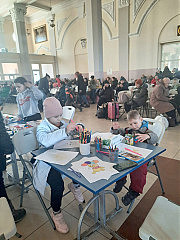
…We were at the railway station last Saturday. The shift team of specialists at the coordination center for internally displaced persons was led by Natalia Gudkova, head of the organizational and personnel support department of the Odesa City Council Social Services Center. According to her, on that day, they initially expected about 160 people from Mykolaiv. But by morning, about eighty had arrived on their own. This means there will be many more refugees. “About 300–350,” predicts Natalia Gudkova. “But we are ready. We have had days when the coordination center received over a thousand refugees per day, but we managed.”
When asked to share which life stories struck her the most, Natalia Nikolaevna pauses for a second.
— Well, there are a million such stories, alas, — she says. — After all, we, the staff of the coordination center, have encountered immense human tragedy. Often, refugees arrive here literally in their home clothes and slippers on bare feet, having miraculously escaped shelling.
Our interlocutor remembers one such story. A woman approached the duty officer in the bomb shelter and asked for tea. She was sad. And next to her was a girl – very serious, but not crying. “I’m trying to somehow cheer them up, saying, you’re safe now, look, the weather is good,” says Natalia Gudkova. But there was no reaction. Then the woman finally shared. She and her daughter, refugees from Mykolaiv, had spent two weeks in the basement. And when they came out, their neighbor’s house was simply gone. Destroyed to the ground. An elderly couple lived there. It was later learned that they were miraculously not at home when the shelling occurred. “But when we saw the destroyed house of our neighbors, my daughter and I literally felt our legs give way, and we can’t get out of that state,” the refugee said.
From Odesa, internally displaced persons continue their journey according to their own choice. Some board evacuation trains – to Chernivtsi and Uzhhorod, some buy tickets to Rakhiv, Lviv, Przemyśl. Some people choose bus routes – to Moldova, Bulgaria, Germany, Hungary. Some refugees stay with relatives in Odesa.

The main conclusion from what was seen at the railway station is that everything here is quiet and calm, efficient and without fuss. You immediately understand how difficult it was to organize all this.
— Within the first two weeks of the war, we switched, as they used to say, to military rails, — says Oleg Kudashkin, head of the Odesa-Main railway station. — First, we identified the most vulnerable categories of the population that require special attention and care. These are women with young children, the elderly, and people with disabilities. Taking this into account, we organized the station’s work. First of all, we changed the functionality of the main entrance. With the start of the war, the flow of people who needed to be advised on evacuation routes, to find out what kind of help a person needed, and to be guided to a safe place to wait for the right train, sharply increased. Selected volunteers, whom we dressed in bright pink vests, began to handle this.
When the flow of evacuation buses started heading to Odesa, another organizational decision had to be made. A special place was allocated for arriving transport. The second floor of the station building was opened, and the city hall ordered about 500 chairs from the concert and exhibition complex of the sea terminal to be brought here.
After determining the accommodation for people, we started forming lists by evacuation destinations to avoid panic and unnecessary excitement during boarding for any particular train. “I compiled the first lists myself, going around to the internally displaced persons and finding out where they wanted to go next,” says the station manager. It should be recalled that “Ukrzaliznytsia,” understanding the situation, canceled all types of tickets for a while; it was possible to travel in any direction for free. From March 25, as the flow of refugees decreased, the number of evacuation trains was reduced, but they remained free.
The next organizational issue was refugee catering. It was resolved quickly – thanks to volunteer organizations. They, in cooperation with several Odesa restaurants, ensured that internally displaced persons received hot lunches, tea with various treats, and baby food.
— When catering was organized, we thought about leisure for the little ones, — Oleg Kudashkin continues his story. — After all, a child cannot sit in a chair for 6–7 hours. As a result, we created a playroom, volunteers organized a cinema, and children could watch cartoons. All free of charge. We also made a sleeping room, installing five children’s beds and several adult ones – for mothers. Finally, in the VIP lounge, we organized a “baby corner”: volunteers brought changing tables, cribs, and strollers.
Now, circumstances have developed such that internally displaced persons waiting for their trains are located in a bomb shelter. This means a new area of work has opened up. After all, a bomb shelter must be equipped and furnished according to all regulations. Work has begun, with significant help, according to the head of the Odesa-Main railway station, from the management of the regional branch “Odesa Railway” and volunteers.
— Honestly, I feel proud of my team, — says Oleg Kudashkin. — We managed – more than 200,000 refugees were able to reach safe places through Odesa. We work calmly, without emergencies; today, by lunchtime, we know how many evacuation buses we will have tomorrow. We will definitely help everyone who needs our help.











