

To say that our Olympians are performing poorly in China is an understatement. They are performing badly. Making it into the top ten is already a success.
And why? Are people not interested in winter sports? That’s not true! I myself watch biathlon with great enthusiasm, although in both components of its program, all I managed to achieve was to demonstrate my egregious lack of athleticism. At Kyiv University, where I studied at the Faculty of Philology, there were no physical education classes as such; instead, we had to regularly attend some sports club. My friend and I signed up for skiing. We decided: we’ll go while it’s warm, and when it snows, we’ll switch to something for summer. But winter was in full swing, and we hadn’t left the ski track in Holosiivskyi Forest, not far from the university campus, even though we regularly and quite painfully fell off it. We had no more success in shooting. The instructor’s voice at the civil defense exam in the shooting range still echoes in my memory: “Number three, don’t shoot at target number five!” So what if we didn’t hit our own targets, at least now we can fully appreciate the sportsmanship and composure of “shooting skiers.”
And what about natural conditions? We have those too! Although we are not a northern country, Ukraine has ski resorts and places for winter recreation. Even here, in southern Bessarabia, we have frosts, and my photo archive contains many pictures of a snow-covered Izmail and a winter Danube, as well as Izmail residents on skis and sleds.
And ten years ago, there was such a harsh winter by our standards that local sports veterans organized a hockey match on a picturesque canal near the Izmail Sea Port, between the first and second loading areas of the port. The passions ran high both on the ice and in the “stands,” i.e., on the shore. Then there was a bonfire, and fish soup. It was great! Unforgettable!
For several years in a row, a portable ice rink operated in Izmail. This year, the city has set up its own ice rink in a more convenient location – near “Tavria V” on Suvorov Avenue. Our team, HC “Bessarabia,” performs and trains here, with Belgorod-Dnestrovsky “Akkerman” as its constant rival. In Odesa, at the “Pearl by the Sea” hockey tournament, they performed together, forming the Bessarabia regional team.
But if the people of Izmail have lost their taste for football (in its time, our “Dunaiets” filled the stands at the central stadium of the Soviet Danube Shipping Company and even hosted Odesa’s “Chernomorets” here), then they haven’t had time to acquire a taste for hockey: our HC “Bessarabia” is only two years old.
But everything needs to be nurtured: sportsmanship, fan culture, and even simple public interest. High-level championships are just the tip of the pyramid, built from hundreds of sports facilities where thousands upon thousands of people spend their time with benefit and pleasure day after day. Scandinavian countries shine at the Winter Olympics not because it’s cold there, but because they have conditions for mass participation in winter sports and a corresponding mass interest in them.
As long as I’ve known the Wernersson couple from Karlskrona, Sweden (our friendship spans decades, and Elon and Birgitta themselves are over eighty), they have passionately supported the local hockey club “Karlskrona.” All three of their sons have successively taken to the ice, and their grandson Rikard even refereed hockey matches. Birgitta has the anthem of her hometown hockey club as her mobile phone ringtone. HC “Karlskrona” plays in the Swedish Hockey League.
Their fellow townspeople watch all matches involving their favorites. Until recently, the Wernerssons even had their own seats, reserved for the entire season, at the five-thousand-seat Arena Karlskrona. They had to give them up recently because Birgitta’s health condition doesn’t allow her to climb to such heights (even at home, a stairlift takes her to the second floor). However, Elon doesn’t miss an opportunity to sit in his former “own” seat and indulge in sports memories.
Actually, why memories? The Wernerssons still watch games and passionately support their club. In general, sports refute the notion of Swedish calmness and composure. When it comes to hockey, they are like Brazil and Argentina in football. And they love football too. I first visited Sweden in the summer of 1994. The World Cup was being held in America at the time. It seemed like the whole country stayed up all night watching the games. The Swedes caused a sensation – they took third place. In the quarterfinals, they played against Romania, and for the “bronze,” they competed against Bulgaria. Imagine my predicament: who to root for – the neighbors on the Danube or Sweden, where I already had many friends?
But the Swedes themselves didn’t face such a dilemma. And they cheered with abandon, the whole country. If, at the moment a Swedish player scored a goal, a plane flew over Sweden, it could have been brought down by the sound wave, as the whole of Sweden simultaneously let out a piercing victory cry. It included the voices of my respectable acquaintances – the head of regional healthcare, the rector of the local university, a member of parliament, a prominent figure in the Social Democratic Party, a newspaper editor… Sport and pride in one’s homeland equalize everyone.
But here’s the inconvenience: to have something to be proud of, you need to work hard. Victories and successes don’t grow out of nothing. And even infrastructure is not enough. In Izmail, during a hockey match on a reed-overgrown reservoir, there was more life than at a well-maintained ice rink. Although, without sports infrastructure, things won’t work out either. Ideally, sport should be at the heart of life, it should become the very life of the city. I still remember the boxing ring on Izmail’s main street, which drew crowds of fans, and the tennis courts.
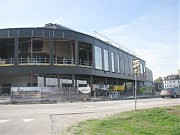
Today, the sports facilities on Suvorov Avenue – the “Portovik” sports complex, the same tennis courts – have been converted into leisure centers, or have disappeared altogether. But in Karlskrona, a city of Izmail’s scale, next to the ice arena, I saw functioning tennis courts, and closer to the sea – a new Sports Palace under construction.
Young acquaintances from Kyiv skied in Bukovel last year, but this winter they went to Georgia. And they didn’t regret it: it’s cheaper, more beautiful, and calmer there (in terms of less crowding than at the hyped-up – if not ripped-off – Carpathian resort). Ukraine has bet not on the development of sports and the health of its citizens, but on extracting maximum profit from its natural and human resources. As a result, there is neither sport nor recreation for the ordinary citizen. And, of course, no Olympic medals.











