

The fate of this army is peculiar and changeable. Many pages of its biography are not fully clarified and require many years of additional archival research. At the very first attempts to conduct them, an annoying thought comes to mind: was the history of the Bug Cossacks deliberately ruined?
Hussars and Uhlans, Balkan settlers became at different times. But one thing is clear – people from the Balkans in various guises, at all times, walked alongside Ukrainians on the thorny road of glory and persecution.
To be fair, it must be said that foreigners, along with Bulgarians of “Odessa settlement,” constituted about a third of the personnel in the Bug Cossack Army. Such a foreign proportion had existed since the times of the Zaporozhian Cossacks.
For those who mistakenly believe that only a few “lost Bulgarians” participated in the war with the “insolent Corsican” Napoleon, I will remind you that after the disbandment of the Yekaterinoslav Cossack Army, the Bug Horse Cossack Regiment, as well as people from the South Slavic lands living on the Bug lands, were united into one army, which by the beginning of that war had three Cossack regiments.
“Drove and Chased”
Perhaps the only one named in the history of the Bug Cossacks was the brave Karp Molchanyuk, who saved the horse of the dashing Polish hussar, the chief of artillery of the 2nd Western Army, Major General K. Levenstern, from under the hooves. This happened near the village of Borodino.
It is noteworthy that a few days before the battle, the general, inspired by the heroism of the battles, wrote a pathetic order with his own hand: “Whoever saves the life of his officer during the battle, repelling a blow threatening him, or frees him from the enemy’s hands… is worthy of being awarded the sign of distinction of the military order.”
The second name, which allows proving the fact that the Bug Cossacks of “Odessa settlement” from the moment of their army’s foundation participated most directly in all campaigns against the Ottomans, Poles, and the “treacherous usurper,” is preserved in the military memoirs of that time. The Bug Cossacks even managed to track down and capture a carriage stuffed with manuscripts and papers from Napoleon’s topographical cabinet, still bearing the fingerprints of the “Corsican monster.”
And this is far from the only mention of the Bug Army itself in the chronicles of that war. The Bug Cossacks rode to the Netherlands and Paris, which, fortunately, is documented, inspiring a Dutch artist to create the painting “Cossacks Liberate a City.”
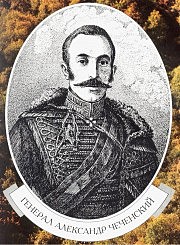
Interestingly, in the letters of General Benkendorf, later chief of gendarmes, to the future governor of New Russia, Prince Vorontsov, there are frequent mentions of the valiant commander Chechensky. Very often, in his reports to the very top, cavalry general Baron Ferdinand Wintzingerode also recalls the hot descendant of the mountaineers. Here is one of the interesting and telling details of that war: “On the 5th in the morning, I ordered the enemy to be driven out of Taukhi, which Colonel Chechensky carried out with the 2nd Bug Regiment, taking more than 400 prisoners.”
Alexander Chechensky, a commander of “boundless enterprise, quick-wittedness, and instantaneous decisiveness,” repeatedly burst into the history of that war, and after him, the Bug Cossacks subordinate to him. Without this vivid personality, who also had a light pen, we would never have known about the martial deeds of the Bug Cossacks during that war.
Moreover, by the end of the war, the commanding ataman Platov committed an official crime, having completely lost the nominal lists of the Bug regiments. And it’s not surprising. The dashing Don ataman was known as an unrestrained reveler and did not deny himself the pleasure of “partisaning” not only on the battlefield but also during endless feasts. As a result, Platov became the only general who, for obvious reasons, was not even awarded the most ordinary commemorative medal for Borodino.
Another matter is Chechensky. “To drive and chase” is what the one who fought in the hussar and Cossack units was very good at doing at all times. Denis Davydov left the most vivid verbal portrait of the combat officer Alexander Chechensky: “Small in stature, lean, aquiline-nosed, with a bronze complexion, hair as black as a raven’s wing, with an eagle’s gaze. A fierce, hot-tempered, and indomitable character; an open friend or foe; of boundless enterprise, quick-wittedness, and instantaneous decisiveness.”
Little is known about the actions of the other two Bug regiments, commanded by majors Kasperov and Nemtso-Petrovsky, possibly because their commanders did not possess the epistolary genre? But it is not for nothing that the suburbs of Taganrog and Novaya Odessa are named after Kasperov, Kasperovka?
“An Open Friend or Foe”
The raids of the Bug Cossacks against the French are sometimes mistakenly called a classic example of partisan warfare, “Asian tactics.” All this is due to the desire to paint a more colorful picture of Alexander Chechensky, and probably also because all the Bug regiments were subordinate to the poet and partisan Denis Davydov, who was also under ataman Platov.
But the tactics of the Bug Cossacks, no matter how you look at it, are essentially the style of the Zaporozhian Cossacks. It is appropriate to recall here that the Bug Cossacks, in the Cossack fashion, never wore beards and were distinguished by good discipline. Well, as for tactics, they could act in small groups and were excellent at navigating the terrain.
At the beginning of the battle, they always acted as “skirmishers,” luring the enemy deeper into their defenses. Such methods are all from the Cossack arsenal. Flying detachments, sharing Chechensky’s daring, made surprise raids into the enemy’s rear and, with their maneuvers, confused the French, forcing them to choose between dying or fleeing.
The following case is also known. Chechensky and his loyal Cossacks, cleverly using military cunning, captured the Saxon Neustadt on the way to Dresden. At night, on the pine-covered heights, setting up campfires, twenty per campsite, they caught the enemy. The French believed in the false number of troops and retreated in haste.
Interestingly, Chechensky’s command of the Bug Cossacks has a backstory. After the second Russo-Turkish War, Bulgarians who later broke with the Sultan would be settled “by Odessa settlement,” that is, between the Dniester and the Bug, and in the future, necessarily with the agreement of the Governor-Generals of New Russia, Richelieu, Langeron, Vorontsov, who alternately, according to their duties, combined the post of Cossack commanders with the governorship. As a result, the Bulgarians were settled in a chosen tract to their liking.
The settlers’ business acumen, having overcome both the unbearable summer heat and drought, soon materialized. They, the newcomers, were eager to make the semi-wild steppe resemble their beloved homeland. It is not by chance that the settlers gave one of the villages a self-explanatory name – Bolgarskaya.
It took eight difficult years for the wide valley, covered with floodplains and boundless meadows, to be covered with gardens and vegetable patches. As it turned out, these places, protected by a steep bank from cold northeastern winds, offer all the conveniences for growing fruit trees and protect from heat and drought in the summer. Large crosses, a legacy of the former owners of these steppes, standing at the crossroads, at wells, and in other prominent places, inspired them, the faithful people, with the hope that the evil year would still pass.
The Bulgarian Cossacks laid the foundations of local winemaking, were the first to cultivate walnuts, and bred a valuable gray breed of cattle, selling breeding stock at the Uman and Kherson fairs. A new variety of wheat, not afraid of droughts, “Arnavutovka,” was also cultivated here, from which the best French rolls in Russia (later called batons) were baked.
Achi-Kale Strengthens Its Walls Again
But soon rumors began to spread, later confirmed, about a new war, about the fact that the Ottomans were stirring again in the Ochakiv fortress, bringing builders from Moldova to strengthen the walls. Their countrymen, who had already settled in the Black Sea villages, were the first to learn about this.
Peaceful life suddenly ended. In 1788, a thousand-and-a-half Cossack regiment was urgently formed from Balkan settlers under the command of Pyotr Skarzhinsky, then still a lieutenant colonel. Continuous maneuvers, attacks, and raids through the steppes to secure the rear became a usual occupation for the Bug Cossacks. The regiment distinguished itself particularly during the storming of the Ochakiv fortress.
Skarzhinsky’s Cossacks, even without their wounded commander, played a key role in the capture of the Yeni-Dunya fortress.
And it is not for nothing that in 1832, in memory of past victories, the Bug Uhlan Division regiment, stationed in Fyodorovka, was renamed Odessa, and the settlement was urgently renamed Novaya Odessa.
A zigzag of luck and fate! It was then, near Achi-Kale, that Alexander Chechensky met the Bug Cossacks.
It is difficult to say whether the young cavalryman fought in their ranks or gained respect for their courage from the sidelines, but the fact remains that Chechensky himself went through the entire Potemkin War with honor. And, apparently, he chose the Bug Cossacks as his subordinates in the war against the usurper not for nothing. Moreover, he had the right to choose, if only as the adopted son of the most valiant General Nikolai Raevsky.
And this is not fiction. A Chechen boy who lost his parents during a military campaign in Chechnya was taken in for upbringing by a sixteen-year-old Russian second lieutenant. This second lieutenant was named Nikolai Raevsky, and he would later become a famous general.
While Nikolai Raevsky served in the troops, Alexander Chechensky was raised in Ukraine by Raevsky’s mother, Ekaterina Nikolaevna.
Throughout the battles, the Bug hussars were never satisfied with their military provisions as promised, with money earned for fodder and provisions.
The aging Empress learned about the unfair treatment of the Bulgarian hussars and, “in consideration of the diligent service of this regiment and the hardships endured,” most graciously ordered Prince Zubov, the governor of the Black Sea region, her last friend, to leave the regiment in service forever, to incorporate four thousand more horsemen into its ranks, bought by Prince Potemkin from various landowners.
The Empress’s order clearly defined the measures to bring the regiment’s staff into compliance with military regulations. The sovereign ordered the officers to be granted ranks, assigned them rank plots, and paid compensation in the amount of previously earned sums. The reason for such highest generosity remains only to be guessed.
Perhaps, in her old age, Catherine was troubled by the thought of the Zaporozhian Cossack freedom, unjustly dispersed by her whim?
Catherine might have remembered Grigory Potemkin’s stories about how, during the second Russo-Turkish War, the Bug Cossacks participated in the siege and storming of Ochakiv (many of them died during the storming, and a memorial plaque with a list of the fallen could be seen in the diorama museum of the storming in the early 70s), repelled the Turkish landing on the Kinburn Spit, distinguished themselves near Bender, Akkerman, and Kiliya.
In the winter of 1790, in twenty-degree frosts, armed only with pikes, the Bug Cossacks overcame the fortress walls of Izmail, earning Suvorov’s gratitude.
That disappeared memorial plaque hardly clarifies the structure of the Bug Cossacks, but it gives some idea of it. After all, the text inscribed on this historical tablet has, fortunately, been preserved. “12 Bug Cossacks died in this battle. Confessional registers of 1787 and 1789 allow us to restore their names: Dmitry Urum, Christopher Voynov, Grigory Zgorily, Dmitry Kolvakh, and Georgy Tryanov from the village of Sokoli, Daniil Voloshin from the village of Fedorovka, Ivan Girinsky, Stefan Shcherbina, Ivan Oleynik, Feodosiy Ovchenko from the town of Novopetrovskoye, Yakov Novak from the village of Kasperovka, and Pyotr Sitnik from the village of Gurievka.”
The highest consent of the Empress prescribed full freedom for the Bug Cossacks: if you want, work in the field, and if not, perform guard duty. And vast lands were granted – all that “lies vacant between the Bug and the Ingul”!
Probably, everything would have happened that way, but Catherine died suddenly, and all her good intentions remained on paper.
The situation of the settlers was exacerbated by the new heir to the throne with his passion to destroy everything “acquired” by his august mother.
The heir ordered the Bug Cossack regiment to be disbanded without unnecessary official decisions. And without long explanations on this matter.
The new geopolitical situation led to the fact that no one was concerned about the fate of the borders, let alone the people left without support.
Moreover, rumors soon began to spread that all former hussars, without exception, were threatened with enslavement. Newly made landowners from former officers caught wandering people in the southern steppes and forcibly settled them on their estates.
The main thing for the Bug Cossacks was service in the army. And it was precisely through diligent service, blood, and sweat that the Bug Cossacks earned their right to the privileges of their position, diligently defending the border and their own homes.
Everything was forgotten at once! And first of all, the promise to grant the Bug Cossacks from Bulgarians and Moldavians the right to increase their estate with people of their own kind living abroad. Previously, by maintaining a guard along the Dniester, they had such an opportunity.
But the tribulations of all the Bug Cossacks did not end there. Someone whispered in the ear of the young, capricious emperor the best way to enslave the Cossacks of the Bug region – military settlements.
Behind the outward brilliance and prosperity of the military settlements, arranged in the German style, lay an openly sweatshop system, meticulous accounting of every step of the settlers. They were tormented by constant inspections and self-reports on their own well-being.
Fortunately, the new emperor Alexander II, upon ascending the throne, freed from bondage and conscription, among the first, the military settlers, who were utterly exhausted by conscription and hard labor under the supervision of excessively strict overseers.











