

This is roughly how we formulated the topic of our conversation with young teachers from Odessa educational institutions, which took place at the municipal institution “Odesa Center for Professional Development of Pedagogical Workers.”
The meeting place was suggested by a great friend of the newspaper, an expert in our publications on education and upbringing, Serhiy Penyaev, a consultant at “OCPDPR.” He also invited teachers for the conversation, whom he admitted to “watching for a long time” and finding them promising, knowledgeable, and responsible in their profession.
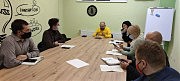
So, in a conversation about modern school and the modern teacher, the participants were Illia Luchynskyi, a history and civic education teacher at school №43, Kostiantyn Holoborodov, a history and civic education teacher at school №56, and Anastasiia Kosareva, a civic education teacher at the law lyceum, deputy director for educational work. Consultants from the Municipal Institution “OCPDPR,” Serhiy Volkovskyi and Anna Asmanska, helped us conduct the meeting.
Partnerships Foster Successful Communication
Despite their relatively short pedagogical experience, the participants in our conversation were able to formulate their own recipe for working with modern children. And they gladly shared it.
— This is my fourth year working at school, and I’ve actually used many approaches in working with children, — shares Kostiantyn Holoborodov. — The main thing is that I didn’t want to be like the teachers from my school days, with an authoritarian model of behavior. Today, the authoritarian model is the worst way to structure work; it won’t work at all anymore. Therefore, I use a model of cooperation with students. I am not some strict teacher for them, whose word should be considered final. I am, first and foremost, an older friend who helps pave the way to the land of knowledge. In my lessons, the most important thing for me is that children are not afraid to express their own thoughts, whatever they may be. And I try to find the closest approximation to the correct answer in their responses, thereby creating a situation of success for each student, which, according to the concept of the New Ukrainian School, is one of the main ones. And also—today, a teacher needs to compete with gadgets, to be able to integrate material into a digital platform. It’s impossible to imagine a modern student without gadgets…
— The modern generation is a digital generation that is constantly in the public space, — continues Anastasiia Kosareva. — To work with such children, you need to interest them. They are constantly searching. Gadgets have formed this habit in them. They have a low level of empathy, the ability to conduct a live dialogue, and recognize gestures. Visual material—illustrations, photos, videos, films—influences them the most. Therefore, material should be presented using visualization, concisely, without long lectures. Considering that children are reluctant to turn to textbooks, we need to adapt and direct them to search for material on the internet.
According to Anastasiia Kosareva, teachers need to constantly engage in creative search, develop, and stay informed about existing opportunities. Modern children need to be taught to understand their own and others’ feelings, to pay attention to the complexity and uniqueness of personality.
Illia Luchynskyi shared: in his pedagogical practice, he is a supporter of partnership relations with students and is confident that this is the path to successful communication with modern children. “I am a student’s assistant in acquiring knowledge, and I need to experiment, not scold gadgets as many do, but use various applications, combine them with different teaching methods,” he says.
How to Discuss Difficult Topics?
Are there forbidden topics in school, what can be discussed, and what cannot? The participants in the conversation generally agreed that there are no forbidden topics, but there are topics that children cannot understand and accept due to their level of development, knowledge base, life experience, ultimately. What should a teacher do?
Anastasiia Kosareva’s opinion:
— If a child asks a question, they have the right to receive a truthful answer. And you cannot redirect them to someone else if they came to you with this question. This means they want to get the answer from you. In this situation, the teacher becomes a connecting link, helping the child to sort out their feelings, make the right life choice, and be happy. If they know how to behave in extreme situations, they will feel confident. We need to foster trust in the police and security services as institutions that can protect.
There are difficult and even terrible things that need to be explained to students, especially history teachers. Genocide, Holodomor, Holocaust…
— Nothing can be taboo if it does not contradict the Constitution and Laws of Ukraine, — believes Illia Luchynskyi. — Pedagogical workers today have broad opportunities to explore emotionally complex historical topics. Teachers can be aided by the activities of various international, state, and public organizations, video materials, posters, infographics, articles, and lesson plans tailored to age-specific characteristics.
Our national historical calendar is filled with tragic themes that must be discussed with children; complex topics should be minimized, broken down into simple components, and, if possible, shown in real life. I conduct educational hours with students from the 2nd to the 11th grade, and I know that in primary school, it’s important not to scare them, to end the explanation on positive aspects, heroic stories, to show that people remain human even in difficult conditions. It’s easier in high school, but one must still remember that they are still children. You can talk to them openly about tragedy, explain it without embellishment, but the main thing is to analyze the causes and consequences of this phenomenon. Of course, emphasize that this should never happen again.
Patriotism is Not Taught, Patriotism is Cultivated
— I cultivate through my own experience and example, through love for the Ukrainian word, films, songs, heroic stories, — shares Kostiantyn Holoborodov. — Work on fostering patriotic feelings should be ongoing, and this process should be a common goal for the entire school so as not to contradict each other. This is the responsibility zone of the entire pedagogical team, not just the history teacher.
Not only at school but also at home, it is important to continue forming national identity, clarifies Anastasiia Kosareva. In her opinion, patriotism should be cultivated without coercion, unnecessary slogans, and constant speculation on nationality. Only then can we talk about forming civic consciousness, which is based on common values and readiness to take responsibility. Patriotism is one of them.
Distance Education—Evil or Good?
While talking with the teachers, we couldn’t help but ask how they feel about this forced form of work, what advantages and disadvantages they note.
— The problems of modern education—digitalization and the pandemic—became the factor that accelerated this process, — said Illia Luchynskyi. — The transition to distance education stimulated teachers to master new and improve existing methods and forms of teaching. However, the limitations of technical equipment, both for teachers and students, motivation, and emotional burnout are challenges that arise in the context of distance learning.
Anastasiia Kosareva listed the advantages of “distance learning”: mobility, the ability to choose one’s own pace of learning, unlimited timeframes, reaching a large audience, and access to various learning tools with minimal financial resources. But she also noted the disadvantages, including incomplete socialization, motivation for working independently, and quality…
— In fact, distance education is a horror! — exclaims Kostiantyn Holoborodov. — Both for children and for teachers. From morning till night, I’m in front of the computer—conducting lessons, preparing new ones, checking assignments… But in the situation we all find ourselves in, distance learning is a way out. Yes, it’s difficult, but new circumstances also bring new opportunities. For example, in an online format, we can visit any museum in Ukraine and the world with students, communicate with interesting people. Therefore, “distance learning” is not entirely evil. But it should not be abused…











