

As it was said in a famous novel, be careful what you wish for – it might just come true.
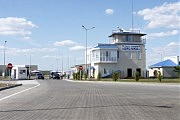
When “Vechernaya Odessa” covered the opening of the ferry crossing across the Danube between Orlovka, Ukraine, and Isaccea, Romania, last summer (issue dated August 13, 2020), the thought immediately arose to see “another life and a distant shore” now that such a wonderful opportunity had appeared. To personally verify the colossal opportunities that, thanks to the crossing, are now opening up for cooperation between the communities of the Odesa region and the counties of Romania, for the development of friendly relations between people living on both banks of the Danube. And simply for travel, because from now on, the road to Europe became pleasant and unburdensome, without the tedious double crossing of the Moldovan border.
Unfortunately, quarantine intervened. And the ferry crossing only started operating at full capacity in the spring of this year, beginning to accept not only heavy trucks but also buses, cars, motorcycles, and bicycles, as well as travelers who prefer to explore the world on foot.
Nevertheless, summing up the results of the “People of Action” competition for 2020, the jury unanimously supported the proposal of the newspaper’s creative team to name Yuriy Dimchoglo – a deputy of the Odesa Regional Council, the founder and benefactor of the Orlovka-Isaccea ferry complex – as one of the laureates. After all, the potential of the new infrastructure facility, even under quarantine restrictions, was striking in the scale of the opportunities it opened up. And it was clear that as soon as the borders opened, intensive movement would begin – in both directions.
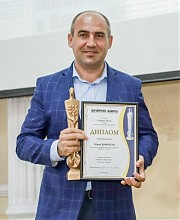
And so, at the solemn award ceremony for the “People of Action” competition laureates, which took place on the birthday of “Vechernaya Odessa” (report on the celebration in the issue dated July 8), Yuriy Dimchoglo, upon receiving the “Gardener” statuette, unexpectedly proposed: isn’t it time for regional journalists, and primarily for “Vecherniyka” staff, to go on a press tour? You wanted to see how important the crossing is for cross-border cooperation, right? So, let’s go! This is how last year’s idea took concrete shape.
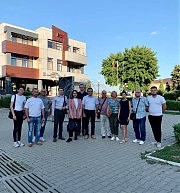
So, from August 13 to 15, journalists from various Odesa media outlets, with the participation of representatives from the Department of Investment and Foreign Economic Activity, International Cooperation, and Tourism of the Odesa Regional State Administration, embarked on a press tour with the task of highlighting the specifics of cooperation between the communities of the Odesa region and the Romanian counties bordering the Danube, within the framework of European projects.
Three days of an intensive program included a visit to Izmail and a meeting with Mayor Andriy Abramchenko, familiarization with the Orlovka-Isaccea ferry complex, crossing the Danube, a meeting with the Mayor of Isaccea, participation in the conference “Green Tourism and Historical Heritage – Steps for the Development of the Black Sea Basin” in the city of Galati, and a visit to a festival in honor of the port day of the city of Macin.
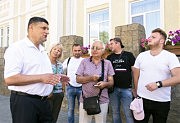
And meetings, meetings, meetings… In order to get answers to two main questions. How has the crossing changed life on this and the other bank? And what hopes do the regions of neighboring countries place on it, what prospects do they see?
Andriy Abramchenko: “We are already short of hotel rooms for tourists”
On the way to Orlovka, we stop in Izmail. In a neat, green, and well-maintained city, we have a meeting with Mayor Andriy Abramchenko and his team. The topic of conversation was formulated in advance: implemented and planned international projects and their impact on the development of Izmail and the Izmail district.
As the city mayor told the journalists, since the ferry complex began operating, the flow of tourists – both Ukrainian and foreign – has significantly increased. We already have to think about additional hotel rooms – there are clearly not enough, and it is estimated that about 1,500 places are needed.
“Mainly, Ukrainian tourists come to the city, stay in hotels, and plan their further journey to Europe, adjusting to the ferry schedule. But we expect to attract more tourists from the Romanian side,” said Andriy Abramchenko.
To achieve this goal, the Izmail authorities have joined a project within the framework of the European cross-border cooperation program “Romania – Ukraine” – “CBConect-Trans – Development of Intermodal Cross-Border Communication along the Isaccea – Orlovka – Izmail – Tulcea Route.” The project’s goal is to restore regular passenger service between Izmail and Tulcea, as well as to create additional conditions for the passage of international cargo and vehicles of the RO-RO type Isaccea-Orlovka. The project implementation period is 24 months, with a total budget of 2 million euros, of which 861 thousand euros are from the budget of the Izmail City Council Executive Committee and the Izmail District.
“According to the project, we, as partners, need to build a modern marina for small vessels with approximately 12 berths (a parking space is already allocated), repair the road to the sea terminal with parking facilities, and purchase 2 passenger vessels, one with 30 seats and the second with 10,” said Andriy Abramchenko.
The mayor shared his concern: currently, the project is threatened by the changed status of another partner – the village council of Orlovka, which had undertaken to co-finance the construction of the road from the village to the crossing. Now Orlovka has become part of the Reni ОТГ, and they are in no hurry to make a decision…
Obligation, consistency, and continuity are very important when participating in international programs, the mayor noted, and those who violate immutable rules risk finding themselves on the sidelines later, outside of promising programs. And Izmail is an active partner in European funding programs, such as the Joint Operational Programs “Black Sea Basin 2014-2020” and “Romania-Ukraine 2014-2020.” Within the framework of these programs, 7 projects with different priorities are being implemented in the city – healthcare, environmental protection and prevention of man-made disasters, revival of cultural heritage, fight against organized crime, development of land and sea transport links.
A Journey We Didn’t Notice
In a publication from a year ago, one of the main points of the story about the new infrastructure project was the speed of crossing the Danube. Seven minutes – and you are in Romania. We checked. Seven minutes or not, but we definitely made it in ten. Of course, this does not include customs and border control, as well as the time needed to purchase a ticket and load the vehicle onto the ferry.
That is why Vitaliy Nikula, Deputy General Director of Orlovka Ferry Complex LLC, during a blitz interview, pointed out that it is advisable to arrive at the vessel an hour before departure. And on weekends and holidays – an hour and a half. The ferry – there is only one for now, a Romanian one – makes seven trips a day; the schedule and tariffs are available on the company’s website. By the way, the prices of our neighbors are the same as ours; such price synchronization is fixed by a corresponding agreement.
The loaded ferry resembled Noah’s Ark. A little bit of everything – heavy trucks, minibuses, cars, motorcycles with Romanian, Ukrainian, Bulgarian, German, and other license plates. And the people on deck were multilingual. A fleeting acquaintance for 10 minutes – and you are already on the other bank, in another country.
In its year of operation, the ferry crossing has transported 33,000 various vehicles (16,000 left Ukraine, 17,000 entered) and 45,000 passengers. Currently, with quarantine eased, up to 250 vehicles use the ferry daily, and even more on weekends. True, the time for business development lost due to coronavirus restrictions cannot be regained. Nevertheless, Vitaliy Nikula remains optimistic. Orlovka Ferry Complex LLC intends to continuously expand its range of services. Upcoming plans include the construction of a gas station complex, a truck parking lot, and a hotel.
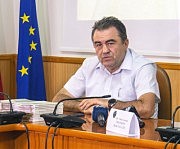
And Yuriy Dimchoglo shared strategic plans in one of his recent interviews: “We want to turn Orlovka not only into a ferry but also into a river port. That is, so that small vessels can also dock, including foreign ones. And passengers from Ukraine can travel along the Danube to other countries. In fact, it will be a river station. Today, the hydraulic structures are designed only for ferries, so we need to build a separate pier. We are currently developing a feasibility study, and then we will understand the required investment volume.”
Anastase Moraru: “In five years, thanks to the crossing, we will see Isaccea flourish”
After docking on the Romanian bank, we set off to meet the mayor of Isaccea, Anastase Moraru. He is eager to tell the visiting journalists about the 700-year-old city in the northern part of Dobruja. About the preserved Turkish mosque, which the Turkish government is restoring, about the bead of Saint George, whose preservation the European Union is concerned about and has allocated funds to preserve the architectural monument for posterity.
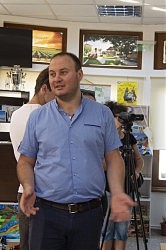
“Isaccea is far from the tourist flow, which is increasingly concentrated in Tulcea, in the Danube Delta,” says Anastase Moraru. “But with the opening of the Orlovka-Isaccea crossing, I am sure the city will become much more attractive to tourists. Moreover, a bridge is being built across the Danube between the city of Braila and the Dobrujan coast – this will also play a role. After all, there are many monasteries in the northern part of Dobruja, the Macin Mountains are interesting, and the Macin winery will attract visitors to our region. We want tourists to spend their weekends with us. There are three guesthouses in Isaccea, and hotels are located near the city.”
As the mayor explained, from Isaccea, you can take a minibus to Tulcea, Galati, and from Tulcea to Bucharest and Constanta. There are plans to establish direct service between Isaccea and Constanta.

Speaking about the ferry crossing, Anastase Moraru noted: “The project was difficult to achieve, the pandemic… I am grateful to Yuriy Dimchoglo, who was the soul of the project, and I am glad to have the honor of knowing him.” Currently, a Romanian ferry operates at the crossing, but, the mayor of Isaccea is confident, the Ukrainian side will also acquire a ferry next year. And two ferries mean even more opportunities. “Economically, Isaccea is not very strong, but the crossing will change the situation. In five years, we will see the city flourish,” said Anastase Moraru.
As we have already heard in Izmail, Isaccea is also participating in the “CBConect-Trans – Development of Intermodal Cross-Border Communication along the Isaccea – Orlovka – Izmail – Tulcea Route” project, and the Isaccea mayor’s office is the main partner in this project. In total, 30 EU projects worth 50 million euros are being implemented in the city.

In the hospitable city, we were treated to baklava and Dobrujan placinta. We took a souvenir photo and heard from Anastase Moraru at parting: “We are glad to see you, as you have come from a friendly country.”
Sergey Captalan: “We have a bicycle. We need to learn how to ride it.”
On the evening of the first day of the press tour, after visiting Isaccea, we headed to Galati. To participate the next day in the conference “Green Tourism and Historical Heritage – Steps for the Development of the Black Sea Basin.” It is noteworthy that the event took place on August 14. On this day, in 1998, during a meeting of the heads of border regions, an agreement was signed to establish the Euroregion “Lower Danube.” Recall that it includes the entire Odesa region, three counties of Romania – Galati, Tulcea, and Braila, and two districts from Moldova – Cahul and Cantemir.
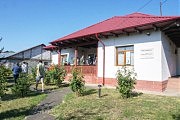
So, the conference turned out to be multifaceted – we discussed current cross-border cooperation matters, summarized the results of 23 years of work, and outlined plans for the future.
We asked Sergey Captalan, Director of the Cross-Border Cooperation Agency “Euroregion Lower Danube,” to comment on the event. He reminded us that the Agency is a specialized organization of the Odesa Regional Council, established in 2004 to develop cross-border cooperation. The Agency also attracts investments and donor aid. Sergey Captalan has headed the Agency for only a year. And at a recent session of the regional council, which took place after our return from Romania, deputies voted to conclude a contract with him for another five years.
“Decentralization opens broad prospects for cross-border cooperation, as ОТГ, as an administrative-territorial entity, is familiar to our international partners,” asserts Sergey Captalan. “All communities have the opportunity to attract funds from European funds for their development, as projects cover areas such as infrastructure, environmental protection, economic and social development, cross-border cooperation, tourism, healthcare, emergency situations, culture, etc. Unfortunately, the potential of the Euroregion is still very poorly utilized. For example, under the “Ukraine – Romania 2014-2020″ program, only 5 million euros were attracted out of the 60 million allocated. A similar situation exists with the Black Sea Basin Program, also funded by the European Union. 54 million euros were planned for allocation, and just over 3 million were attracted. What does this indicate? That local authorities, communities, have a poor understanding of the opportunities that cross-border cooperation opens up for them.”
Sergey Captalan sees the task of the Cross-Border Cooperation Agency “Euroregion Lower Danube” as disseminating information about European projects, understanding them, coordinating them, helping to write applications, and preparing all necessary reporting. “We have a bicycle, so let’s learn to ride it,” he commented figuratively on the emerging opportunities. For example, under the “Ukraine – Romania – 2021-2027” program, which is currently being prepared, a fund for various projects is planned in the amount of 80 million euros. You must agree, there is something to fight for. And to solve problems that hinder the development of a territorial community or a specific settlement, which do not have sufficient funds in their own budget.
Maximum cooperation with territorial communities and local authorities to attract investment and international donor funds to the Odesa region – this is the task that Sergey Captalan and his team set for themselves for the next five years.
This directive finds full understanding and support at the regional leadership level, from the Chairman of the Odesa Regional State Administration, Sergey Grinevetsky, who, during his first gubernatorial term, imbued cross-border cooperation with strategic meaning, and the Chairman of the Regional Council, Hryhoriy Didenko.
Sergey Captalan actively involves his like-minded colleagues from academia, as he, a candidate of economic sciences, teaches at the Odesa National Economic University, is a co-author of a startup training program, and involves talented students in working in the field of cross-border cooperation.
In general, territorial communities – wake up!
Wine, the Virgin Mary, and Navy Day
The three-day trip turned out to be extremely eventful. In addition to the official program, many interesting things awaited us. This included a visit to a traditional Romanian peasant dwelling (in our Frumushika-Nova, Bessarabian life is represented more broadly), and the house-museum of writer Hortensia Păbădat-Bengescu (these objects were restored using EU project funds), and the Roma quarter in Ivești (much will be forgotten over time, but not this ornate architecture), and meeting the colorful Ananie Ivanov – a Romanian Cossack of the fifth generation, whose ancestors settled on the banks of the Danube long ago.
And a surprise was a visit to Macin. This town in Tulcea County, Dobruja region, was once the scene of fierce battles during the Russo-Turkish wars of the 18th-19th centuries. According to history, it changed hands at least seven times. Moreover, in the 1791 campaign, the Danube flotilla under the command of Lieutenant General O. M. de Ribas, the future founder of Odesa, took an active part.
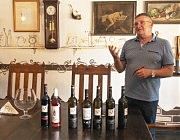
After familiarizing ourselves with the rich history of the region at the Tourism Center, we headed to a winery run by Sergey, a native of Minsk. How stereotypes are broken! What kind of wine could a Belarusian make? Well, he can! And of excellent quality, as we were able to verify at the tasting. It was nice on a hot day to sit in a cool room at a rich table, sipping delicious local wine – a pleasant way to relax after a busy program. To be honest, we didn’t want to leave, but, as they say, it was time to go. However, how could we leave without visiting the company store? We visited. And although we were being hurried along, we parted with regret. And in vain.
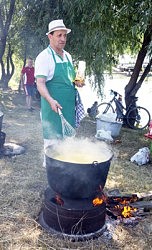
It turned out that our arrival coincided with the celebration by Orthodox Christians in Romania of the Dormition of the Most Holy Theotokos and the country’s Navy Day. Therefore, after attending a prayer service, half the city, led by clergy, moved to the Danube bank, where delicious fish soup was being prepared in numerous cauldrons, and Danube herring was sizzling on a grill over a fire. People were celebrating. There wasn’t enough space at the tables – no problem: people sat comfortably on the grass and by the water. From there, it was easier to watch the festive fireworks.
We also had a good time. Hearty fish soup, delicious fish, spicy mamalyga, sweet peppers and their hot “relatives,” fragrant herbs, and, of course, wine (beer for those who prefer it), and most importantly, the hospitality of the hosts – everything lifted our spirits.
Without straying too far from the topic of our press tour, we asked Macin Mayor Gheorghe Vacaru if the city participates in European programs. It turned out that Macin is one of the partners in the large-scale project “Cross-border Health Infrastructure” together with the Tulcea County Council (Romania), the Danube Regional Hospital (Ukraine), the Izmail City Council Executive Committee of the Izmail District of the Odesa Region (Ukraine), and the Cross-Border Cooperation Agency “Euroregion Lower Danube” (Romania). The project implementation period is 36 months, and its main goal is to support the development of healthcare services and access to medical care in the border zone of Romania and Ukraine. Macin has fulfilled its project obligations – hospital renovation, organization of telemedicine – by 99%.
…The return journey passed unnoticed. We were overwhelmed with impressions. Thanks to the trip, we also got acquainted with the non-touristy side of Romania.
Galati, where the main office of the Cross-Border Cooperation Association “Euroregion Lower Danube” is located, the hospitable Isaccea and Macin. It’s a pity we didn’t make it to Tulcea. Nothing, it’s all still ahead.











