

Continuation. See here for the full story.
2012, London
Once again, Yuriy Cheban and Vasyl Lomachenko are among the laureates. The boxer, it’s true, represented Kyiv in England, but we know that he is still ours, from Akkerman. Cheban, having switched from the 500-meter distance, where he won bronze four years ago, to the sprint, gave his rivals no chance at all. And the bronze medal of the weightlifter from Chernomorsk, Yuliya Paratova, was a pleasant surprise.
Yuriy was brought to the rowing section by his mother at the age of 14 (Lyudmyla Cheban, née Loshchytska, was a student of the honored USSR coach Hennadiy Dyachenko in her youth). At one time, she was considered the heir to the glory of Olympic champion Yuliya Ryabchinskaya, but it didn’t work out. Her son settled the score with fate for his mother.
“In 2001, Zhenya Lesyak handed over a whole group of children to me, among whom was Yura Cheban,” recalls Vyacheslav Sorokin, the coach of the two-time Olympic champion. “True, some colleagues took his decision badly – why him specifically? But Lesyak stood his ground: ‘I worked with Sorokin and will continue to work with him.’ It was Yevheniy who got him on his knees; before that, he rowed in a kayak.”
Three years later, Yuriy became the silver medalist of the Junior World Championship. Before the 2004 Athens Olympics, he won the Ukrainian Cup at the 500-meter distance, was fifth at the European Championship, thus securing an Olympic license.
“We were not sent to the competitions where the tickets to Athens were being awarded,” Sorokin said about the “undercurrents.” “They said he was too young. As a result, the Odesa Port Plant sent us to Poland outside the team. And Yura proved all the ill-wishers wrong by winning the license. It didn’t work out in Athens, though. It’s a shame, of course, but we avoided the “star sickness.” Who knows how it would have turned out if he had shone at his very first Olympics? But we moved gradually: in 2004 – participation, in 2008 – bronze, in 2012 and 2016 – gold.”

In Beijing, he snatched bronze thanks to a phenomenal finishing sprint. He was a bit slow off the mark at the start of the 500-meter distance and had to catch up. Just before the finish, he made such a powerful surge that his canoe even capsized.
“When we decided to focus on the sprint,” V. Sorokin continued his reminiscences, “Yura told me: ‘Mikhalych, what’s 200 meters? I’ll blast through it with brute force!’ I replied: ‘Are you crazy?'”
— You have a cheerful student.
— Of course! He’s from Deribasivska Street, 1.
— So, what’s the specificity of sprinting?
— 200 meters is the start and the finish, that’s all! So we practiced that. I always have reasons to be dissatisfied. He also has complaints: ‘Mikhalych, how much longer? I’m not doing this right, and that’s not right either.’ But the races on the British Dorney Lake showed: we are doing everything RIGHT.
Cheban started powerfully, and with each stroke, he increased his lead. 42.29 seconds, from start to finish of the 200-meter distance, became the winning, golden time.
Vyacheslav Mykhailovych Sorokin, Honored Coach of Ukraine, Moldova, and the USSR, laureate of the “Večernaya Odessa” “People of Action” competition, passed away at the age of 79. When asked about his future plans, he chuckled: “Yurka has a son growing up, so the prospects are promising.” The most titled Ukrainian rowing coach, Sorokin, was awarded the Orders of Merit, 2nd and 3rd degrees. Until his last days, Vyacheslav Mykhailovych continued to work with the national team, training canoeists. Sorokin often repeated: “It’s not easy to find a ‘golden fish’.” He knew how to recognize one.
His student, Yuriy Cheban, now heads the national kayak and canoe team.
THE FIRST QUESTION asked to Yuliya Paratova at one of the press conferences was not entirely usual: “Tell me, haven’t you done rhythmic gymnastics?” The piquancy of the question lay in the fact that the weightlifter, accustomed to dealing not with ribbons and clubs, but with weights of 100 kilograms and more, was being honored.
“I was born and grew up in the village of Nova Dolyna in the Odesa region. I remember watching the boys who were into weightlifting. I really liked this sport. At 15, girlish curiosity got the better of me, and I decided to join a sports section,” Yuliya recounted her first steps in sports.
She started under the guidance of Dmytro Staroshchuk. Then the famous Yuriy Kuchinov took her under his wing. Her first major success came in 2011 when she won a silver medal at the World Championships. Back then, in Kazan, she competed in the weight category up to 58 kg. To go to London, she had to lose weight to 53 kg.
Athletes know what weight loss is. In England, she felt she was not in her best form. Nevertheless, she managed to lift 91 kilograms and then push 108 kilograms. The total of 199 kg was fifth, not too bad, considering she outranked more than thirty competitors. But she wanted more.
However, fate fully rewarded the girl from Chernomorsk for her hard training and belief in victory. In August 2016, it became known that due to the disqualification of Kazakhstani Zulfiya Chinshanlo and Romanian Cristina Iovu (holders of first and third place, respectively), Paratova was awarded the bronze medal of the 2012 Olympic Games.
After the London Games, Paratova won gold at the European Championships twice – in Tirana in 2013 and in Tbilisi in 2015. She graduated from the Odesa National Law Academy, with a degree in International Law and Legal Journalism. She is involved in coaching at her native sports school in Nova Dolyna.
2016, Rio de Janeiro
Once again, the phenomenal Yuriy Cheban is in the spotlight. However, the first medal for the Odesa region was brought by sabre fencer Olena Kravatska.
SHE STARTED FENCING under the guidance of Serhiy Boryachynsky. Then the Honored Coach of Ukraine, Oleksandr Vasyutin, started working with her. In the national team, Harnik Davydyan took care of her.
Her first significant success came in 2010 when the Odesa native won a silver medal at the Junior European Championships and, in the same year, a gold medal at the Junior World Championships as part of the team. In the 2014/15 season, Kravatska made her World Cup debut, where she won a bronze medal. In June 2015, at the first European Games in Baku, the sabre fencing team – Olha Kharlan, Olena Kravatska, and Alina Komashchuk – won a gold medal, defeating the Italians 45:43 in the final.
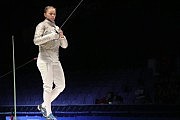
The same glorious trio, plus Olena Voronina, competed at the Rio de Janeiro Olympics. In the quarterfinals, the Ukrainian women defeated the South Korean team, and in the semifinals, the Italian team. In the final, the Russians proved stronger, and our girls were awarded silver medals.
Olena Kravatska is awarded the Order of Princess Olga, III degree, and the jubilee medal “25 Years of Independence of Ukraine.” After giving birth, she returned to the national team and continues to compete for the highest places in world fencing.
IF IN LONDON CHEBAN immediately took the lead and gave his rivals no chance, then four years later in Rio de Janeiro, things were different.
At the 2015 World Championship qualifiers, Yuriy took 9th place, and he needed to be in the top eight. He drank something before the start and couldn’t sleep. He rowed as if in slow motion. The management of the Odesa team had already “written him off” – Sorokin, they said, was past his prime, and Cheban had exhausted himself, spent all his energy. He had to go to Duisburg, and then to Račice, for a license. But then Oceania refused, and the license automatically went to Ukraine. Who would go to Brazil? Yura won the Ukrainian Cup, then beat his competitor Maksymchuk in two consecutive World Cup stages. What other questions were there? No, they forced him to participate in a fourth race. And this was an additional psychological burden.
Vyacheslav Sorokin’s words:
“It seemed that the head coach Motov would have been happy with his defeat, paradoxically. After all, it was he who claimed that Cheban had exhausted himself. ‘Exhausted,’ what a word! And when the judges at the Rio Olympics made a mistake and sent Cheban to Final B, where places starting from ninth are contested, Motov didn’t lift a finger to defend the athlete. Yura himself, along with coach Zhelyayev, went to sort it out. And then the head coach started lying: ‘I sorted everything out.'”
“We arrived in Rio on July 31st,” Sorokin continued. “Two days were spent on acclimatization. On August 2nd, we went on the water. And at that time, the ‘academics’ were training and competing there. The training distance was 300 meters. And I stood there like a buoy, not seeing anything. Rowing, especially long-distance, is quite monotonous; you can fall asleep during such work. Therefore, the coach must control every stroke. Usually, a boat or a bicycle is used. That’s how it was in London; I wasn’t worried about technique there. But in Rio, the anxiety was very high. I looked, and something was wrong: from the outside, it seemed everything was normal, but during the process, it wasn’t. I didn’t sleep for two nights, tormented, thinking. Fortunately, we figured it out: it was just a delay in the stroke, and that was all. We corrected the technique before the final, and during the warm-up, I realized: everything was back in place.”
— Cheban himself acknowledged the victory in Brazil as the most important in his career.
— He was in such a competitive fury that he left his rivals no hope from the very first stroke. He shot off the start like a catapult. Not everyone can do that; he feels: the command is about to be given, and whoosh! His rivals hadn’t even all touched the water yet, and he was already gone. What can I say, a true leader!
The honored master of sports Yuriy Cheban now confirms his leadership as the head coach of the Ukrainian national team. He is a knight of the Orders “For Courage” III degree and “For Merit” III and II degrees. We believe that the first degree is not far off.
This is how brilliant the symbolic Olympic relay from Odesa turned out to be. We hope it will be continued in Tokyo. Let us remind you that eight of our compatriots earned the right to go to the capital of Japan: Iryna Malovichko (skeet shooting), Anastasiya Lysenko (weightlifting), Anzhelika Terliuga and Anita Serhina (both – karate), Anastasiya Todorova (kayaking and canoeing), Vasyl Mykhailov (freestyle wrestling), Dayana Yastremska (tennis), and Tsotne Rogava (boxing).
The Tokyo Olympic Games will last until August 8th.











