

Gifted individuals in the artistic sense also study at the Odessa State University of Internal Affairs. Of course, young talents need to be structured and united in some way, which is what Valeriy Slatvinsky, the head of the socio-humanitarian work department, does. Valeriy Ivanovich works in several areas. His responsibilities include the cultural life of the university and cultural and educational work among the staff.
— We have agreements with all the theaters in Odessa, — Valeriy Ivanovich informs us. — Our cadets attend performances free of charge. We have established very warm friendly relations with the Odessa Philharmonic, where cadets are present at almost all concerts. We also have very good relations with the Opera and Ballet Theater, and the Musical Comedy Theater — our guys see almost all the performances and are very pleased. The same can be said about the Russian and Ukrainian theaters. We have close ties with the Center for Ukrainian Culture — we visit them, and they hold their events at our base. We also successfully cooperate with the municipal enterprise “Parks of Odessa.” Our creative groups, for example, the KVN team “Resort Zone,” participate in all events held in Shevchenko Park.
“Resort Zone” does not have a permanent leader or a permanent team; there is a constant rotation. The team has existed since 1996, and many talented people have passed through it.
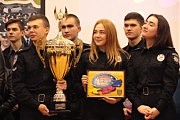
— The KVN environment itself is specific; the team captain is a person gifted in all respects, — our interlocutor emphasizes. — He must understand choreography, songs, music, and be able to write topical jokes, which allows him to maintain the thread connecting the audience with what the team wants to convey. Of course, acting training is also important, and it requires time and practice; the guys need to be seasoned by the stage, and then they will be able to “sell” their jokes. In due time, the team captains were Oleksandr Strelnytskyi, Serhiy Sarakov, Serhiy Satsyk, who went through all the stages, joining the team in his first year. In his final year, he became the team captain, and after graduation, he remained in service and work, leading the team for five years. Currently, the team is led by fourth-year cadet Yuriy Kibukevych, who also joined the team in his first year. Knowing the team’s work from the inside, he became a successful captain in his third year of study. “Resort Zone” is a сборная команда (all-star team) of the university, but each faculty also has its own teams. The composition of the сборная команда is determined by the results of the annual Rector’s Cup championship. Everyone awaits this event; thorough preparation takes place for three to four months, and the participants of “Resort Zone” train their faculty teams. As a rule, there are no losers, because everyone gets a boost of energy and positive emotions.
The vocal ensemble “Krok do zirok” has existed since 2007. The ensemble constantly participates in official events of Odessa organizations, including the House of Officers of the Naval Forces of the Armed Forces of Ukraine and the municipal enterprise “Parks of Odessa.” The vocal ensemble is well-known for its successful performances at the inter-university festival of student creativity “StudVesna-2017,” “StudVesna-2018,” and “StudVesna-2019.” In 2018, it received a laureate diploma of the 1st degree in the regional inter-university festival-competition of amateur art. In 2020, “Krok do zirko” remotely won second place in the All-Ukrainian festival-competition of arts “Pearls of Talent” and a laureate diploma of the second degree of the All-Ukrainian festival-competition of arts “Music Universe.”
— Since the ensemble’s inception, its leaders have been Olha Derevyanko and Ramina Rudnytska. Since 2017, the ensemble has been led by Kseniia Prykhodna, a graduate of the Odesa National Music Academy named after A.V. Nezhdanova, — adds Valeriy Ivanovich. — Among our talents is also Olena Burkoun, who dances beautifully and recites poetry, and even became a laureate of “Shevchenko Readings” at the inter-university competition of universities of internal affairs of Ukraine.

Olena is a girl of stunning beauty, a participant in all university competitions, and a multiple winner of “StudVesna” in the “Small Choreography” nomination.
— My father works at the South Ukrainian Nuclear Power Plant, — says Olena Burkoun. — My mother is a creative person; in her youth, she was seriously involved in singing and dancing, but she went to work in an insurance company. It was my mother who instilled in me a love for art and literature from childhood; she read me Korney Chukovsky’s fairy tales before bed. My mother and I sang a lot at home, especially folk songs. And from the age of three, I became a participant in the ensemble “Kvity Ukrayiny”; dancing became my life. My teachers are Olha Borysivna and Valeriia Volodymyrivna Forostyak, mother and daughter. They gave me a lot.
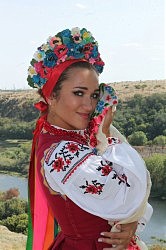
Nevertheless, when it came time to choose a profession, it was decided at a family council to focus not on art, but on law enforcement. Lena is a future investigator.
— I was raised with respect for justice, — the girl explains. — The ideal person for me is one who strives to be just, and such people should serve the observance of the law. After all, the law is just; everyone is equal before the law — it doesn’t matter whose son you are, who your parents are, or what you are wearing. And dancing… I am sure that in any case, I will develop as a creative person; it will not interfere with my main job.
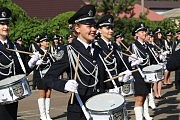
A flowerbed of beauties grows in this university! The head of the drum unit, Tetiana Mokh, a lecturer at the Department of Tactical-Special, Fire, and Physical Training, is passionate about her work. At the end of last year, in “Gardens of Victory,” the drummers adorned the award ceremony for the laureates of the “People’s Recognition” rating with their performance; this bright number opened the program. Previously, there were performances in the Green Theater in Shevchenko Park.
— The drum unit is a new project of our leader Viacheslav Vasyliovych Abroskin, — says Tetiana. — He implemented the first such project in the Donetsk region with the participation of police officers. The unit is still developing and performing there. For me, it was something beyond the possible; fortunately, we managed to achieve much of what was planned. The main goal of the project is career guidance and the participation of our drummers in official events. We brought together girls from different courses, following three main criteria: the cadets’ desire, successful studies (if they suddenly go to work and it turns out that someone doesn’t know how to use a weapon, stories about drums won’t help), and appearance. If any participant fails to meet the academic plan (fails a test or exam), they are expelled from the drum unit. The minimum height of our drummers is 165 centimeters; there is no upper limit. We need tall, slender, and beautiful girls, as this unit is the face of the university. The girls have beautiful uniforms, and at city events, everyone definitely uses red lipstick; it’s like theatrical makeup! And when performances take place on our parade ground, I insist on a neutral shade of lipstick for greater correctness… Unfortunately, precisely during the active period when we were being formed, the pandemic began, and there is very little time allocated for training (distance learning and other restrictions on conducting classes).
The drummers’ training takes place daily, usually outdoors. When the weather turns bad, they have to train in the gym, and it’s very difficult because the roar of the drums in a confined space is unbearable.
— We usually train in Shevchenko Park near our main building. Training also takes place at “Tsentrolit”; we use a beautiful, huge parade ground, — Tetiana continues her story. — We are constantly learning and improving because I, not having a musical education (luckily, the Almighty gifted me with some reasonable hearing), first learn myself and then pass these skills on to the participants. As soon as our ensemble was created, Viacheslav Vasyliovych sent me on a business trip for training to the Kharkiv National University of Internal Affairs, where such a unit has existed for many years. Then I searched for relevant information on social networks, on YouTube, and I also have many relatives and friends with musical education; they are always ready to help and advise.
The marching drum is an ancient instrument that is not played solo. It is a system, a collective. Many drums sound in unison during a parade, sometimes muffled, sometimes ringing, and there are peculiarities: you need to know how to tune, adjust the instrument, tighten the membrane without damaging it, and know how to preserve the drum during rain.
— Now in America, this art is at the peak of fashion, — smiles Tetiana Mokh. — They attach great importance to it, and the participants show extraordinary performances — both staged and improvisational. Our girls really like to feel a little special, uninhibited; they are inspired. I hope this project will develop and flourish.
The successes of the university’s hand-to-hand combat masters should also be noted; they recently took second place at the regional festival-competition of amateur art among students of higher education institutions of III-IV accreditation levels in the original genre. This is somewhat clear, but singing, dancing, and acting, no matter how surprising it may seem, are no less important for training future police officers.
— I always recall the film “The Meeting Place Cannot Be Changed,” the episode where Sharapov, undercover in a gang, is saved by his ability to play the piano. The profession of a police officer involves communication with people. His task is not so much to eliminate as to persuade. To learn communicability, it is very important for him to be uninhibited. The stage, in particular, helps to uninhibited and find oneself. Being among the population, police officers must understand the people around them, and communication should be the main weapon. The task of our creative groups is precisely not only to somehow brighten their leisure time but also to cultivate such qualities in a police officer as communicability and sociability, — summarizes Valeriy Slatvinsky.











