

Only true connoisseurs of the city’s history can correctly answer the question of which descent in Odessa is framed by three bridges and one semi-bridge. Of course, we are talking about Devolanovsky descent. However, it received its current name only 25 years ago, in 1995. Before that, it was called Quarantine, Novikov, Practical, Novikova Balka, Sikardov Descent, and Levashevsky, Vakulenchuk.
The oldest of the bridges is Novikov Bridge. Rope maker Ilya Novikov built it in 1822-1823 on favorable terms for the city under the supervision of military engineer Just Guyot, who revised the initial project by architect Alexander Digby. Novikov, like his neighbors, needed a direct road to the city through Quarantine Balka. Finishing work in 1823-1824 was carried out by contractor Giacomo Rossi.
In 1824, contractor Ilya Orlov began the construction of the so-called Sikard (Sikara) Bridge across the balk along Evreyskaya Street. The name is due to the fact that the road from the city across the bridge led to Laura Sikard’s house on the odd side of Kanatnaya Street. Due to the filling of the upper reaches of Quarantine Balka, the bridge gradually turned into a semi-bridge. Only fragments of it remain, which are still visible at the beginning of Evreyskaya Street, right behind the garages located there.
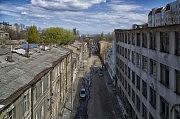
In 1851, the construction of Stroganov Bridge began, which lasted more than 10 years. This is not surprising – this bridge became the longest in Odessa. Its length was 120 meters. And finally, Kotzebue Bridge. It was built according to the project of architect Semyon Landesman in 1889-1892. It was considered a special pride that part of the metal structures was produced in France, at the factory that produced the metal structures for the world-famous Eiffel Tower.
“The descents were unique arteries leading to the port; in essence, they connected the city and the port into a single whole. The entire initial planning of Odessa was based on two balks leading to the harbor. It was impossible to enter or leave Odessa without passing these descents,” says historian, local lore expert, writer, honorary citizen of Odessa Oleg Gubari. “And life was boiling there. There were taverns, flophouses, offices of brokers, stevedores, warehouses of components and accessories – from travel accessories for passengers to anchor chains. Since the port operated around the clock, the life of the establishments located on the descents also followed this schedule. Before regular dredging, cargo was transported to ships or from ships by boats. There was a special institute of boatmen who concluded relevant contracts. For several years, contracts were also concluded on a competitive basis with teams of carters who carried out cargo transportation to and from the port, as well as with teams of loaders. For the convenience of feeding, so-called “white eateries” operated around the port almost around the clock, where strong drinks were not allowed. On “Kanava,” as the balk was colloquially called, and its offshoots, there were hospices for pilgrims, baths, illegal brothels, and other “dens of iniquity.” In order to prevent the main transport arteries of the city from being washed away by rainwater and meltwater flowing from the high Odessa plateau into the balks, the descents were first paved with scarce durable stone, which was delivered from the Mediterranean. Initially, it was simply unprocessed ballast stone: that is, ships arrived, as was customary then, “in ballast,” which was left in the port, and in return, bulk materials, mainly grain, were loaded. Later, the city began to specifically purchase processed durable stone: basalt, gabbro, diorite, granitoids, durable sandstone, etc. The balk was built up in the center, and two descents appeared – Polish and Devolanovsky.

The desolation reigning on Devolanovsky descent is due to the fact that the connection between the city and the port gradually became less significant and noticeable. Today, each of them exists on its own, separately, and this is unnatural. I believe that this corner of old Odessa must be put in order. But first, it is necessary to determine its function today and in the future. We can hope that in the future the road to the port will not only open but will become well-trodden. However, at the moment, it is simply a descent near a transport interchange, and not the most comfortable one. There is a small green area on the descent. An interesting idea was discussed to create a Polish Square there. It would be nice – a green corner would slightly relieve the dense development of the descent. Furthermore, one must ask the question: what direction will the reconstruction project take? How to combine all historical construction periods in it, at least partially preserve a certain specific local atmosphere?
Indeed, the possibility of creating a cultural and historical cluster in the Devolanovsky descent area has been discussed for a long time. First of all, the presence of three bridges and one semi-bridge is attractive – the main transport arteries connected to the port as the main city-forming object. What other city can boast such a dense complex? Bridges, each with its own unique and memorable history… In addition, at the base of the descent, there is a monument to Grigory Vakulenchuk – an artillery non-commissioned officer, organizer and leader of the uprising on the battleship “Potemkin,” who was shot there, on the battleship. His comrades carried his body to the Customs Square, where many townspeople came to pay their respects. Sergei Eisenstein’s film “Battleship Potemkin” is one of the most famous masterpieces of world cinema of all time.
Devolanovsky descent, among other things, is also an open-air museum of the history of urban industry. On it and in its surroundings, you can see fragments of archaic real estate of Novikov and his contemporaries, as well as the buildings of the “Epsilon” plant – one of the largest enterprises in the city during the Soviet period. “Epsilon,” however, in some sense, has been reborn – a Maritime Business Center has grown on the site of one of the buildings. And only the name of the transport stop – “Epsilon” – reminds of the once successful enterprise.
Perhaps it is time to think about holding a competition for a reconstruction project for Devolanovsky descent and its adjacent territories. To turn it into an attractive cultural and historical corner, where you can take pictures not against the backdrop of frightening ruins, but against the backdrop of well-kept buildings. This idea will probably appeal to young architects, designers, designers: they will not be afraid to explore new spaces, they will prove that even the most neglected, depressive area can be given a decent appearance.”
I fully agree with Oleg Gubari. It is absolutely unacceptable for chaos and desolation to reign in the city center. This is a manifestation of disrespect for the city’s founding fathers, for the port from which our hometown began, and for ourselves. How long can we look away shamefully when someone from Odessa’s guests asks again: “What are these ruins, how is this possible in a modern big city?”
I have already started gathering information. I am talking with historians and local lore experts. I intend to initiate a conference and “round tables” on the future of Devolanovsky descent and its adjacent territories. I am sure that with the support of the city organization of the political party “Opposition Platform – For Life,” we will be able to find an interesting, modern reconstruction project and bring it to life.











