

Anatoliy Gozhenko, Doctor of Medical Sciences, Professor, Honored Scientist and Technician of Ukraine, Director of the Ukrainian Research Institute of Transport Medicine, has always been distinguished by his unconventional judgments and assessments of what is happening in domestic healthcare.
This time, he characterized the situation as the destruction of medicine under the guise of system reform. And medical science as a branch existing in conditions of severe hypoxia – no, it has not been completely destroyed yet, but the vessel feeding science (financial support from the state) has been reduced so much that it, in essence, no longer exists.
Young doctors have to choose: to engage in science, but lead a semi-starving existence, or forget about their medical degree and switch to another field of activity. According to Anatoliy Ivanovich, the influx of young personnel will decrease even more sharply due to the fact that one can now enter medical science only through postgraduate studies. As a consequence, many talented doctors will be left behind.
“Healthcare is the most important component of a social state; it is based on the professionalism of doctors, who cannot be trained at a modern level without serious medical science,” says Anatoliy Gozhenko.
Today, there is much talk about disease prevention, but nothing is being done to implement preventive measures. Quite the opposite. For example, there was the All-Union Research Institute of Water Transport Hygiene of the Ministry of Health of the USSR. It dealt with the issues of the impact of working conditions and job specifics on humans. This institute was destroyed almost among the first. Then came the turn of prevention: 6 years ago, sanitary and epidemiological services ceased to exist. Yes, there were claims about the organization of their work, but sanitary services are very necessary. Following this, sanitary and hygienic faculties in medical universities were closed. As a consequence, the sanitary and epidemiological situation in the country has sharply worsened. Mass poisonings of people have become frequent. But they were not paid attention to.
And everything would have continued like this if not for the coronavirus. Suddenly, a chief sanitary doctor appeared in the country. It is a pity that the SES was not protected earlier, and people lived under the slogan “do not interfere with business.” The consequence of this “do not interfere” was that now most food products are produced according to technical specifications developed by the entrepreneurs themselves, based on their own benefit, and products made according to GOSTs, which guaranteed quality and safety, have become a great rarity.
The Ukrainian Research Institute of Transport Medicine switched to self-financing 23 years ago, in 1997. Perhaps this is what helped it survive. And not just to survive, but to continue working very, very effectively – the institute publishes more textbooks, journals, and research materials than all Ukrainian medical institutes of preventive profile combined. By the citation index of the works of the employees of the Research Institute of Transport Medicine, it ranks 4th in Ukraine. It is surpassed, for example, by the Lviv Medical University. But the Odessa Research Institute has 24 employees, while Lviv has 650, of which 150 are doctors of sciences! Calculate how much more effectively our compatriots work.
According to Anatoliy Gozhenko, the coronavirus pandemic has shown that the situation with infectious diseases is very bad. The situation has to be constantly “caught up.” And only virologists are trying to do it.
In 2009-2010, on his initiative, a working group was created under the Ministry of Health to study influenza. At that time, the majority of patients died from complications in the form of viral pneumonia. The working group did not exist for long. Now, with coronavirus, the main mortality is also associated with pneumonia. But over the past 10 years, science has learned nothing and has not conveyed anything to practitioners in terms of how to combat these pneumonias. Although, if the work had continued, scientists could have done a lot during this time.
“The health status of bus drivers is very concerning,” says Anatoliy Gozhenko. “They work for private owners, and no one remembers the need for alternating work and rest. Drivers already have cardiovascular pathology twice as often and it develops 10-15 years earlier than in other people. Very recently, there was a case where a minibus driver lost consciousness and crashed into a pole. If we were tasked with checking the health status of minibus drivers, then approximately 20% of them would no longer be allowed to work, and 75% would require serious treatment.”
A very relevant problem is the transportation of particularly hazardous goods. The Research Institute of Transport Medicine is the only specialized institution that deals with this problem. And almost all firms involved in the transportation of grain (which has to be treated with toxic agents) turn to it with questions about ensuring the safety of both processing and transportation of the cargo.
“We need to teach people how to properly process grain so that not only consumers are not poisoned, but they themselves do not suffer,” continues the deputy director of the institute, scientific secretary Nataliya Badyuk. “Our employee Yevhen Belobrov has developed the composition of a special first-aid kit for poisoning.”
A Treasure Trove of Opportunities
Employees of the Drinking Water Laboratory of the Ukrainian Research Institute of Transport Medicine opened the first bottled water plant in the USSR, in Ashgabat. And now a large volume of work is being carried out: water samples from artesian wells are being evaluated, water quality is monitored monthly in all city fountains, and analyses of ballast and bilge water from ships entering the port of Odesa are being taken.
The Toxicology Laboratory is well known for its capabilities in determining heavy metal salts.
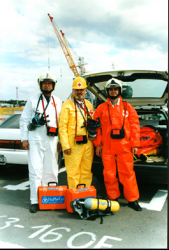
Work is being carried out with the Ministry of Emergency Situations units to determine the composition of combustion products of building materials, or rather, all materials that a person comes into contact with at home and at work. A serious area of work involves processing soil and air samples taken from landfills. An occupational pathologist helps determine whether a person’s illness is professional.
All these are completely unique areas of work that can become the pride of any state. If, of course, it cares about its people and the prospects of its development.
Do What Is Right
The Research Institute of Transport Medicine is participating in the creation of the Odesa International Medical University (OIMU) – a new private university that will train personnel in areas that are largely ignored by the state today. People who do not see themselves in the structures of the old system of medical education are ready to work there, but they well understand the challenges of the time and how a modern healthcare system based on highly qualified specialists should respond. The first intake of students is this year.
“Very soon, Ukraine will face a serious shortage of medical personnel,” is confident Anatoliy Gozhenko. “After the pandemic, about fifteen percent of our doctors and about a quarter of the mid-level medical staff will go to Europe to fill the places of their deceased colleagues. And who will treat our citizens?”
I was told an interesting episode. During Ulyana Suprun’s tenure, a letter arrived at the Ministry of Health stating the intention to destroy the Kirovohrad Medical Library. Specialists understand how important a good library is for training doctors. But in the Ministry of Health, the minister’s assistant remarked: “Why do we need a library when there is Google?” Unfortunately, it was precisely such people who made decisions concerning each of us and imposed the execution of these decisions on us. Look, there are specialized institutes of the Academy of Sciences, there are 15 departments of immunology and infectious diseases in Ukrainian medical universities. But not a single speech by a scientist, not a single forum where the challenge posed to society by coronavirus would be discussed. All quarantine measures are again adopted without broad dialogue with professionals – sanitary doctors, infectious disease specialists, immunologists, virologists. It is especially offensive when this happens in Odesa, the city that is the cradle of many serious discoveries in the fight against infectious diseases.
Yes, access to information is good. But with the development of information technologies, the automatic transition of the quantity of available information into its new quality has not occurred. Because quality depends on the presence and level of scientific schools. And they are barely surviving here. As a consequence, we now lack middle-level scientific personnel.
“I said back in 2011 that we would definitely return to the need to train doctors of the medico-preventive profile,” says Lina Kovalchuk, head of the Department of Preventive Medicine at the Odesa International Medical University, Doctor of Medical Sciences. “And now coronavirus is punishing us very harshly for our unpreparedness to confront it. But before coronavirus, there was the problem of botulism, related to the elementary inability to properly preserve and store food. It was simply ignored… I believe that we have great prospects in terms of training personnel. The principle should be: ‘Do as I do.’ Specialists with extensive, sometimes completely unique, practical experience will teach students at OIMU. Currently, treatment protocols have become the pinnacle of everything. But this leads to paramedicism, which destroys a doctor’s ability to think creatively, to understand that each person is unique, and to prescribe the correct course of treatment, one must think, analyze, compare patient data. And move step by step, ensuring an individual approach to the patient. But to learn this, one must first ensure an individual approach to training a doctor.”
The new university will have a system for student aptitude testing. Theoretically, an applicant’s phrase “I want to be a doctor” does not mean that they can become one. Proper aptitude testing at the initial stage, at the admission stage, will prevent life tragedies associated with an erroneous choice of vocation. Then, it is necessary to properly organize the work and rest regime, and to think about psychological relaxation methods. During the learning process, one can figure out the prospects of a particular student, advise them on what they would be more interested in, and where they could achieve more. It is the teacher’s task to help the student correctly determine what they will do next.
Crisis as a Starting Point for Revival
Listening to my interlocutors, I involuntarily thought about how the current crisis is interestingly forcing us to find completely new approaches to traditional things. It would seem, who can compete with the training of doctors in traditional state medical universities?
But that was before. Today, the mass, assembly-line training adopted there no longer provides the necessary depth of knowledge, on which the individual approach to the patient is based – what medicine worldwide is gradually reorienting towards. This means that new forms of organizing the educational process and transferring knowledge from teachers to students are needed. OIMU will try to implement them, relying on the experience and qualifications of its professors and teaching staff. And if this bold experiment proves successful, Odesa will have a new generation of doctors to whom we can entrust our lives and the lives of our loved ones without fear.











