

Last Friday, Mykola Mykolayovych Prokopenko, People’s Artist of Ukraine, member of the National Union of Artists of Ukraine, whose works adorn museums, art galleries, and private collections in Ukraine, England, Germany, the United States of America, Mexico, Greece, France, and Switzerland, turned 75 years old.
…In the artist’s studio, you feel an atmosphere of wonder, it smells of paint, brushes, pencils, paper, and colorful tubes lie on the windowsill. In the middle of the small room is an easel, like a work of art, and everywhere are paintings: landscapes, portraits, female figures, animalistic works, still lifes… Magic! We found the artist at work.
— Mykola Mykolayovych, what are you working on now? How are the themes of your works and images born?
— The themes of my works are diverse. It’s almost the universe – everything that surrounds a person from birth; everything that the human eye can perceive, like a mirror of the soul… That’s what I paint – the sky, clouds, trees, birds, the sea, people, children. The world is incredibly rich, diverse, and extraordinarily beautiful. An artist has this extraordinary spiritual joy to show it – to convey beauty! There is an artist – a master, and there is an artist – a philosopher. I consider myself an artist-philosopher. When you reveal a unique idea through color, graphic line, composition, and image – you create a creative philosophy and convey it in the language of art.
— What do you find attractive about your profession?
— Any person who engages in creativity is always a happy person! They think – they live by the categories of the world and create. Creativity is when the divine manifests through a person as a creator, then their creativity is true. In general, the best teacher is God, and all creativity is spirituality. When you sincerely dedicate yourself to this activity, it ceases to be work, it absorbs you, captivates you, becomes your life.
— How is a painting born?
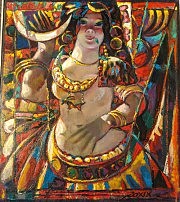
— I take a blank canvas and look at it… I have no idea what will happen next. It’s a mystery… You see, God has already created everything – and created the picture. All I have to do is hear and see Him through the veil. God always guides us, He acts through us. Therefore, art must carry inner light and beauty!
— Did you always dream of becoming an artist? When did you start drawing?
— I started drawing from early childhood, when I first held a pencil. We always drew something. My childhood was the post-war years; it was a difficult time, there were no pencils or paper, we drew on scraps. We drew tanks, planes, partisans; we copied everything that surrounded us. I always participated in school exhibitions, drew wall newspapers. Then I served in the army and drew there for three years. Then for three years, I tried to enter the Grekov Odesa Art College – for the third time, I finally got in. I graduated from the Kyiv Academy of Fine Arts. I have always had a passion for drawing, which has remained to this day.
— Do you remember your first drawing?
— I remember. Once a neighbor showed me a small picture – a white swan flying over a garden, holding a basket of apples in its paws, and below, a hare – the owner of this garden – is looking at it and waving its paw at it. I remembered that drawing. It encouraged me and strengthened my desire, I tried to recreate that picture.
— Who are your favorite artists, masters whose work you admired?
— Among my favorites are Diego Velázquez, Francisco Goya, Paul Gauguin. When I was studying, I copied the Dutch artist Frans Hals. I made many sketches, practicing the “a la prima” technique. The stroke of the brush, it cannot be drawn, it must be executed.
— You were involved in restoration for a long time. Please tell us about this work.
— After graduating from the Kyiv Academy, I worked for about 10 years at the Odesa Museum of Western and Eastern Art. At that time, Seraphim Charkin and I were perhaps the only restorers in Odesa with an academic specialized education. Over time, I earned the title of a highest-category restorer. I saved many items then, restored icons from the 12th-15th centuries. I worked with everything – panels, icons, paintings on canvas, wood, metal. Restoration is a complex process. A restorer requires a lot of knowledge and skills, one must know special chemistry, be able to determine the condition of damage to the work, analyze the primer, know which glue to use, which paint, varnish, or oil is suitable, what saponification to use, how to remove dust. It’s a whole science. In addition, one must describe and photograph all stages of the work. Here, the artist works as an art historian.
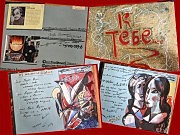
The main task of restoration is conservation, to protect the artwork from further destruction. And then to restore it. It is important to remember that this must be done very carefully, only within the limits of losses, preserving the author’s painting. One of my restoration works is the icon of the Iveron Mother of God, which was painted for the 100th anniversary of Odesa in 1894. Now it is located in the Odesa Transfiguration Cathedral.
— Art critics distinguish several periods in your work: “earthy,” “white,” “striped,” “monumental.” What exactly influences the formation of your artistic style?
— I never worked on style. I just work – that’s all. I work as God directs. And then viewers at exhibitions see the paintings and say: “Prokopenko has changed…” or: “When I enter the hall, I immediately recognize Prokopenko’s work. The style is palpable…”. It’s pleasant to hear. Probably, this “style” forms on its own. I haven’t thought about it… “Striped,” perhaps, is due to the rays of light, you know, how the sun plays on the surface through the window on a table. I have such works too…
— Your paintings are incredibly poetic. Your creative projects with writers are widely known. Do you write yourself?
— I write a little… I also have poems. My daughter Tetyana helped me publish a few copies of a book of about 100 pages – poems with blank pages, which still need illustrations. In general, I have illustrated a lot, for example, children’s books. I love this kind of work, it attracts me. Give me a poem or some work – I will create illustrations, but without instructions on how and what to do: I decide that myself.
— Finally: what qualities do you value in people?
— How to explain… If I were smart, I would answer the question (laughs). But without jokes – I believe it is important for a person to have honor. Not only and not so much honesty, but honor itself, dignity. And to check oneself more often against the Ten Commandments, to listen to them.
In conclusion, I want to say that Mykola Prokopenko is an incredibly interesting person with a sincere soul. He glorifies our city, our region, our country far beyond its borders with his talent. He is generous with gifts. In the near future, the M. Prokopenko Museum of Contemporary Painting is planned to open in the city of Ochakiv, Mykolaiv region.











