

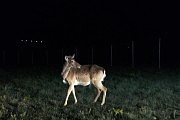
Last week, 20 kulans and 8 European fallow deer were introduced to the Tarutino Steppe in the south of Odesa region. The conservation organization Rewilding Ukraine made this happen. It is the Ukrainian branch of the European conservation organization Rewilding Europe, which operates in more than 10 countries in Europe. Its mission is to provide more space for wildlife, biodiversity, and natural processes.
After a 30-day quarantine, the animals arrived from the Askania-Nova Biosphere Reserve to restore the populations of wild herbivores that once inhabited the Tarutino and other steppes of Ukraine. Later, in the autumn or early next year, the animals will be released from the enclosure into the wild. They will roam freely across the steppe, returning to the environment in which they existed several hundred years ago. Natural grazing will help increase the region’s biodiversity, reduce the risk of fires, and promote the development of ecotourism.
The Tarutino Steppe, which has the status of a landscape reserve of local significance, is one of the few almost untouched steppe territories remaining in Ukraine and in all of Europe. Like all steppes, it is characterized by large grassy plains and is home to many endangered species. If not for human intervention, herds of wild herbivores such as kulans, saiga antelopes, and deer would graze here. Currently, these species have disappeared from the steppe, mainly due to hunting.
— This release of kulans is the first step in a long-term reintroduction program in the Danube Delta region, which aims to create a viable free-ranging population of 250 to 300 kulans here by 2035, — comments Mykhailo Nesterenko, Executive Director of Rewilding Ukraine. — In addition to the Tarutino Steppe, we plan to reintroduce kulans to the Zhebrіyanska Spit, near the town of Vylkove. Their grazing will help keep the grass short, which will benefit animals such as the ground squirrel and the steppe marmot.
A subspecies of the Asian wild ass, the kulan once inhabited Eastern Europe, the Middle East, and Central Asia – from the Mediterranean to eastern Mongolia. Over the last two centuries, due to excessive hunting and habitat loss, its population has decreased by more than 95 percent. The kulan is listed in the IUCN Red List. Incredibly hardy, kulans adapt well to their environment. One of the fastest mammals on the planet, the kulan can reach speeds of up to 70 kilometers per hour. These social creatures form well-structured herds, which helps the animals defend themselves against predators.
Although they will be monitored, the kulans and fallow deer will be able to sustain themselves in the fenced enclosure, which has a small pond and a patch of forest. Some animals will be equipped with GPS transmitters, allowing the Rewilding Ukraine team to track their location and further monitor and analyze their behavior.
The kulan reintroduction program is being implemented as part of the project “Restoration of Wetlands and Steppes in the Danube Delta Region,” which is funded by the Endangered Landscapes Programme (ELP), and which “Vechirnya Odesa” has reported on. The plan includes the restoration of parts of the Tarutino Steppe that were plowed up several years ago, the reintroduction of steppe cranes to the region, and the Taurus – a descendant of the extinct aurochs.
The fenced enclosure, into which the kulans and fallow deer were released, was built as part of the regional development project “Increasing the Competitiveness of Rural Peripheral Communities in the South of Odesa Region by Diversifying Their Economy,” which is being implemented by the Department of Economic Policy and Strategic Planning of the Odesa Regional State Administration, the Odesa Public Organization “Center for Regional Studies,” in cooperation with the company “Borodino-A.”
The two projects are collaborating within the framework of the herbivore reintroduction and tourism development program in the Tarutino Steppe. Thus, in the autumn of this year, saiga antelopes, Ukrainian grey cattle, and another group of kulans will also be released into the Tarutino Steppe. This will further increase the diversity of animals, enhance natural grazing in the steppe, and boost ecotourism in the region.











