

In the evening after the first day of play, the sponsor invited all tournament participants to a gala dinner. Only Anand responded. If not for Korobov, I was rooting for him. Full of self-esteem and nobility, elegant, a true aristocrat, he, being twice as old as many of his rivals, played with abandon, demonstrating examples of high-class play. I don’t know if it was the fish delicacies that affected Viswanathan (he didn’t touch alcohol) or something else, but the next day he lost disastrously to Korobov. The attacking combination of the Kharkiv player was not only effective but also spectacular. In the confrontation with Mamedyarov, Korobov had a slight advantage, but he failed to realize it – the rivals each scored one point (one point was awarded for a draw in rapid and blitz, two for a win). And in the game with So, a catastrophe almost happened. Even to me, an amateur, it was obvious: Anton played the opening terribly. He himself, when asked to comment on the position after the 13th move, replied in his style: “Ha! What is there to comment on? I should resign.” But he didn’t resign. And the new American, who previously played for the Philippine national team, hesitated once, then again… As a result, the Ukrainian seized the initiative and organized such an attack that Wesley was forced to resign due to the inevitable checkmate.
— You got out of such a situation, — was all the winner could say after the game.
— Anton, — I decided to joke, — I won’t be able to attend the tournament tomorrow – it’s time to go home. But I will be in Romania throughout the tour. So you can count on my support. And after that – on your own.
— I’ll try.
I must say that our conversation did not go unnoticed. Artemiev, for example, directly asked: “Tell me, what relation are you to Anton?” — “Countryman” — “Ah, a fan,” Vladislav concluded with doubt in his voice. They are so superstitious, these great chess players! Perhaps Artemiev assumed that I was a psychologist like Rudolf Zagainov, who once helped Anatoly Karpov? Be that as it may, there is something to sports omens.
In the third round, Korobov drew all his matches – against Aronian, Giri, and Caruana (alas, if I had been present in the hall, perhaps the result would have been even better – just kidding!) and sensationally led the tournament standings after the first “rapid” stage. He scored 12 points out of a possible 18. Aronian from Armenia, the Dutchman with Nepalese-Russian roots Giri, and the Azerbaijani Mamedyarov were two points behind. Anand, Caruana, and Le Quang Liem scored 8 points each. So closed the top ten with 6 points.
Some Ukrainian chess reporters rushed to declare A. Korobov the winner of the tournament. Unfortunately, this is not the case – blitz was still ahead. But first, a small digression.
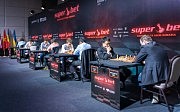
AT THE BEGINNING OF THE CENTURY, thanks to the then management of Pivdenny Bank, several tournaments were held in Odessa with the participation of a number of world celebrities. We had the opportunity to directly observe the creativity of Anatoly Karpov and Viktor Korchnoi, Vasily Ivanchuk and Ruslan Ponomarev, Boris Gelfand and Alexander Beliavsky, Joel Lautier, Teimour Radjabov, Alexander Grischuk, Sergey Karjakin, Peter Svidler, Judit Polgar, Alexei Shirov, Vladimir Tukmakov, Vyacheslav Einhorn… Blessed times! Honor and praise to the organizers of chess festivals led by Vadim Morokhovsky. But what happened in Bucharest cannot be compared to the Odessa starts. Imagine a hall filled to capacity where chess players were playing. Here it is silent, only by the electronic demonstration boards do amateurs whisper opinions. In the adjacent room, the best Romanian masters are fighting in their tournament. And in the huge foyer, passions are boiling – someone is waiting for their idol to come out “into the light” to get an autograph, and someone is listening to the commentary, which is being broadcast live from the USA to St. Louis by grandmasters Jennifer Shahade, Alejandro Ramirez, and Maurice Ashley; on-site, this mission is entrusted to the Romanian maestro Cristian Chirila. A total of two TV studios are involved (one in Romania, the second in America), thanks to the internet, tens of thousands of fans of the wise game were simultaneously following the games online! And what is noteworthy, today’s celebrities, unlike many capricious “stars” of past years, easily make contact: an autograph – please, an interview – no problem. And this is despite the fact that in ten or twenty minutes they have to sit down at the board again, fight for points and, importantly, for serious (by chess standards) money.
— Representatives of Superbet, — M. Khodarkovsky shares details, — specifically traveled to the tournament in Zagreb to gain experience in organizing such competitions. Saying goodbye in the capital of Croatia, the Romanians assured: we will organize everything better. Our employee, whom we sent to Bucharest to provide assistance, confirmed: everything will be at the highest level. And so it happened: the organization is thought out to the smallest detail, the resonance throughout the country is appropriate (it is enough to say that one of the rounds was opened by the Chairman of the National Olympic Committee of Romania, Olympic fencing champion Mihai Covaliu). I have the impression that the hosts themselves do not fully believe that they managed to gather such a constellation in their homeland. At the same time, the organizers are not just doing their job excellently, they, it seems to me, are themselves enjoying what is happening. And they have already officially announced that the 2020 cycle will start here, in Romania. This time the tournament will be held in a classic format, possibly with the participation of world champion Magnus Carlsen. This only pleases us, because the mission of the Grand Chess Tour is not limited to holding tournaments for elite chess players; elite chess should become a model for children and youth. Here, this idea is being implemented.
IN MY OPINION, holding such a grand chess festival in Romania is by no means a result of chance. It is impossible to get an idea of a country by spending five days in it, and mostly in the game hall. Nevertheless, it seemed to me that the organization of such a tournament logically follows from the gradual integration of the country into the European community. According to another of my friends, Alexei Bibik, who has been working here on contract for several years, the country has made a sharp leap in both the economy and the social sphere in the last three years. The skyscrapers being built outside the historical center, the high-quality roads, the cleanliness and abundance of greenery on the streets are impressive (however, Bucharest was famous for its beauty even in previous times). Of course, the mentality of the people is not easy to change. For example, cars on sidewalks are a common sight (to get around them, you have to go out into the roadway). And the local drivers reminded me of a long-ago (in the early 80s of the last century) visit to Tashkent: twice I narrowly avoided cars speeding through a red light. A funny incident happened to us on the last day of our stay on Romanian soil. Mikhail and I decided to take a walk in a park, landscaped with EU funds. The park is magnificent. After walking around the square with statues of Konrad Adenauer, Jean Monnet, Robert Schuman, and other founding fathers of the EU, we decided to sit on one of the many benches. A few minutes later, a handsome, fashionably dressed young man approached us with a request to join our company, although there were plenty of “seats” around, as I repeat. Misha and I exchanged glances: he wants to “scam” us, the Odesans?! Then events unfolded according to the script. First, the uninvited neighbor took out his wallet and placed it next to me, then, rummaging through his phone for about thirty seconds, he stood up, leaving his wallet on the bench. Then we had a good laugh: “Brother,” we shouted after him, “mister, monsieur, genatsvale, you forgot something.” “Thank you,” the unexpected acquaintance mumbled disappointedly and, without achieving anything, headed towards his companions (accomplices?), who were waiting for him with cameras in their hands. Perhaps I am mistaken, but in Odessa, the fashion for this type of fraud has long passed. Although, who knows? There are plenty of crooks in Italy or France too.
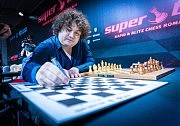
RETURNING TO THE TOURNAMENT. As mentioned above, I did not have the opportunity to watch the blitz directly. I followed the games on the website www.grandchesstour.org . What passions flared up, what dramas unfolded! It is enough to recall the duel between Caruana and Karjakin. The American (the main loser of the tournament) was supposed to announce checkmate to the Russian, but ran out of time when his opponent had only one second left on the clock! Blitz turned everything upside down. Famous masters of super-fast play Karjakin and Anand more than made up for what they lost in rapid and broke into the leading group. Giri and Mamedyarov lost their positions. So and Caruana were unexpectedly among the outsiders. The only one who went through the entire distance evenly was Aronian. As a result, Aronian and Karjakin scored the same number of points. The Armenian grandmaster won the tie-break match between them, but both received the same prize – $31,200 each (Caruana, who finished last, earned $7,500). Anand finished third. And what about Korobov? Alas, without the moral support of the special correspondent of “Vechernyaya Odessa,” he was unlucky (how can one not become superstitious?). As a result, 5th place, which, let’s not tempt fate, is a more than worthy result, as such aces as Giri, Artemiev, Mamedyarov, So, Caruana were left behind.
What’s next? According to the Grand Chess Tour regulations, the top four are determined by the sum of results from seven tournaments. They will compete for the main prize in London (semifinals, match for 3rd place, final). Magnus Carlsen has already secured a ticket to the capital of England, having earned 200 thousand. And this is not the limit: he can increase his personal account by playing in Kolkata and London. The positions of the Chinese Ding Liren are quite strong. But the fate of Maxime Vachier-Lagrave, who was third in the rankings before the tournament in Bucharest, hangs in the balance. The fact is that the Frenchman has already finished his performances in the Tour (it is necessary to play in five tournaments), and his competitors have a start in Kolkata in reserve. So Aronian, Anand, and Nepomniachtchi (he did not play in Romania) had every chance to overtake Maxime.
I FELT A MIXED EMOTION upon returning home. On the one hand, I was fortunate to attend a grand chess festival. On the other hand, it was a shame for the Ukrainian chess school. Korobov is a good fellow – he showed a great result, but let’s admit it, it’s a pleasant surprise, nothing more. It is enough to say that in the entire history of the Grand Chess Tour, besides Anton, only the brilliant Vasily Ivanchuk played in it once, and not as a full participant, but, like Korobov, receiving a wild card. To the credit of our chess players, they, without reaching for the stars in the elite, achieve success in team competitions. Just recently, the Ukrainian national team took 2nd place in the European Championship. Great! But if you think about it, apart from Ivanchuk, whose best years, alas, are already behind him, there are no “stars” in its lineup. True, E. Shtembulyak, a native of Chernomorsk, became the world junior champion under 20 years old. Will he be able to break into the ranks of the world’s strongest chess players? I would like him to. Currently, Evgeny lives in the USA, where he studies at the University of Texas. He is coached by former Sevastopol resident Alexander Onischuk, whose name is inscribed in the US Chess Hall of Fame. In which museum will the exhibition dedicated to Shtembulyak be located? What melodies will be played in his honor?
P. S. On Tuesday, the tournament in Kolkata finished, where world champion Magnus Carlsen won a confident victory. Now, on December 2, the final stage of the Grand Chess Tour will start in London. In the semifinals, Magnus Carlsen (Norway) will play against Maxime Vachier-Lagrave (France), and Ding Liren (China) against Levon Aronian (Armenia). The opponents will play 2 games in classical chess, 2 in rapid (rapid), and 4 in blitz.











