

October days in our city are always associated with the end of the defense of Odessa in 1941. The question remains debatable: could the Primorskaya Army have defended the city for longer than those very 73 days? Was it part of the plans of the military and naval commanders of the Odessa Defensive Area? Were there any reserves left or not? Let’s try to understand the events of early October 1941.
After the Stavka managed to establish supplies of ammunition, reinforcements, and military equipment to Odessa in the second half of September, and the Romanian troops in the steppe around the city began to go on the defensive themselves, the command of the fleet and the Primorskaya Army felt so confident that they began to seriously discuss the possibility of further prolonged defense of the city. On the night of September 23, the Military Council of the ODR considered the issue of preparing the army for winter. It was decided to begin the construction of heated dugouts along the entire defense line. General Major Khrenov was entrusted with the overall leadership of construction, and Colonel Kedrinsky with the technical leadership. Major General Kolomiets, the chief of logistics of the Primorskaya Army, was responsible for providing the troops with boilers, stoves, baths, lamps, lanterns, candles, and necessary equipment.
By decision of the Military Council, the ODR headquarters developed a detailed plan for preparing the defensive area for winter. Its main provisions were outlined in the order of the commander of the ODR troops, Rear Admiral Zhukov, dated September 25.
It paid special attention to equipping the field positions of the defending troops for the winter period:
“For full and timely winter engineering support of the troops, I order: on field positions – commanders of units and sub-units to immediately begin equipping trenches with drainage channels, wells, and drainage. To protect trenches from snowfalls, prepare shield mats (from reeds, corn stalks, brushwood, and straw) to cover the trenches. Cover and insulate shelters in trenches. Immediately begin the construction of foxholes and dugouts under the parapets, according to the attached instructions; on road service – commanders of formations and units in the combat zone to prepare the road network, clear drainage channels; repair bridges and culverts, prepare detours, etc. During the autumn rains and mud season, organize road detachments for the operation, repair, and maintenance of roads; for billeting – billeting of military units and rear establishments to be carried out only in dugouts-shelters. Begin the construction of dugouts-shelters immediately and complete them no later than October 15; for water supply – immediately begin equipping water sources at a rate of one per battalion, regiment, depending on the source’s yield. Equip water tanks in trench niches, protecting them from freezing.”
The rear services also began to actively prepare for winter. Quartermaster of the 1st rank Ermilov reported that workshops capable of sewing tens of thousands of sets of warm clothing had already been deployed – a fur factory, together with sewing cooperatives named after Lastochkin and the Third Five-Year Plan, had organized the production of winter hats, padded trousers, and quilted jackets; a woolen factory had organized the production of pea coats, sweaters, woolen shirts, and woolen trousers. In addition to city reserves, it was planned to use materials discovered by Odessa economic managers during an inventory conducted by the defense commission in a freight train stuck on the railway tracks.
2,000 sets of anti-skid chains and tracks were manufactured for the available vehicles.
The chief of staff of the 95th division, Prasolov, reported that potato harvesting and sauerkraut production had been organized on the abandoned fields of suburban state farms. Straw was also being stocked for insulating dugouts.
Documents have been preserved on how the city itself was preparing for winter.
On September 24, the bureau of the regional party committee adopted a resolution on improving living conditions in the catacombs and basements, where thousands of families had moved to escape bombings.
Centralized supplies and the still-functioning collective farm market could not fully provide the population with food for the winter. Therefore, food supplies prepared for Odessa in the Krasnodar and Stavropol regions, from where they were regularly delivered by sea, acquired special significance. The provision of fuel for the city was becoming a serious problem. At the request of the regional party committee, the Council of People’s Commissars of the USSR authorized the delivery of over 25,000 tons of coal, about 12,000 tons of coke, 18,000 tons of firewood, and over 22,000 tons of oil and fuel oil to Odessa by sea.
On the same days, the executive committee of the regional council decided to create a repair and construction organization at the city executive committee to restore the destroyed housing stock. As a priority task, by October 5, its employees were to complete the selection of houses to be repaired and organize the preparation of housing for winter.
The further development of defense production was also in full swing. Odessa enterprises received additional orders for various types of weapons. The city had already supplied the army with four armored trains, dozens of tank tractors, hundreds of thousands of grenades, and tens of thousands of mines. Small arms repair was established. And the production of 50-mm mortars reached such a scale that a batch of 50 mortars was allocated to the naval brigades being formed in Crimea.

But…
But on the night of October 1, 1941, Vice Admiral Levchenko, Deputy People’s Commissar of the Navy, arrived in Odessa, who issued an order for an emergency convocation of the Military Council of the Odessa Defensive Area. Vice Admiral Zhukov opened the meeting of the Military Council and announced that a directive from the Stavka on the evacuation of Odessa had been received, and read it:
TO THE COMMANDERS OF THE BLACK SEA FLEET, THE ODESSA DEFENSIVE AREA, THE 51ST SEPARATE ARMY, THE PEOPLE’S COMMISSAR OF THE NAVY
ON THE EVACUATION OF THE ODESSA DEFENSIVE AREA
September 30, 1941, 01:10
In connection with the threat of losing the Crimean Peninsula, which is the main base of the Black Sea Fleet, and due to the fact that the army is currently unable to simultaneously defend the Crimean Peninsula and the Odessa Defensive Area, the Supreme High Command has decided to evacuate the Odessa region and reinforce the defense of the Crimean Peninsula at the expense of its troops.
The Stavka orders:
Soldiers and commanders of the Odessa Defensive Area, who have bravely and honestly fulfilled their task, to evacuate the troops of the Odessa region to the Crimean Peninsula in the shortest possible time.
The commander of the 51st Separate Army to commit all forces of the army to hold the Arabat Spit, the Chonhar Isthmus, the southern shore of Sivash, and the Ishun positions until the arrival of the troops of the Odessa Defensive Area.
The commander of the Black Sea Fleet to begin the transfer of troops, materiel, and property from Odessa to the ports of Crimea – Sevastopol, Yalta, and Feodosia, using other convenient landing points at his discretion.
The commander of the Black Sea Fleet and the commander of the Odessa Defensive Area to draw up a plan for withdrawing troops from combat, their cover, and transfer; special attention should be paid to the stubborn holding of both flanks of the defense until the completion of the evacuation.
The commander of the Odessa Defensive Area is to destroy all armaments, property, and factories, communications, and radio stations that cannot be evacuated, appointing responsible persons for this. Upon landing in Crimea, the military units of the Odessa Defensive Area are to be subordinated to the commander of the 51st Separate Army.
Confirm receipt and execution.
Supreme High Command
I. STALIN
B. SHAPOSHNIKOV.
This was a shock to everyone present. What? Odessa is ready to defend further! There were attempts to appeal to the Stavka with a request not to surrender the city. But the decision of the Supreme Command remained the same – to prepare for evacuation as quickly as possible.
The already developed plans for winter preparations were decided to be used for disinformation purposes. The head of the operational department of the Black Sea Fleet headquarters, Zhukovsky, who arrived in Odessa with Levchenko, engaged in a complex of disinformation measures, ensuring that naval intelligence “helped” the enemy obtain Soviet “secret” documents. They indicated that fresh units were arriving in Odessa to help the Primorskaya Army hold the defense until spring. And the enemy’s intelligence activity indeed increased in the right direction: its aviation was only interested in transports heading to Odessa, and paid no attention to those heading to Sevastopol. Metal stoves used for heating temporary housing and large bales were still being loaded onto the decks of ships heading to Odessa. All this was very noticeable even from a distance.
The unloading of such transports was carried out during the day, calculated to attract the attention of enemy agents.
Memoranda on winter preparations were distributed among the troops. Sappers began building insulated dugouts along the entire front. Intensive vegetable harvesting continued. Winter uniforms were issued to soldiers of some units.
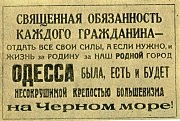
In general, only some documents were false, while the winter preparation measures simply continued, sometimes given a demonstrative character. In general, the entire situation in Odessa in September – early October 1941 was itself well-suited for enemy disinformation. Until the very last moment, on the instructions of the country’s top leadership, measures were constantly carried out in the city confirming that “Odessa was, is, and will be Soviet,” which were then reported throughout the country and beyond via radio and newspapers. On September 15, by decision of the Odessa City Executive Committee, the school year began in schools. Shops, cinemas, and hairdressers were operating in the city, but its fate had already been sealed.
It is unequivocal that after German troops broke through Perekop into Crimea, supply problems and troop shortages made the evacuation of the Primorskaya Army from Odessa inevitable. The Black Sea Fleet was unable to organize full-scale supply for two besieged bases simultaneously, and the Primorskaya Army troops were needed for the defense of Crimea. As time showed, this decision proved to be justified, as the defense of the fleet’s main base was subsequently carried out by the Primorskaya Army, and the Black Sea Fleet could not cope with supplying even one Sevastopol under active enemy opposition.











