

On Boris Fyodorovich Derevyanko’s birthday, his fellow villagers visited us
On October 6, the first editor of “Vechernaya Odessa” would have turned 81. And for 22 years, the newspaper’s staff has been celebrating another anniversary of his birthday on this day without the birthday boy – a bullet, sent by the hands of vile people, ended the life of a great man in 1997.
This golden autumn day, we spent every year in Boris Fyodorovich’s homeland, in Ivanovka, Ivanovsky district, which he repeatedly described in articles and books. The names of many fellow villagers, both departed and currently living, are present on the pages of his works, and the stories about these people are detailed, warm, and heartfelt. When we visited Ivanovka, we always visited all the memorable places – Boris Derevyanko Street, the old editorial office of the district newspaper, where his career began, and the school named after the Honored Journalist of Ukraine B.F. Derevyanko.
This year, we decided: let’s invite Boris Fyodorovich’s fellow villagers to visit us. The invitation was accepted, and it was our turn to show them the memorable places associated with the first editor of “Vechorka.” We laid flowers on his grave, walked around Derevyanko Square, where a memorial sign-pointer was recently installed, and showed our guests the editor’s office and the “Vechernaya Odessa” museum, where a large part of the exhibition is dedicated to Boris Fyodorovich Derevyanko. Then we remembered him and talked for a long time about him, about Ivanovka, about life.
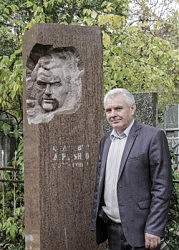
Alexey Mazur, who previously headed the district state administration and is now an advisor to the head of the district state administration, recalled the indelible impression Derevyanko’s books made on him at the time, and how much wisdom and foresight they contained. Alexey Ivanovich is an unusual official; he is the author of a major documentary and historical work about Ivanovka and is keenly interested in the past of the district’s settlements. He is a poet and, if you like, a bard. It’s a pity he didn’t bring his guitar this time, but he read his poems dedicated to Boris Fyodorovich.
Alexander Ivanovich Derevyanko, the village head of Buzinovo village. No, not a namesake, but Boris Fyodorovich’s cousin. Look at the photo – how similar they are! We talked with him about the prospects of decentralization. There are already three united territorial communities in the district – Konoplyanskaya, Znamenskaya, and Bolshebulykskaya. Documents for the registration of another one, which will include the villages of Buzinovo, Baranovo, Bilka, and the district center itself, have now been sent to the Central Election Commission. We discussed this reform, as well as the possible lifting of the moratorium on land sales, with the village head, and heard in his voice the same intonations as his brother’s, a firmness in defending his convictions.
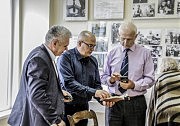
“You preserve the memory, and thank you for that,” said Alexander Ivanovich. “In Ivanovka, they also do not forget their fellow countryman. In the Derevyanko school, every student knows who it is named after and how much this person, truly deserving of remembrance, accomplished in his life.”
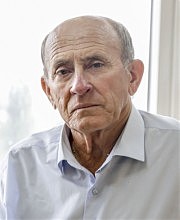
We were delighted to host Mikhail Fyodorovich Shevchuk – our editor’s physical education teacher. He is in good health, celebrated his 92nd birthday, and, as he said, does 25 squats and at least as many push-ups in the morning. May he be healthy for us, as they say in Odessa. It is about him that Boris Fyodorovich wrote: “…And it is still memorable how Mikhail Fyodorovich Shevchuk brought two bags of uniforms from Odessa. In one – cleats, in the other – jerseys, shorts, socks. The most incomprehensible thing was the cleats. Heavy socks, six studs on each boot. There was no and could not be more beautiful, more elegant, more masculine footwear…” Back then, cleats were something to be amazed by. That Boris Fyodorovich was fond of football and played volleyball is known, but this time his teacher revealed that our first editor was also not averse to acrobatics in his school years – “acrobatic pyramids were fashionable then, and Borya participated in them. Football was, of course, the main thing – when Boris came onto the field, the stadium applauded.”
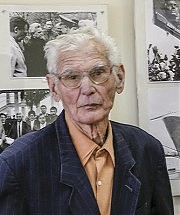
Maria Danilovna and Boris Vasilyevich Pokhlebin. I always thought they were both Boris Fyodorovich’s classmates. Not quite. The sharp-eyed beauty with a long braid, Masha Koeva, studied in the same class as Boris – that’s what they called him, according to her. And Boris Vasilyevich is four years older, and their acquaintance was made by friends in the village of Sukhomlinovo, where their grandmothers lived in childhood. They were friends for many years, and then their families became close. The surname Pokhlebin can often be found in stories about Ivanovka youth alongside others – Nikolai Ogrenich, Vladimir Bondarenko, Nikolai Golota… It was to him, Boris Pokhlebin, that his friend advised: “Go work at a school, children love you.” He did, and for many years was the director of the Kalinovskaya school, and then in the village of Radostnoye.
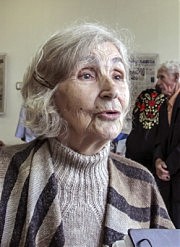
The opinion of Vasily Grigoryevich Chernenko, the creator of the B. F. Derevyanko museum at Ivanovka school, laureate of the editorial “People of Action” competition, and author of several books about the school, was very important to us. We showed him our museum for the first time, and he approved of both the initiative and the exhibition. And he advised us to get a guest book – so that guests could leave entries as souvenirs.
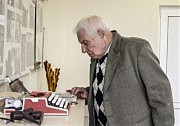
It turned out to be a warm meeting, with a relaxed conversation and memories of a man who always gathered friends in his office on his birthday, and it was remembered that it was quite crowded. We said goodbye to the villagers until our next meeting. And there is no doubt, neither for us nor for them, that it will take place next year on a warm Indian summer day.











