

“Want to visit Europe without crossing the borders of Ukraine? Come visit us!” — this is what local residents say with pride. And it is quite natural that the press tour “Europe in Chernivtsi Oblast: in Business, Education, and Communities,” organized by NGO “Internews-Ukraine,” attracted great interest from media representatives from ten regions of the country.
The Main Resource is People
Chernivtsi Oblast consistently ranks among the top ten regions in Ukraine for the pace of decentralization. This was told to us by Tetyana Tatarchuk, director of the Chernivtsi Center for Local Self-Government Development, and her colleagues. The Center is funded by the “U-LEAD with Europe” Program, which in turn receives financial support from the European Union and its member states, specifically Denmark, Estonia, Germany, Poland, and Sweden.
The Center’s specialists provide thematic expert consultations, methodological recommendations, and organize training on strategic planning, regional and local development, investment activities, and entrepreneurship; they facilitate the preparation and conduct of various events, educational campaigns, conferences, seminars, exhibitions, and competitions; they provide organizational and methodological support and further follow-up for projects and programs in the field of local self-government and decentralization of power; they offer services to citizens and small and medium-sized businesses regarding the implementation of projects and programs related to local self-government.
The results are evident. Today, 33 amalgamated territorial communities operate in the region. According to T. Tatarchuk, people have not lost faith in reforms, despite the difficulties they sometimes face in the process of decentralization.
Among the successful communities are Volokivska, Velykokuchurivska, and Hlybotska. “We have little land, so the main resource is people,” noted T. Tatarchuk at a meeting with journalists. We saw the truth of these words when we visited the Hlybotska village amalgamated territorial community.
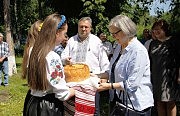
“Our Strategy is from Small to Large”
This is how the head of the community, Hryhoriy Vanzuryak, formulated the chosen path of development.
During our conversation with the specialists of the Local Self-Government Development Center, it became clear that the main problems facing the region are related to transport communication, energy efficiency, solid waste disposal and recycling, and the utilization of agricultural potential. How are they being addressed in this particular community?
Dmytro Hloback, director of the Hlybotska Lyceum, spoke about the work on implementing energy efficiency in the ATC’s institutions and the participation of young energy managers in the “Energy School” project.
“The lyceum is a kind of testing ground,” believes H. Vanzuryak. “Many projects implemented in the educational institution are then introduced in the community. It was the experience of the lyceum students that prompted us to implement monitoring in all ATC institutions. As a result, we managed to save 40,000 cubic meters of gas compared to last year.”
The community has also seriously addressed waste disposal. The existing landfill in Hlyboka, which is certified according to all international requirements, is projected to be filled in thirteen years, according to specialists. The community decided not to wait until the last moment and organized the sorting and recycling of three types of waste: bottles, glass, and paper.
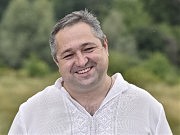
In the three years since the ATC was established, it has managed to improve healthcare and education, illuminate villages (there are 5 settlements in the community with a population of 13,500 residents), and repair roads. Hlybotska, Velykokuchurivska, and Storozhynetska ATCs intend to sign a cooperation agreement in the field of road management. In particular, this includes reviving their own asphalt plant (for the three communities).
Thanks to the decentralization policy, the Primary Healthcare Center, the Ministry of Internal Affairs Service Center, the “Florium” flower company, the “Mivira” apitherapy wellness complex, and the “Dobri Hazdy” cheese dairy in the village of Mykhailivka have become firmly established and are successfully operating.
We managed to visit the latter two organizations.
Cheese for the Ambassador
On the way to Mykhailivka, Hryhoriy Vanzuryak shared:
“What were our residents who kept cattle supposed to do? Go sell milk to the district center or Chernivtsi? It’s not rational! We thought and thought and decided to build a cheese dairy.”
The total cost of the project was 760,000 hryvnias. Of this, 607.3 thousand was provided by foreign partners — the Austrian Development Agency and the United Nations Development Programme (UNDP).
“The project is aimed at processing milk into hard cheeses and sour cream,” said Volodymyr Bilous, director of the cooperative. “Today, over thirty families in Mykhailivka supply milk to ‘Dobri Hazdy’.”
“Where you put on shoe covers,” H. Vanzuryak shares interesting details, “people supply milk. But they don’t leave immediately. After individual veterinary inspection, samples are taken for fat content. Everyone waits for the result. The base price for 3.2% fat content is 9 hryvnias per liter. If the fat content is higher, people receive an additional financial bonus. For some, the price per liter reaches 11 hryvnias.”
“And at the beginning of our activity,” adds V. Bilous, “some people were indignant: ‘Do you want to bring back the collective farm to our settlement?’ Now, sometimes they are indignant for a completely different reason: ‘Double-check, maybe the fat content is higher.'”
The cooperative’s philosophy is as follows: the ultimate beneficiary of the profit is the person who raises cattle. Sometimes people receive 5-6 thousand hryvnias a month just for supplying quality milk. This is a good additional income. Moreover, they don’t need to go anywhere, sit waiting for buyers at the market; their job is just to look after the cattle.
They started making cheese in Mykhailivka in January of last year (one of the “pioneers” was Vasyl Zelenivskyi, manager of the Hlybotska ATC), and officially opened the cooperative in March. This was because they wanted to surprise the Austrian Ambassador to Ukraine, Hermine Poppeller. She was treated to several types of cheese made using different technologies — Dutch, Italian, and Austrian. And Ms. Ambassador immediately identified: “This cheese is just like what they make in Tyrol, where I come from.”
It’s not surprising, because Yuriy Viznyuk, a graduate of Chernivtsi University, trained the Mykhailivka cheesemakers. He used to go to Austria for work. First, he looked after cattle for a cheesemaker, then he started helping the owner make cheese. In 2002, over 750 cheesemakers from all over Austria participated in a competition announced by the Mayor of Vienna. And when the winner went to receive the grand prize (100,000 euros), he looked at the labeling (each sample has the production date embossed) and unexpectedly declared: “I didn’t make this cheese; my Ukrainian assistant from Bukovina, Yuriy, did. See the numbers — that’s my birthday, the only day of the year I don’t make cheese.” According to the competition rules, Vuznyuk did not receive the money, but he was granted an interest-free loan for the same amount for 15 years. And now Yuriy is building a cheese dairy in the village of Shyshkyvtsi, Chernivtsi Oblast, which has no analogues in Ukraine. But despite his busy schedule, he couldn’t help but assist his fellow countrymen.
Today, the “Dobri Hazdy” cooperative processes up to 700 liters of milk per day, and it can process 1.5 tons. When they started, this volume was sufficient, but due to increased demand (the company’s products are well-known far beyond Bukovina, and individual orders come from other regions), the community is considering having its own herd. A joint project of the European Union and the Bukovina Community Development Agency involves the creation of ten new cooperatives (766,000 euros have been allocated for this). And one of them is planned to be organized in Mykhailivka, where small ruminants will be raised — so as not to compete with those who supply milk. In my opinion, this is an important detail: the interests of the individual come first.
Bees for Some, Honey for Others
After tasting the wonderful cheese, we smoothly moved to the domain of Mykhailo Balovsyak. For him, a beekeeper with 25 years of experience, there are no secrets in his beloved craft. But once, while attending a beekeepers’ seminar in Lviv, he learned about apitherapy. The idea captivated him instantly: on the train ride home, he was already calculating the parameters of the treatment beds.
By joining the project of the Austrian Development Agency/UNDP “Sustainable Development of Rural Territories of Chernivtsi and Odesa Regions,” M. Balovsyak received 100,000 euros and began his work.
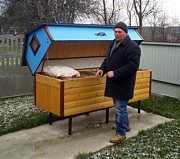
Today, the “Mivira” apitherapy wellness center is the main concern and pride of its creator. Everything is carefully thought out and done with love. The house where guests are received is built in the shape of a beehive, and even the tiles on it are hexagonal.
Mykhailo Vasyliovych demonstrates the therapeutic “chamber” and offers to experience the healing properties of bee venom firsthand, as it is used worldwide to combat diseases of the musculoskeletal system, nervous system, autoimmune diseases, and many others. Honey is valued not only as a dietary product but also as an antioxidant and broad-spectrum antimicrobial agent — with antibacterial, antifungal, antiviral, and antimycobacterial properties — suitable for fighting heart and skin diseases.
Apparently, our delegation consisted entirely of healthy people, and the cold weather was not conducive to experiments. In general, we agreed to have tea with honey and its derivatives in the invitingly fragrant living room.
The Center is served by 300 bee colonies. The cost of a one-hour session is 43 hryvnias. There is no shortage of желающих (especially in the summer). And M. Balovsyak has new plans: he has started collecting exhibits for an ethnographic museum.
“It’s turning into a full-fledged tourist route,” Hryhoriy Vanzuryak stated with satisfaction.
While in Mykhailivka, he often recalled T. Tatarchuk’s words: “Our resource is people.” Volodymyr Bilous, Mykhailo Balovsyak, and their associates have fully utilized the advantages of decentralization. And now the cooperative and the Center they created have gained popularity throughout Ukraine.
But there are enterprises operating in Chernivtsi Oblast whose products are competitive not only within the country but also in Europe. More about them in the next publication.











