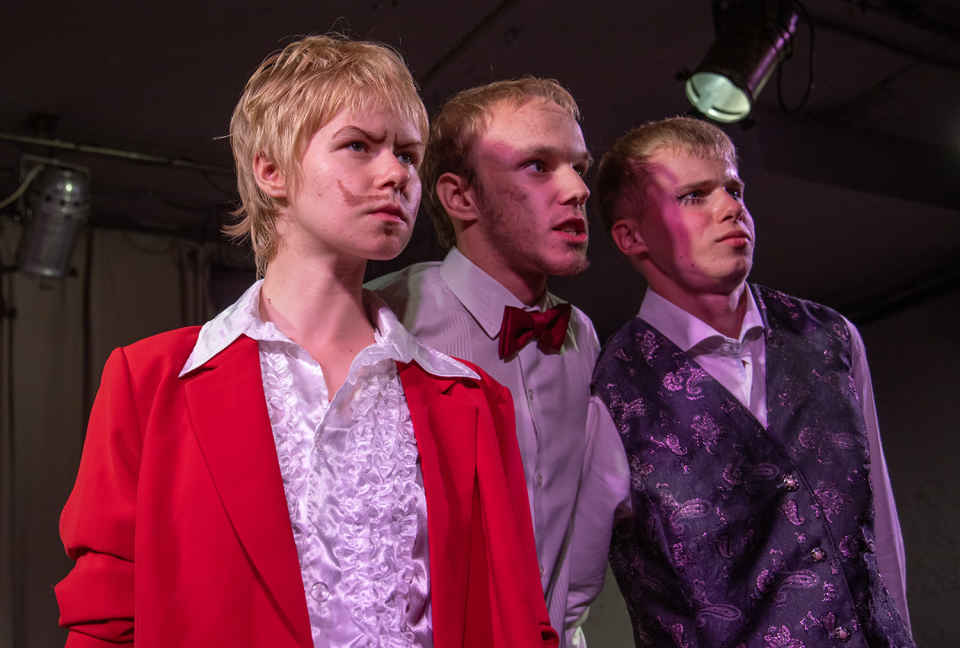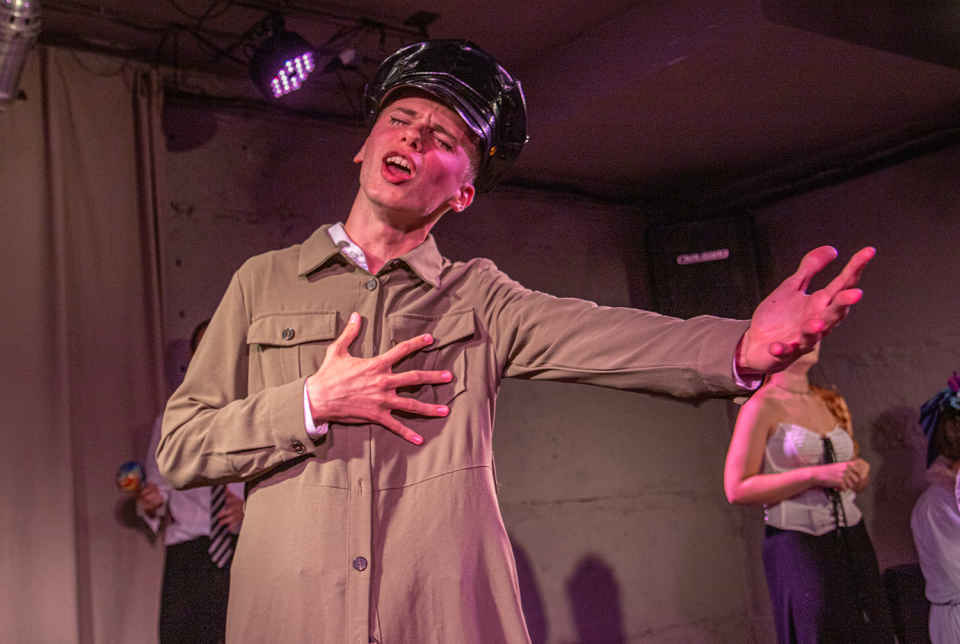
Have you heard? People’s Artist of Ukraine Oleg Shkolnik came up with the idea to rewrite Shakespeare’s comedy “The Taming of the Shrew.” And the artistic director of the Russian Academic Theater, Elena Pushkina, staged this opus on stage: under the title “The Taming of the Shrew.” The premiere performance took place last Sunday.
The director herself defines the STYLE of the production as a hit show. Of course, it’s playful, mischievous. A caprice, if you delve into the forgotten traditions of the theater.
Having heard about such audacity, we, the writing fraternity, could not deny ourselves the pleasure of mocking. Also quotable: “Isn’t it time, my friends, for us to take on William, you understand, our Shakespeare? And we will! So what?”
I went to the play, feeling intimidated and timid. But… the beginning of the play encouraged me: it was indicative and significant for the further impression of how the actors come on stage – yes, yes, the very process of their appearance. It turned out to be impeccable: it became clear that they would play and fool around with abandon. And so it happened.
If we step out from under the hypnosis of authorities… then what, essentially, did we see? In the theater boom years of the 80s, we ourselves took on challenges, and your humble servant too. We parodied and staged classic texts. It was not a product for sale: fun theater evenings among ourselves.
What came of Oleg Shkolnik’s work? In his text “based on,” there is no flat brutality characteristic of the well-known Odesa clown “Shakespearean” adaptations. The production is generally marked by good taste. However… those who are not inclined to absorb texts with “lots of letters” will be satisfied with a retelling, and will even think that this is Shakespeare. Such is the sad reality, such are the laws of psychology. The case of parody needs to be explained. So I personally regretted that Oleg Shkolnik did not introduce elements of topical satire into his text – even in a veiled form; our theater has been accustomed to “figs in the pocket” since the Taganka era, and our audience is genetically understanding in this regard. Then it would have been funnier and sharper.
Overall – it’s nice, mischievous, fun. Relax and smile. The Russian Theater has shown that it can compete with musical comedy theaters, as well as music halls. The entire play is sung. And danced too: a merry tarantella, as they say, is touching. In general, it looks like a street popular retelling of a popular stage work from Shakespeare’s or Molière’s times: this was practiced when a play from the court theater went to the people, and the original text was not at hand. Why practice this in the age of the Internet, I cannot answer you. There is only one answer here: why not fool around sometimes.
The arrangers deserve SPECIAL praise. The musical score of the play was created by Valery Chernis and Alexander Melnichuk. And it, I must tell you, is excellent. The arrangers used the timeless Italian hits of the 50s-60s. Here are a few examples: Lazzarella, Guarda che luna, Marina, Guaglione, and God knows what else, and Katerina sings her final monologue in defense of family values to the tune of Come prima. Purely like the San Remo festival non-stop. But!.. Popular melodies are delicately woven into the overall score, and the musical component of the action dominates – as in a real musical. You listen to this music as a completely cohesive, inseparable, and captivating orchestral work, in which no “seams” are felt.
The actors fool around with abandon, they are very charming. A successful find of the play is the recurring mini-interlude: dialogues between a city commoner husband and wife (Yuliana Ignatovskaya and Andrey Sakara), in which the wife, harried by domestic life, nags her husband, and the latter laments why he got married at all, when he had no worries. Here we are slyly invited to consider the pros and cons of marriage in general: think for yourself, decide for yourself…
Other options for a sad female fate are also offered: the fate of an old maid duenna (Honored Artist of Ukraine Hanna Furdiy; actually, duennas are in Spain, but that’s okay) and the fate of a permanent, or black, widow (Honored Artist of Ukraine Yulia Skarga). Both find their female happiness…
Katerina Baptista was played by Hanna Dyachenko that evening. Her sister Bianca – by Elena Yashchenko. Don Petruchio – by Dmitry Zhilchenko. Father, the famous merchant Baptista, was portrayed by Oleg Shkolnik himself. In general, everyone showed themselves to be quite worthy… of the Shakespearean original.
ABOUT THE ORIGINAL: what if we take a shot at it? – a malicious intellectual viewer will ask. And here, you know, is a special topic for conversation. After all, the Russian Theater, in our memory, has already taken shots, and took on “Hamlet” and “Richard III” for development. The results were deplorable. Alas, alas, alas. Here it is appropriate to reflect on many things: on how “eternal” the “eternal cultural heritage” actually is and how it relates to our present; on why the viewer, in different periods of time, went and goes to the theater and what they expect from the theater; and, finally, on such a delicate, intimate, and mysterious natural factor as the presence of talent.
If Shakespeare appeared today and proposed a play for production, I would tell you: it would be unstageable and uncinematic. Pure literature! Wordplay. Above all, Poetry. That’s how Shakespeare the poet is brilliant. And immortal. And what the theater was like in his era, what the audience was ready to perceive and laugh at – that’s a topic for separate research. Do you know many impressive examples of adapting Shakespeare’s plays in theater and cinema – examples where cuts were not needed, where the plot was adapted, in one way or another, to modernity? What do we want from Shakespearean productions in the theater? A connection with today? Or just a historical reconstruction?… How funny is the comedy about the shrewish Katerina today?
So this doesn’t mean that instead of adapting Shakespeare’s plays, we should “mess around” with his plots, – a strict critic will say. Oh well… you can “mess around” sometimes. But, honestly, I personally am too lazy to go to the theater for “fun.” And I’m tired of showman directors, even if it’s Dmitry Bogomazov. And Elena Pushkina herself appeals to me as a subtle, sensitive, and lyrical developer of “Chekhovian motifs” (“Uyezdnaya kaniyel”): this is her personal theme, her directorial individuality, her potential.
And humanity has an intellectual drama heritage, it has not become obsolete, unlike some Shakespearean conflicts: Brecht, Shaw, Dürrenmatt; even Radzinsky, his best plays; even McDonagh, now recognized as one of the best contemporary European playwrights. Choose. No money? Nonsense: spread out a mat – and the theater will begin. By the way, for “The Taming of the Shrew,” they invented such an elegant and functional enclosure – Elena Pushkina and Dmitry Bogachenko.
I am still waiting from the theater… well, if not a shock, then at least knowledge: tell me something that I don’t know; what I thought about, but in the wrong direction, and you direct my thoughts. And I will read Shakespeare in a deep armchair. And I will “have fun” myself in company, if the opportunity arises…