

“He who does not know his past has no future,” says an old proverb, and proverbs, as we know, are right. The past is not only the history and “roots” of one person, family, or an entire people, it is also a treasure trove of clues for the present and a warning for the future.
One such source for understanding the causes of certain contemporary events can be the study of population censuses in past eras. And for a city like Odesa, this study also turns into fascinating discoveries and a rethinking of its own history. Moreover, a population census is generally a very important and necessary tool for effective city management (especially a port city), as it allows the administration to see the true state of affairs in various aspects, from demographics to the average level of education of the population.
In our city, the Odesa Statistical Committee was responsible for the census. It was established in 1835, and its tasks included collecting and processing information about the population of the Odesa Governor-Generalship and the region. This committee had its own periodic publication, the “Address Calendar of the Odesa Governor-Generalship,” which was published until 1917.
In the first half and middle of the 19th century, the board member and secretary of the committee was the famous Odesa scholar, local historian, statistician, and economist Apollon Alexandrovich Skalkovsky. A very significant figure for our city.
Let’s get to know this interesting person a little. A. A. Skalkovsky (1808-1898) was born in Zhytomyr into a family of petty nobility (according to another version, the Skalkovskys originated from the Cossack elders of the Chernihiv region). Apollon Alexandrovich received his education at the universities of Vilnius and Moscow. From 1828, he was in the service of the Chancellery of the Novorossiysk Governor-Generalship in Odesa (here he headed the Odesa Statistical Committee and managed it for over fifty years). He was also the founder and head of the Ministry of Internal Affairs archive in Odesa.
The historian and philologist Skalkovsky became one of the founders of the Odesa Society of History and Antiquities. In 1856, Apollon Alexandrovich became a corresponding member of the St. Petersburg Academy of Sciences.
A. A. Skalkovsky dedicated four dozen scientific works to Odesa and the region, as well as to the entire South of Ukraine, for which he justly earned the nickname “Herodotus of the Novorossiysk region” from his contemporaries.
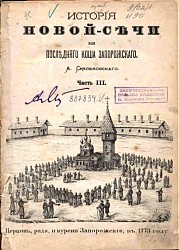
It was Apollon Alexandrovich who, during his research, discovered and saved from oblivion the archive of the last Zaporozhian Sich and was the first to undertake the study of the history of Ukrainian Cossacks and the Haidamak rebellions of the eighteenth century. And in 1840, he published in Odesa, in three volumes, the first scientific work on this topic, “The History of the New Sich, or the Last Zaporozhian Kosh” (later reissued three more times).
A. A. Skalkovsky is also the “author of the date” of Odesa’s founding, which he announced in his work “The First Thirty Years of the History of the City of Odesa. 1793-1823. A Work by an Odesa Resident A. Skalkovsky,” which was published in 1837. The famous Polish-Belarusian poet Adam Mickiewicz dedicated his poem “Do imionnika Apollona Skalkowskiego” to Apollon Alexandrovich.
And one of the future creators of Ukrainian statehood, M. S. Hrushevsky, responded to Skalkovsky’s death in 1898, calling him “the oldest of Ukrainian historians, contemporary and past.”
The memory of this worthy Odesa resident has been honored in our days as well. As part of the decommunization law, since April 26, 2016, the Second Stakhanovsky Lane in Odesa has been renamed in honor of this prominent representative of the scientific elite of 19th-century Odesa.
But let’s return to the topic of population census. In the first half of the 19th century, Odesa was experiencing its “golden age.” The status of a free port and the successful export of Ukrainian wheat, brought to the city by chumaks from all over Podolia and the Dnieper region, made the city an attractive place for both living and investment. But at the same time, the city administration faced a number of socio-demographic problems. In order to have an idea of the population of the city and region, the dynamics of its changes, social status, and occupations, the Odesa Statistical Committee was created.
For population accounting, the committee used the so-called “Saxon method” of population census. It was conducted as follows. The public elected special representatives – counters, who performed their duties voluntarily and free of charge. A few days before the survey, these counters distributed questionnaires to households, which were filled out by homeowners or heads of families. On the day of the census, the counters went around to the households and collected these questionnaires, which were then submitted to the committee. But Apollon Alexandrovich, as a scholar, was interested not only in dry figures about the number of men, women, children, and the elderly; he was interested in the ethnographic and social components. Therefore, the questionnaires contained the following fields: current number and full name, age and sex, social class, occupation and craft, religion, family life, spoken language, level of literacy.
The first official population census of Odesa was conducted by the committee in the 1830s. According to its data, there were 44,589 Ukrainians (or as they were called then, “Malorossy”) in the Odesa Governor-Generalship of both sexes, while there were only 4,938 people of both sexes from Russia (then called “Velikorossy”).
The next census was conducted by the Odesa Statistical Committee in 1851. According to its data, 15 nationalities lived in the Odesa Governor-Generalship and province, and Ukrainians (Malorossy) held the leading position in terms of numbers, with 703,699 people. Moldovans and Vlachs (Romanians) were in second place with 75,000 people, and Jews with 55,000 people. A comment-addendum to this census by committee employees draws attention; it eloquently complements the language of numbers. Let’s quote its text in full:
“Thus, more than two-thirds of the province’s population consists of Little Russians (Ukrainians). But the rest of the population, due to constant communication with the common people, has in many places lost its original type, adopted the language, clothing, and customs of the Little Russians, and can be more attributed to the Little Russian than to any other tribe…”
Much later (in the second half of the 19th century), in a report to Tsar Alexander III, the temporary Governor-General of the region and commander of the Odesa Military District, I. V. Gurko (who served from January 9, 1882, to June 7, 1883), wrote that he found it difficult to call the region Russian “in spirit” due to the large number of “elements alien to the Russian people.” Gurko also included “Malorossy” among these “elements,” pointing out that they “tend more towards Polish and Zaporozhian traditions.”
The population census conducted in the city in 1897 (during the reign of Nicholas II) showed: in the city’s population, 37,925 people identified themselves as Ukrainians (Malorossy) by their native language, while 198,232 citizens identified the Great Russian language as their native language. The empire was gradually making the region and the city more Russian.
At the same time, A. I. Markevich, in his work “Odesa in Folk Poetry,” published in Odesa in 1888, describes the ethnographic picture of the city as follows: “I had to record songs sung in the suburbs of Odesa – the so-called Moldavanka… The songs, in their language, fully reveal their Little Russian origin.”
All of the above fits perfectly into the historical, social, and political processes that influenced our region over many centuries. After all, the territory of modern Odesa Oblast is inextricably linked with the history of Ukraine-Hetmanate and the Moldavian state, and in the 18th century, it was even called “Khan’s Ukraine.” And six Cossack regiments of the Black Sea Host (consisting of former Zaporozhians and Hetman Cossacks), along with Don Jose de Ribas, took the Turkish fortress and town of Khadjibey in 1789, thereby laying the groundwork for the birth of the “pearl by the sea,” and later, in the 1790s, settling in the sloboda on Peresyp, they helped de Ribas and de Volan build and guard the new port, fulfilling Catherine II’s rescript. And to this day, citizens know the toponyms of Odesa that are inextricably linked with Ukrainian history, such as Nerubayskoye, Usatovo, Chubayevka, Belyaevka, and Koryntsy.
And on Shevchenko Avenue, the oak tree “Chorna nich” still grows, planted, according to legend, by former Zaporozhians. And it is not for nothing that the oldest song about our city, recorded by local historians and dating back long before the appearance of “Limonchiki,” “Sem’ sorok,” “Kostya the Sailor and Sonya the Fisherwoman,” sounds like this:
And it’s good to live in Odesa,
Not to carry sacks of grain,
Not to go to forced labor,
Not to pay poll tax,
Neither for the plow nor for the ard,
They call me a gentleman!











