

Of course, we are getting ahead of ourselves by talking about the return of the country’s only research vessel, but the process has begun, and the prospect of “Vladimir Parshin” going to sea is even marked with a date – 2019.
As a reminder, the vessel of the Ukrainian Scientific Center for Marine Ecology spent a long eight years docked in the port of Yuzhny. In mid-November last year, the Ministry of Ecology and Natural Resources announced the allocation of funds for repairs, and, according to the tender results, a ship repair yard in Chornomorsk took on the work.
On November 24, the vessel was delivered to the ship repair yard’s dry dock. According to the tender terms, by the end of 2018, the ship repairers were supposed to repair the hull, propeller-rudder unit, main engine, and replace radio navigation, emergency rescue, and fire-fighting equipment. As reported recently by the First Information Portal of Chornomorsk, all these works have been completed, and the vessel has been re-towed from the yard’s dry dock to the port of Yuzhny to await a new tender for the continuation of restoration work.
The Ministry of Ecology and Natural Resources states that the second phase of repairs will begin in the current year and will be completed by its end.
A note of regret: back in 2000, the UkrSCME (before 1991, it was called the State Oceanographic Institute), despite the upheavals in shipping companies, managed to preserve a unique research fleet: “Passat,” “Sevastopol-1,” “Ernst Krenkel,” “Breeze,” “Georgy Ushakov,” “Yakov Hakkel,” “Vladimir Parshin,” “Viktor Bugaev,” “Pegas”! Almost all the vessels were sold off, often for scrap metal prices.
But we rejoice in what we have. “Vladimir Parshin” is undergoing restoration. The vessel was built in Finland in 1989, is equipped with seven laboratories, and is capable of conducting complex hydrophysical, hydrochemical, hydrobiological, meteorological, radioecological, and geoecological research of water, bottom sediments, and marine organisms, as well as collecting samples even at a depth of 4 kilometers.
Currently, the monitoring of the Black Sea, as reported by “Vechernaya Odessa,” within the framework of the EMBLAS expedition, is being carried out by an international group of scientists on the Romanian vessel “MARE NIGRUM” – the European community wants to know the state of the Black Sea and what help it needs.
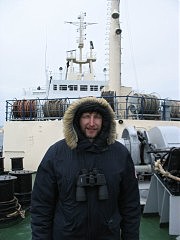
Viktor Komorin, Director of the Research Institution “Ukrainian Scientific Center for Marine Ecology” – exclusively for “Vechernaya Odessa”:
– Indeed, the first stage of repairs to the research vessel “Vladimir Parshin” has been completed. Today, a request for funding for the second part of the vessel’s repair has been formed. If the government allocates funds in February, the vessel will be repaired in the first half of the current year.
This will allow us to begin work on the ecological monitoring of the Black and Azov Seas within the framework of Ukraine’s implementation of the Water Framework Directive and the EU Marine Strategy Directive. Funding for the monitoring program can be allocated both within the national program and through international grants. In addition, we plan for the research vessel “Vladimir Parshin” to participate in a tender for an international research expedition in the central part of the Black Sea, which is planned for 2019. All of this is very important for enhancing Ukraine’s international image as a maritime power.











