

“Sea of Watercolor”, Odessa Biennale 2018: The second All-Ukrainian and International exhibition, featuring representatives from Ukraine, Moldova, Russia, Latvia, China, Italy, Slovakia, USA, and Turkey, opened on November 20 at the Odessa Museum of Western and Eastern Art (OMZEI, Pushkinskaya St., 9).
There were so many people – not a drop from a brush could fall. Just think: about 260 participants alone; not all of them could make it to the vernissage, yet 41 cities of Ukraine are represented here, with their own unique regional painting traditions. The exhibition as a whole provides a characteristic panorama: what are painters doing nowadays in this most capricious of techniques, what methods are preferred, what themes are authors focusing on?
It is significant and useful that an exhibition of such a solid scope did not do without retrospection. Firstly, the organizing committee dedicated this year’s biennale to Taras Shevchenko as the first ethnically distinct, national Ukrainian master of watercolor technique (let’s not forget, however, to thank his teacher, “Charlemagne,” i.e., Bryullov, whose academic style Taras diligently adopted; the exhibition release emphasizes “academic” watercolor, but in Bryullov’s time, it could not have been any other way). For this occasion – a dedication timed to the days of T. G. Shevchenko’s return from exile exactly 160 years ago – the National Museum of T. G. Shevchenko in Kyiv is acting as a co-coordinator of the project.
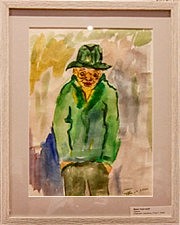
A substantial catalog has been released for the vernissage. The first pages are dedicated to the luminaries: Oksana Pavlenko (1895-1991), Ivan Krasny (1917-1990), Odessa painters Ivan Silvestrovich-Davoyna (1902-1963), Grigory Krizhevsky (1918-1992). The preface to the catalog was written by the president of the National Academy of Arts of Ukraine, People’s Artist of Ukraine Andriy Chebykin, who is also a participant in this exhibition; the introductory article was provided by artist and culturologist Volodymyr Kudlach. The exhibition’s organizing committee is headed by the chairman of the National Union of Artists of Ukraine, People’s Artist of Ukraine Volodymyr Chepelyk.
“Watercolor carries the MEMORY of light,” thus characterized this capricious technique Doctor of Art History Olga Tarasenko, who also contributed her “couple of words” to the catalog. Tarasenko is an artist by basic education, so she is very precise in her definitions when it comes to technique: her fingers “remember,” it’s not theoretical knowledge.
Indeed: if in oil painting, or gouache, or tempera – the latter two techniques, like watercolor, are water-based – we can imitate the effects of light by combining tones, then watercolor itself carries light, as it must be transparent, and the base should show through its layers: paper or, sometimes, fabric. That is why the biennale is named so: “sea” – water, water everywhere. With modern watercolor manufacturing technologies, often synthetic, it is devilishly difficult to maintain transparency, because the paint forms clumps and does not tolerate more than two layers. I have had to note this with regret in reviews more than once.
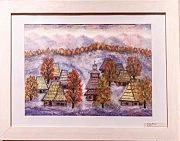
The modern watercolorist is simply doomed to the “alla prima” technique: in one stroke. This requires developing a special subtlety of calculation. But there is also the danger of becoming superficial, when the depth of interpretation is replaced by external bold brushwork. Anyone who has seen Vrubel’s and Borisov-Musatov’s watercolors in person will understand me; or go to the Odessa Museum of N. K. Roerich, look at Fonvizin’s watercolors – ah, those were different times and technologies.
Well, having sympathized once again with the artists, like martyrs of the synthetic era, I will note that they are emerging from the situation very honorably. The signature individual styles of the Odessa artists are visible from afar on the exhibition wall: here are Galina and Anatoly Kravchenko, here is Mikhail Parkhomenko, and here are Petr Nagulyak, Nikolai Prokopenko, Nikolai Vilkun, Dmitry Zhizhin…
But here is something I would criticize the organizing committee for – the lack of strict selection. Of course, “young people have a road everywhere,” but is it worth selecting works of an openly academic nature for an exhibition of this scale, worthy of a study sketch in the fourth year of art school? After all, such a biennale should, I believe, demonstrate real artistic breakthroughs, formal explorations. Of course, there are such works in the exhibition, but alas, there are far fewer of them than openly academic ones. Is it absolutely necessary to “gain quantity”?
THEME – is also the Achilles’ heel of modern exhibitions. No matter how many there are, no matter how many have already been, they are all still lifes, flowers and berries, or, if it’s a landscape, then, as a rule, fragmentary, openly sketchy. The portrait genre is generally in decline, barely breathing. And here the artists are again blameless. The dictate of money has turned out to be almost worse than the dictate of ideological censorship. The potential buyer, as a rule, is not a connoisseur of the highest order, but has ambition. And watercolor today is commercially a complete failure: our artists are great optimists and devotees if they still cling to it, not letting this exquisite technique die. In an office, they want to hang something substantial, rough, and visible on the wall, and it’s a thank you if they don’t prefer a poster to a painting (artist Galina Lekareva-Nikitina has complained to me about this many times).
For the entire huge exhibition, I found only… two portraits! I will clarify: not “figures,” not “faces,” not sketches, but precisely psychological portraits. A rather interesting characteristic male portrait “At Privoz” by Odessa artist Viktor Novotny: interesting for its psychological effect of a “snapshot,” executed, however, not at all instantaneously, not alla prima, but by repeated washing: this is a difficult technique. I remember from my student years a masterfully executed example: “Portrait of pianist Elisso Virsaladze” by the great stage designer David Borovsky.
The second portrait is “Girl and Summer” by Tamara Tkach from Artsyz: a compositional portrait, quite ceremonial in character, graphic in its techniques.
Well, overall – the exhibition is optimistic, the flowers are pleasing to the eye, the sketches radiate light, there is something to admire, relax, and enjoy, despite the crowded hanging. And the organizational work done is colossal. Thank you from the bottom of my heart. With the caveat, however: less is more. So that each biennale is truly an event of art, not a calendar.











