

It so happened that the Fourth Arts Festival “Velvet Season at the Odesa Opera” was opened and closed with productions by Vasyl Vovkun — first, the folk opera-ballet “When the Fern Blooms” by Yevhen Stankovych was shown with the participation of soloists of the opera, choir, ballet, and orchestra of the Solomiya Krushelnytska Lviv National Academic Opera and Ballet Theatre, and “under the curtain” of the festival — Verdi’s opera “Nabucco” with invited soloists Oksana Kramareva and Taras Shtonda.
And between these grand and spectacular theatrical canvases, there was a ballet open-air with classical and contemporary choreography, Gluck’s repertoire opera “Orpheus and Eurydice,” in which the main part was sung by the famous countertenor Konstantin Derri — in this tessitura, everything sounds more convincing than in cases when Orpheus is sung by a baritone, the guest feels confident in the baroque element, boldly improvises “ornaments” in the arias, as tradition dictates. The soloist easily entered the mise-en-scènes of Odesa’s ultra-modern production, and the performance will not be limited to this…
Ballet soloists Natalia Kush and Maxim Chashchogorov extraordinarily adorned “The Sleeping Beauty.” They pleased fans of the chamber genre with free concerts “Waiting” to the music of Mikael Tariverdiev and a solo piano recital by pianist Yevhen Gromov, where Wagner, Liszt, Bartók, Schoenberg were performed…
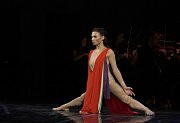
And a true breakthrough was the concert of works by Richard Strauss “The Last Romantic” — critics who came to the festival unanimously envied Odesa, because the capital does not have such programs! Brilliant sound was achieved by the chief conductor of ONATOB Oleksandr Samoile, and the chief director of our theater Yevhen Lavrenchuk brought freshness of perception to the scenes from the operas “Ariadne auf Naxos,” “Capriccio,” “The Knight of the Rose,” and “Salome,” perfectly maintaining the line separating the piquancy and boldness of the solutions from something else that would be unworthy of the Odesa stage. Choreographer Oleksiy Sklyarenko staged a stunning “Dance of the Seven Veils” for the Honored Artist of Ukraine Olena Dobryanska, and the biblical princess in her predatory ecstatic dance threw one flowing fabric after another over her shoulders, and in the finale she wriggled out of a cocoon of clothes, remaining in a flesh-colored leotard and in beams of light that instantly “dressed” the ballerina.
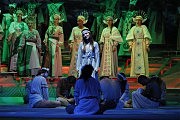
By the way, lighting designer Vyacheslav Usherenko and set designer Igor Anisenko in the Strauss concert dispensed with the notorious velvet curtains and backdrops altogether, baring the stage. And they won due to the richness of the musical material, unexpected mise-en-scènes, and the placement of the choir and ballet on elevated platforms. This does not exclude, of course, future productions with full splendor of scenery — we want the comic opera “The Knight of the Rose,” bloody stories like “Salome” should remain fragmentary, in concert performance! Proudly watching the velvet “Golovinsky” curtain descend, we begin to anticipate the fifth, anniversary, festival, which will be adorned with premieres planned for the 209th season (may it all be “velvet”!) of the Odesa Opera, which has begun so successfully.











