

…Even if half of its residents have long been living in the USA, Germany, or Israel. The Russian Academic Drama Theater is preparing a proof of the immortality of the Odessa courtyard: director Georgy Kovtun is rehearsing the play “Meshchanskaya, 24” based on the play of the same name by Lyusyk Zaslavsky, who defined its genre as “tragicomic nostalgia.”
“WHAT WILL IT BE?” I asked. “A brain explosion,” Georgy Anatolyevich answered without blinking. “And specifically?” “I know this courtyard. My grandfather lived there. And Lyusyk Zaslavsky grew up there.” It’s very difficult to make plays about Odessa, says Georgy Kovtun. “Well, there are so many of them already,” I reply, “and quite a lot of vulgarity.” “And ours will also start with this local vulgarity,” the director comments again, without blinking, “and it will end… with tears.”
Georgy Kovtun is not inclined to “think conceptually”: “I am a director of musical theater, and I see a play as a score.” Well, as for what turns out on stage, the Odessa residents are aware. Recently, my colleagues and I rewatched an edited version of “Viy” at the Russian Theater. The play is thirteen years old, but it hasn’t become outdated in thought or technique; it makes you delve deeper into Gogol’s story, which we’ve been accustomed to perceiving since childhood as a mystical thriller, a romantic horror story, but there are such underlying layers there, and Kovtun clearly reveals them. And “Viy” still fills the hall to this day.
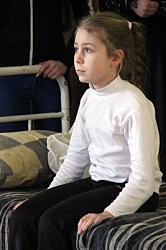
“Meshchanskaya, 24” will, of course, be a musical performance. But not a musical, but a play with active musical accompaniment, which is intended to intensify the mood and deepen the thought. And the appearance of melodies, and these will be melodies heard by the playwright and director in childhood, in that very courtyard, will be justified by the plot: for example, in the episode I watched being rehearsed, the source of the music is a courtyard radio point.
The actors, of course, will sing themselves. A beautiful lyrical song, authored by pop singer and composer Igor Nikolaev, has been taken as the leitmotif.
All the characters in the play have prototypes, says the author of the play. And only the central heroine, the girl Roza, is fictional: she is like the “author’s representative,” through her eyes the life of the Odessa courtyard is seen. Roza is played by three very young actresses, students of Odessa Children’s Music School No. 3, who have managed to “creatively grow” in Georgy Kovtun’s play “Pippi,” which will soon be revived at the Russian Theater. These actresses are Eva Molotyuzhenko, Sasha Kachur, and Sasha Rachkovskaya.
“Meshchanskaya, 24” will be staged on the small stage, in the upper foyer: it will be a play at arm’s length from the viewer, directly involved in the events and experiences of the old courtyard, in its quarrels and feasts, weddings and funerals, illnesses and recoveries, in memories of the terrible war, which is remembered by everyone, not from a textbook. The setting of the courtyard and the costumes of those years will be recreated by set designer Igor Bryl.
And where, in general, is this Meshchanskaya? It was renamed at one time to Zaslavsky Street. It occupies three blocks from Uspenskaya to Malaya Arnautskaya, parallel to Preobrazhenskaya.
About the playwright Zaslavsky, see our website, issue of February 12, 2015: “There is nostalgia. It’s up to imagination…”, it discusses a reading of the play “Meshchanskaya, 24” at the World Club of Odessa Residents and the author of the play, a director, a graduate of GITIS, the creator of the Odessa mime theater “Signs” at the philharmonic society, around 1984, and a teacher of the comedy group “Masks.” So, we have waited for the staging of the play. Well, what will come of it?
“I am Lyusyk,” insists Leonid Semenovich, “that’s what my mother called me, and now it’s my literary and stage name. In that courtyard, I also had my wet nurse: Mara Weinstein, she is one of the heroines of my play.”
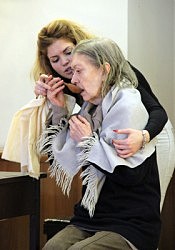
He also calls himself a “film consultant on the Odessa way of life.” “The stereotype was not formed in Odessa,” says the author of “Meshchanskaya, 24.” “And we should try to destroy it. Odessa is very… folksy, and the people in its different districts are very different. And any native Odessan believes that the city is as he, the Odessan, sees it, that it has always been so and will remain so. But this is not true. Although there is something that is inherent only to this city. Pay attention to Odessa’s plasticity! It hasn’t disappeared anywhere. Since the founding of the city, there have been many nationalities. But this is not a conglomerate that has settled in the USA, it’s a mixture! How did people find a common language here? They developed a special sign language, a special way of looking at the interlocutor, directly into their eyes,” – then followed a funny and characteristic “director’s demonstration”: head slightly tucked into shoulders, an insinuating look from bottom to top, and palms making rapid rotational movements near the face…
What is “nostalgia”? It was and is gone, should we reconstruct it? “It exists!” Georgy Kovtun firmly objects. “It’s from childhood. It hasn’t gone anywhere and won’t go anywhere. Childhood is something that lasts a lifetime, something we will pass on to our descendants. It is remembered in detail, with all the accessories and props. We want to have a conversation with today’s youth with our play. We want to create a mosaic from scenes of life in an Odessa courtyard: it’s not a clip, it’s a whole canvas, with a span into the past and future.”
…So, the intrigue! The premiere of “Meshchanskaya, 24” is scheduled for February 21. Kovtun and Zaslavsky still have a titanic task ahead: to teach young actors the “Odessa pronunciation”! And at the V. Vasilko Ukrainian Academic Musical Drama Theater, another intrigue has been completed: Georgy Kovtun is starting the production of the musical “Konotop Witch” based on the story by Hryhorii Kvitka-Osnovianenko. The music for the play was written by, you know who? Our wonderful Odessa jazzman, pianist Oleksiy Petukhov!











