

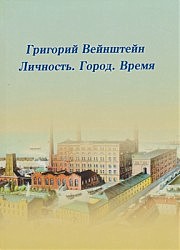
The Odessa National Academy of Food Technologies celebrated its 115th anniversary on October 20. For this occasion, the book “Grigory Weinstein. Personality. City. Time” was prepared and published, dedicated to the founder of our educational institution – a bright, active, and versatile personality.
Publications about G. E. Weinstein had already appeared in the Odessa press (“Vechernyaya Odessa,” February 22, 2011) and academic publications. The published book is the result of meticulous work, reflecting complete and accurate information about his life and activities, based, as a rule, on documentary sources. Many of these materials are published for the first time.
The book includes the genealogy of the Weinstein (Vainshtein) family, a graduate certificate from the Odessa Mill Technical School from the collection of the famous Odessa local historian and collector A. A. Drozdovsky, a letter from Paris confirming the burial place of G. E. Weinstein and his wife, and many other interesting materials.
Odessa local historians know G. E. Weinstein as a representative of the milling dynasty, the owner of the trading house “Emmanuil Weinstein and Sons” and the mill in Peresyp as part of it, and the founder of the Odessa milling school. The public aspect of Grigory Emmanuilovich’s activities is much less known – an equally bright page of his life.
Since 1896, when the executive body – the Council of Congresses – was elected at the IV Congress of the All-Russian Union of Millers, Grigory Emmanuilovich was consistently elected and actively worked as the Deputy Chairman of the Council. Even a cursory review of the industry periodicals of those years, covering the work of sessions, congresses, and various events organized by them, reveals G. E. Weinstein’s active participation everywhere. Moreover, as a rule, he acted as chairman – the leadership of the All-Russian milling organization was effectively concentrated in his hands.
At the 60th session of the Council of Millers’ Congresses, held in March 1916, G. E. Weinstein was unanimously elected Chairman of the Council by “closed ballot.” De facto became de jure! Grigory Emmanuilovich also led the work of the congresses of the Black Sea region.
Grigory Emmanuilovich’s active life position is very impressive. In addition to his effective activities in public associations of the milling and groats industry, he actively contributed to the organization and operation of a wide variety of societies – there are more than twenty of them. Moreover, he most often became part of the active core of these associations, heading the entire work or its individual directions in many of them.
G. E. Weinstein’s activities within the Odessa Branch of the Imperial Russian Technical Society (OB IRTO) deserve special attention. Heading the Chemical Department of OB IRTO from 1890, he contributed to the organization of a chemical (1893) and radiological laboratory (1911) within it – the first in the empire. These laboratories of the Chemical Department were essentially predecessors of several research and educational centers in Odessa and formed the foundation for the creation of the V. S. Martynovsky Institute of Refrigeration, Cryotechnology, and Eco-energy and individual faculties of the M. V. Lomonosov Technological Institute of the Food Industry within the Odessa National Academy of Food Technologies, and the A. V. Bogatsky Institute of Physical Chemistry of the National Academy of Sciences of Ukraine.
Grigory Emmanuilovich was a member of many trade and industrial public organizations in Odessa and the south of modern Ukraine – the Society for the Protection of Interests and Development of Odessa Industry, the Odessa Society of Manufacturers and Factory Owners, the Odessa Society for the Supervision of Steam Boilers, the Odessa Branch of the Russian-British Chamber of Commerce (Chairman), the Odessa Military-Industrial Committee, the Odessa Committee of Trade and Manufactures, etc. He was a member of the Odessa Stock Exchange Society and a deputy of the Odessa City Duma.
Year after year, his authority grew as a major entrepreneur and active public figure. As noted in the journal “Trade and Industry South” for 1915, “…he managed to win the trust of the most diverse segments of society,” because “he lived, one might say, by their interests.”
In 1915, G. E. Weinstein was elected to the State Council of the Russian Empire from the trade and industry of the South – a logical outcome of his activities in defending the rights and interests of Odessa and all of Southern Ukrainian industry.
The article in the publication “Melnik” for 1915, “Representative of Millers in the State Council,” notes: “There is no doubt that in the person of G. E., who enjoys a reputation as an impeccable public and political figure, not only the needs of Russian milling, but also, in particular, the hopes and aspirations of Odessa, as the center of the trade and industrial life of the South, will find their… convinced, steadfast defender.”
Grigory Emmanuilovich was also actively involved in various charitable organizations, including the Society for Mutual Assistance of Jewish Clerks of Odessa, the society “Trud” and the craft school attached to it, the Odessa Branch of the Society for the Spread of Enlightenment among Jews in Russia (Chairman), the Trusteeship for Needy Students of the Imperial Novorossiysk University, the Society for Assistance to Jewish Farmers and Artisans in Syria and Palestine, the Trusteeship Society for the House of Industry in Odessa, the Society of Saint Magdalene, the Odessa Branch of the Russian Society for the Protection of Women, the Odessa City Clinic for Outpatients, etc.
Grigory Emmanuilovich’s participation in one public movement or another allows us to judge his civic position. For example, his contribution to the emancipation of women – a pressing issue of that time – once again testifies to his caring, humane nature, striving for justice.
As a member of the Odessa Jewish community, G. E. Weinstein invested significant effort and resources in organizing and improving the education of Jewish children and youth, and expanding the publication of Jewish literature. In this regard, his activities within the Odessa Branch of the Society for the Spread of Enlightenment among Jews in Russia (OPE) are very indicative. Grigory Emmanuilovich headed the Odessa branch of this largest cultural and educational organization of Russian Jews for about 30 years, contributing to the solution of fundamental problems of community development. He managed to attract the most authoritative representatives of the Jewish people, one might say, the intellectual elite, to work in OPE. In the sharp polemics that unfolded at the end of the 19th century, the positions of not only individual directions of the Society’s activities and the community as a whole, but also future parties and public associations, were born and strengthened.
The distance in time allows us to appreciate the activities of our remarkable compatriot. Few have made such a significant contribution to the development of the city and the industry. The cause to which he dedicated the main part of his life lives on to this day.
A whole century now separates us from the last events in the life and activities of Grigory Emmanuilovich Weinstein, and a century and a half from the beginning of flour production at the Odessa mill of the trading house “Emmanuil Weinstein and Sons.” The Odessa Grain Processing Plant, created on the basis of the Weinstein mill, still operates in Peresyp – the largest enterprise of the milling industry not only in Odessa but also in all of Southern Ukraine. This year, the Odessa National Academy of Food Technologies, which traces its history back to the founding of the Odessa milling school, celebrated its 115th anniversary.
But these are, so to speak, the materialized ideas of G. E. Weinstein, and how many other deeds of his were aimed at the spiritual and intellectual development of his contemporaries! How much money and effort did he invest in the upbringing and education of youth, in supporting various social projects, in the development of science and culture! Grigory Emmanuilovich’s generosity was noted by his contemporaries even in that era when helping one’s neighbor was a norm of life among noble people.
Undoubtedly, Grigory Emmanuilovich Weinstein deserves to have his name remembered by posterity. He was an Honorary Citizen – and will remain so in the history of Odessa.











