

The presentation of the novel “The Man from Preobrazhenskaya,” dedicated to the 165th anniversary of the birth of the famous inventor Iosif Timchenko, took place at the World Club of Одесситы. One can assume that soon, in the same venue, we will see a novel about Vera Kholodnaya.
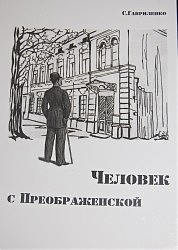
The author of the novel is Sergey Gavrilenko, a historian and film archaeologist from Poltava. The two-hundred-page historical and biographical work, released by the Poltava publishing house “Kopi-Print” in a thousand copies this year, is written based on scientific research and documents related to the life and work of the famous inventor and scientist Iosif Timchenko, and covers the period of his creation of an original mechanism for demonstrating “moving pictures” – the progenitor of cinema.
“This book is based on scientific facts collected by Ukrainian film historians. It can be of interest to anyone interested in the history of world and domestic cinema, as well as the life stories of famous personalities who lived in Odessa in the late 19th and early 20th centuries,” says Sergey Gavrilenko.
Mechanic, inventor, scientist Iosif Andreevich Timchenko was born on November 26, 1852, in the village of Okop, Kharkov Governorate. In 1874, together with friends, he moved to Odessa, where he lived the rest of his life. From 1880, he worked as a mechanic at the Faculty of Physics and Mathematics of Novorossiysk University. With a loan of 15,000 rubles, he built a new workshop building on Preobrazhenskaya Street. In 1875, he developed a device for testing steam boiler gauges, in the same year he made the world’s first electric clock, which was presented to Emperor Alexander II and then sent to St. Petersburg, and designed a programmable mechanical device for tracking the movement of celestial bodies along their orbits, which was used at the Odessa Observatory.
Timchenko also developed microsurgical instruments for eye operations and actively participated in the development and creation of equipment for the magnetic-meteorological observatory at Malaya Fontan, including an anemograph, pluviograph, anemoru mograph, and a recording mercury barometer. The inventor received four gold and four silver medals at major Russian and international exhibitions.
Timchenko’s invention related to cinematography received the greatest media attention. In 1893, together with Professor Nikolai Lyubimov, a physicist at Moscow University, he developed a “snail” – a Geneva drive mechanism that allowed for intermittent frame changes in a stroboscope. The same mechanism was used in the “kinetoscope,” designed in collaboration with Mikhail Freidenberg. The “apparatus for analyzing stroboscopic phenomena” was first demonstrated on January 9, 1894, at the ninth congress of Russian natural scientists and physicians. Sergey Gavrilenko, together with mechanic Nestor Kislenko (who also illustrated the book with his own graphics), managed to recreate this “apparatus.”
But ideas are in the air, and the Lumière brothers invent a film camera and hold screenings, including in Odessa. Sergey Gavrilenko recreates in the book an episode where Timchenko invites a French film mechanic to lunch with the ulterior motive of learning about the intricacies of the mechanism’s design.
“I didn’t tell him the story of how Lyubimov and I created the ‘apparatus for analyzing stroboscopic effects,’ nor about the first filming with Freidenberg’s kinetoscope.
‘You know, Michel, I liked your documentary shots more than moving trains and people,’ I admitted sincerely.
‘It seems to me too that people will eventually get tired of watching moving pictures and will want something more, something meaningful, so to speak,’ Michel stated with complete confidence.
‘Yes, that is undoubtedly true,’ I confirmed and continued the conversation. ‘How does this apparatus perform in terms of maintenance?’
Michel squinted slightly, thinking for a second whether to tell me everything, but then replied:
‘You know, Iosif, it varies. Sometimes it works without problems, and sometimes it starts tearing the film at the perforation. As a result, the frames start to “jump” on the screen.’
An hour later, after a good meal, Nikolai and I let our guest go to his hotel, and we headed home ourselves. On the way, Nikolai asked only one question:
‘Father, but didn’t you invent this two years ago?’
I could only smile in response.
Upon arriving home, I sat in my favorite armchair, standing alone in the study, and thought: a geared drum for advancing the film after it passes through the aperture would be a much more successful solution. The perforation on the film would not be subjected to such loads as with a claw mechanism, and the frame stability during shooting and projection would be much better! I once suggested this option to Freidenberg…
I got up from the chair and, approaching the desk, took a sheet of paper, writing only one phrase on it:
‘I saw nothing new for myself today!’
With the active participation of Odessa resident Sergey Kurkayev, the authors managed to go much further and, based on Timchenko’s invention, create a simple film camera that could have been made in those years, and shoot films themselves, ahead of the Lumière brothers: ‘Cinema could have been!..’ Using this camera and old film stock, lost in the warehouses of the film faculty of the Karpenko-Karyi Kyiv National University of Theatre, Film and Television, they filmed the celebration of Odessa’s 220th anniversary in almost the same quality as the originals of silent films. This proves, says Gavrilenko, that even in conditions of technological collapse, one can take grandmother’s meat grinder, adapt it into a film camera, and start shooting!”











