

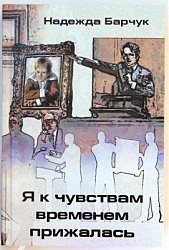
A presentation of Nadezhda Barchuk’s poetry collection “I Pressed Myself to Feelings with Time” was held at the House of Scientists.
This is the author’s thirteenth poetry collection, and its special ordinal number in this case, contrary to superstitions, is undoubtedly lucky. If a person, not being a professional writer, has been enthusiastically not only writing but also publishing their poems for many years (and this is a very costly undertaking!), it means the fire of creativity burns within them with unabated strength, and this in itself cannot but evoke respect and interest.
At the same time, Nadezhda Barchuk strongly emphasizes during the presentations of her collections: first and foremost, she is not a poet, but a loving wife, mother, grandmother, and homemaker. She even describes her “creative laboratory” as follows: “I’m cooking borscht and suddenly I feel a poem being born within me! I drop everything and start writing it down. Sometimes even at the expense of the borscht!”.
The fact that she, like most people of her generation, has gone through a long working life, is for Nadezhda Evgenievna nothing more than a biographical fact that is practically not reflected in her poems. The author’s focus is always on feelings and emotions. And even when she touches on philosophical or historical themes, they still serve only as a pretext for another “story of feelings.” It is precisely this that makes Nadezhda Barchuk’s poems interesting in the first place.
Indeed: what do we know about the real feelings and thoughts of our mothers, if they have forever remained only mothers who raised us and did not succeed in poetry? What do we know about the feelings of ordinary people, figuratively speaking, “from the street,” who never even thought of somehow recording their experiences on paper? But Nadezhda Barchuk (perhaps without even realizing it) has taken on this burden: to give voice to the “mute street,” to reveal its feelings, emotions, and reflections. The emotional directness and frankness, the unclouded sincerity of her poems give grounds to consider them a reliable imprint of the mental organization of many of our contemporaries.











