

The organizers of the Third International Music Festival Odessa Classics this time held even more concerts in the Grand Hall of the Philharmonic, the Opera House, and under the open sky. The festival’s president, pianist, and People’s Artist of Ukraine, Oleksiy Botvinov, noted the exhibition “Sounds of Silence” by Stepan Ryabchenko at the Museum of Western and Eastern Art as one of the important festival events.
Stepan Ryabchenko, one of Ukraine’s leading contemporary artists and an Odessa native, calls his working method “computer painting.” The exhibition featured video installations with picturesque shadows and a pendulum chandelier, as well as a ghost cage printed on aluminum. The exhibition has a musical component – the compositions of Yan Freidlin, an Odessa composer long living in Israel, are played in the background. And they are performed by Oleksiy Botvinov. This is a case where Freidlin’s exquisite music received adequate reinforcement from visual imagery.
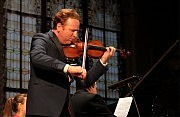
After the vernissage, the grand opening of the festival took place at the Philharmonic. Odessa residents were welcomed by the Mayor of Odessa, Gennadiy Trukhanov, the Governor of Odessa Oblast, Maksym Stepanov, and a member of the Bundestag from the Green Party, Maria-Luisa Beck. Violinist Daniel Hope, playing a Guarneri violin, brilliantly performed works by Einaudi and Elgar alongside Schumann and other classical romantics at the Philharmonic, but his participation in the festival was not limited to this. The musician wished to visit the Petro Stoliarsky Specialized Music School and pay tribute to its founder. Most of Daniel Hope’s teachers are former “Stoliarsky” students!
— I have always considered Stoliarsky the greatest violinist. All the heritage of that era originates here. And Odessa is the violin mecca I always wanted to visit, — admitted Daniel Hope.
The program “Ukrainian Bel Canto Stars” at the Odessa Opera allowed the audience to hear popular opera arias performed by the outstanding Ukrainian singer Olga Mikitenko, a graduate of the Odessa Conservatory and now a soloist at La Scala, Vitaliy Bilyy, as well as Lena Belkina, who sings at the Vienna State Opera. Arias and duets from the operas “Lakmé,” “The Tales of Hoffmann,” and “Carmen” filled the hall with sublime harmony, and the soloists were received with great enthusiasm! The performance by the “ArteHatta” ensemble under the direction of Myroslava Kotorovych, the chamber orchestra of the Odessa Philharmonic conducted by Igor Shavruk, plus piano solos by Oleksiy Botvinov accompanied by video installations by VJ Videomatics were planned for the open-air event near the Vorontsov Colonnade, but this venue was closed for restoration. The open-air concert was hastily moved to a smaller area at the intersection of Lanzheronivska and Pushkinska streets. There wasn’t enough space for everyone who wanted to attend, but what can be done, we hope to be able to perform in front of the colonnade again next year.
The program in the Philharmonic Hall continued with the German pianist Sebastian Knauer performing masterpieces by Beethoven and Schubert, as well as piano jazz, the Orlovsky Trio with a new program of klezmer music “Paris-Odessa,” and writer Viktor Yerofeyev, who read his new works.
The lectures held as part of the festival at “Terminal 42” were informative. Those who were lucky enough to attend the lecture by musicologist Lyubov Morozova “The Role of the Listener in the History of New Music” learned that today compositions that resemble near-musical performances more than music itself are popular: sometimes a piano is set on fire, or a violin is broken… And the audience is often silent, because loud reactions in the hall were common, for example, in Paris until the middle of the last century, then the fashion for reacting passed. The listener became quiet and convenient!
Speaking about the trends in Ukrainian culture, theater critic and culture editor of the newspaper “Dzerkalo Tyzhnya” (Mirror of the Week) Oleg Vergelis named contemporary Ukrainian art as such a trend, and first and foremost, the work of the same Odessa native Stepan Ryabchenko, “the creator of special worlds where, unlike ours, happiness exists.” Such high praise from a professional was very pleasing. Creative Odessa is a trend in itself, and thanks to festivals like Odessa Classics, this is becoming very noticeable.











