

The unique, one-of-a-kind Museum of Sound in Ukraine, founded by Odesa resident Vasyl Pinchuk, turned 5 years old.
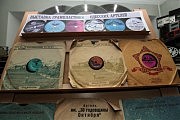
ON THE OCCASION of the “half-round” date, the Museum of Sound at 25 Dvoryanskaya Street presented the stand “Exhibition of Gramophone Records from Odesa Artels.” The founder and keeper of the museum collection, Vasyl Pinchuk, was congratulated by photographer Yevhen Volokin, who gifted the museum a small record with a recording of the waltz “Amur Waves.”
And this is a symbolic gift, because the author of the popular waltz, Max Avelyevich Kyuss, was born, according to some sources, precisely in Odesa. True, the city of Šiauliai disputes the composer’s birthplace, but it is certainly known that Max Kyuss’s father, a Jewish craftsman, worked at an Odesa button factory. And that the future author of the waltz graduated from the Odesa Music College, and from 1903 served as a bandmaster in the 2nd East Siberian Rifle Regiment, participated in the Russo-Japanese War, and composed “Amur Waves” in Vladivostok. From 1934, he conducted in clubs and schools in Odesa, led a music circle at the October Revolution (ZOR) factory, and was appointed bandmaster of the Odesa People’s Militia orchestra. Before the war, he taught clarinet at the Odesa Military Music School.
During the Great Patriotic War, Max Kyuss remained in Odesa, was placed in the ghetto, and was shot in the village of Dalnyk in the late winter of 1942. A memorial plaque has been opened on house No. 2 on Yekaterininskaya Street, where the musician lived in the late 1930s…
…Oh, these collectors! They told at the exhibition how a boom in sound recording arose in the USSR in the first post-war years: the reason for this was the trophy gramophones brought from Germany in ’45. The artels of disabled people, organized everywhere, were given a directive to produce gramophone records with recordings of popular songs: the hungry, destitute citizens who had lost loved ones in the war needed some kind of comfort.
During the days of the World Festival of Youth and Students, the Leningrad “Plastmass” factory made the first recordings of the then unknown Edita Piekha. The incredibly popular hits of the early 50s (although the word itself wasn’t used then) “Mishka, Mishka, Where is Your Smile” and “Oh, My Beloved Odesa” were recorded only in Leningrad!
…Vasyl Fedorovych Pinchuk puts a record with “Mishka” on a gramophone manufactured in 1940. Wow, a very decent sound! The song is performed by Volodymyr Nechayev – there was such a performer, the older generation should remember, a humorous couplet singer who performed with Pavlo Rudakov. Vasyl Pinchuk’s collection includes over a hundred rare records with songs.
And in Odesa, there were many sound recording artels, like that famous Leningrad one, Vasyl Fedorovych claims. There were five large cooperatives producing records – it’s unlikely any other city in the USSR could boast such enterprise, such sensitivity to market demand. Here: “Oblmestprom. Plastic Products Factory”; “Production Combine of the Regional Trade Department of the Executive Committee”…
LET’S TURN… “to mammoths.” The oldest gramophone record in the world, according to Wikipedia, is considered to be a sound recording from 1860. Researchers discovered it on March 1, 2008, in a Parisian archive and were able to play a 10-second recording of a folk song made by inventor Édouard-Léon Scott de Martinville using a device he called a “phonautograph.” Well, let’s not unnecessarily describe the phonograph with a wax cylinder, created in 1877 by Thomas Edison – the prototype of a tape recorder. One of the first real gramophone records was released in 1897 by the Victor company in the USA.
So, Vasyl Pinchuk’s collection includes a so-called “Polyphon” from 1867 – a kind of music box, one of the first sound-reproducing devices, invented in Germany. In general, the collection covers the period up to the early 2000s.
The museum exhibition – a kind of neat warehouse with shelves along the walls in a semi-basement – includes about 20% of the entire collection. The rest is “in garages”: so to speak, in reserve, in “funds.” Moreover, about 70% of the exhibits are in excellent working condition, restored by the collector and his friends.
The first collectible acquisition of Vasyl Pinchuk, in 1977, was a “Victrola” gramophone: the world’s first gramophone, manufactured between 1898 and 1902. Vasyl Fedorovych didn’t have the money to buy this rarity. But he had an antique carved wooden armchair at home. He traded it! And… the business started. Collecting is a passion, it’s not exactly a diagnosis, but a certain psychophysics. Let’s recall the legendary Odesa resident Oleksandr Bleshchunov…
…The “Kometa” tape recorder – remember this suitcase? Pinchuk was gifted it with reel-to-reel recordings of Vysotsky. An impressive reel-to-reel “Jupiter-Stereo-203,” a blue dream, awesome. A souvenir transistor radio – in the USSR, transistors began to be produced around 1960 by military factories as a byproduct of specialized planned tasks: consumer goods, – in the form of, imagine, a miniature red gramophone, a toy music box: released for the Moscow Olympics in 1980. The smallest – the size of two matchboxes – transistors from 1967: designed by Soviet military specialists, they received an award in Europe. And here’s a wall-mounted “plate,” covered with black paper: 1924.
And a truly sensational rarity: a “Kremlin” microphone. Only 100 of these were manufactured in a special Kremlin laboratory – for Stalin’s government. The last time such a microphone was used was in 1945, on Victory Day. Vasyl Pinchuk was gifted an example by his friend Igor, a colonel who worked in the Kremlin guard. Moreover, the microphone is still working.
A MODEST sound engineer of the Odesa Youth Theatre, who dedicated over 40 years to this theater, and before moving to Odesa worked at the Donetsk Youth Theatre, Vasyl Fedorovych Pinchuk is a true devotee. Thank you, the city authorities have met the enthusiast halfway: they are renting him a semi-basement on Dvoryanskaya for a symbolic rent…
But, but! Do we, the residents of Odesa, realize the true value of Vasyl Pinchuk’s collection and the significance of his Museum of Sound for the city? Do we imagine the tourist potential contained in this unique collection? The value of these exhibits for cinema (after all, there will be one in Ukraine, and filmmakers from other countries could rent exhibits for real money!). And purely scientific value? No, imagine in Odesa a solid museum, not in a basement, of sound recording and reproducing devices, visually illustrating the evolution of sound recording systems.
And to properly exhibit the collection, museum space of about 250-300 square meters is needed, says the owner of the collection. Moreover, we would add, according to modern museum exhibition requirements, equipped space, with necessary lighting, with an alarm system, with a competent catalog and Internet resource. But then what fertile opportunities for promoting the “Odesa brand”!











