

At the “House with an Angel”, on Pushkinskaya, 51, a solo exhibition of paintings by Yeva Yatt from the city of Yuzhny has opened.
YOUNG, beautiful, intelligent, sociable, and with a sense of humor, the artist has gained many admirers. Yeva is a graduate of Odesa’s “Grekovka”, she studied under teachers N.I. Dudchenko and Boris Lukin, whom I know from many exhibitions. The artist has experience working in animation – at a specialized Odesa association, which was housed at the Union of Cinematographers in the San Donato mansion at the film studio.
Much earlier, at group exhibitions, Yeva Yatt’s strong inclination towards realistic, objective, and textured painting, combined with a truly unrestrained, impatient temperament (I smiled when I read the ironically interpreted saying about patience and hard work at the head of Yeva’s Facebook page). Another circumstance is also evident – the artist is still in the process of searching for her creative identity and her theme. But concrete objectivity is Yeva’s inherent way of seeing the world, it’s a matter of psychophysics, you can’t escape it, and why should you?
The paintings of this artist also show a joyful perception of reality, optimism, and strong mental health.
…Many floral still lifes are exhibited. Flowers: Yeva’s compositions should be viewed from a distance – up close, the riot of an impatient brush can cause confusion with its almost feverish disarray, with a powerful, masculine sweep. But from a distance, all this colorful, shimmering fragmentation “comes to its senses”, forming a luminous coloristic integrity, just as multi-colored cubes of mosaic smalt are assembled into a clear picture in the viewer’s eye. In general, this is a sign of a monumental beginning in the artist’s style: if today’s developers spent money on wall painting, perhaps Yeva Yatt would have found herself in it?
It is impressive that among the dominance of fashionable “isms” and “advanced concepts”, Yeva Yatt is not afraid of being considered old-fashioned. After all, essentially, such a manner of painting was practiced in the era of “socialist realism” of the USSR in the 40s-50s! Looking at some of Yeva’s compositions, you recall Arkady Plastov and Tatyana Yablonskaya. So what? They, of course, considerably embellished Soviet reality, in accordance with the official “trend”, and created a myth of “all-people’s labor happiness” in painting, just as I. Pyryev’s “Kuban Cossacks” did in cinema… but they were powerful painters, masters of the brush! The manner of that time: a sweeping brush, almost to the point of decomposition of the objective material form – and a paradoxical attachment to plot (“art should be understandable to the people”) – this manner echoes in Yeva Yatt’s painting in an interesting way. But!.. About this “but” – a little later.
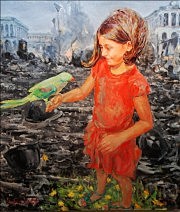
Yeva’s playing infants in the paintings seem to be taken from postcards of those victorious and impoverished years. A kind of cheerful game of socialist realism. Sometimes, Yeva’s compositions show open poster-like qualities, multiplied by lyrical feeling: as in the depiction of this little girl, on whose palm a parrot has landed, and around – either ruins or a construction site, with helmets lying around: either military or construction. An ambivalent picture, forgive me, Apollo…
Still lifes with fruits and bottles – the same quick brush, as if hurrying after a fleeting sunbeam.
NOW ABOUT THE “BUT”. The art universities of that dilapidated “Soviet Union” had quite a training! As did “Grekovka” in the post-war years. In Ukraine, the number of hours for specialized subjects in art universities has been cut so much that teachers groan, and what is left for their students? To catch up after receiving their diploma. But live and learn. Let’s recall Salvador Dali, who was “objective” to the point of illusion: his early works show him flailing in search of himself – the artist rushed to imitate one or another of his avant-garde contemporaries, and it’s noticeable that he was not a good painter either. But he was a great worker with great respect for the heritage of the classics – and became an excellent draftsman. The rest followed. So, in Yeva Yatt’s works, a certain kind of difficulty is still noticeable: it is difficult to connect a maximally liberated brush with a given plot.
Drawing, drawing, and drawing again! This is a fundamental lifelong problem for artists like Yeva: for those who see the world as objective, the world as a movie. Turn to disciplined drawing, to its mathematical logic. After all, with such a perception of the world as Yeva Yatt has, you can’t hide behind spectacular brush techniques, behind “symbols” and “concepts”. Today it’s spectacularity, and tomorrow it’s superficiality. One must cultivate in oneself the patience of a contemplator, who goes deeper, from delight – to the understanding of the form of all existence. This is what one would like to see from the next solo exhibition of this undoubtedly gifted artist.











