

On the prizes of “Evening Odessa”: “100 km in 24 hours along the Glory Road”
He rightfully belongs to the cohort of legends of the “evening hundred.” Anatoly Potaneyko finished first nine times, Vitaly Koval – 6, Viktor Lozovik – 5, Vladimir Mamchich and Alexander Kostenko – 3 each.
“And I could have been a four-time winner,” my interlocutor smiles.
“What prevented you?” I ask Alexander Ivanovich Kostenko from Chernomorsk.
“Lack of experience and poor knowledge of the route. I first started the ‘hundred’ in 1976. At the 30-kilometer mark, I was second, and at the halfway point – also. Vladimir Mamchich was five minutes ahead of me then. Soon I caught up with him, and we ran side by side for about a kilometer and a half. Somewhere around the seventieth kilometer, Mamchich started walking, and I broke ahead. At the entrance to the catacombs, the controller marked my time on the route sheet (it was 1:15 AM). And then I… got lost. I managed to get back on ‘my’ route only after an hour and forty minutes. As a result, I took 4th place. Of course, I’m not telling all this to dispute Vladimir Mamchich’s first place. Especially since I finished first in the next three races.
“So, you missed the first two starts in 1974 and 1975…”
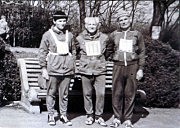
“Can you imagine that, living in Ilyichevsk, I hadn’t even heard of the hundred-kilometer races in Odessa. Gennady Fedorovich Zavertkin told me about them during a joint training session. He also expressed confidence that I could take 1st place. I was surprised then and didn’t believe his prediction, but, as we can see, he was right.
Zavertkin, Yuri Mikhailovich Volokitin, and I were among the first members of the Breeze Running Club. Volokitin completed the ‘hundred’ fourteen times; he is a master of sports in tourism and taught at the construction institute for many years. Many know him as a brilliant tour guide. Once he was invited to participate in the USSR Championship in hiking tourism of the 5th category of difficulty somewhere near the Chinese border, where no vehicle could pass. Later, I saw a silver medal he had. Together with Zavertkin, they climbed the highest mountain peak in Ukraine – Hoverla. And Gennady Fedorovich, unfortunately, died tragically. His daughter Anna Gennadievna Komolova (née Zavertkina) once conquered the hundred-kilometer route along the Glory Road with her father and fiancé. She has been working as a pediatrician for many years.
“As far as I know, you got lost on the route more than once.”
“That’s true. I don’t remember in which year I caught up with a man about ten years younger than me in Chernomorka. The guy said he was running third. I kept him company, but after a while, he suggested I leave him, saying I still had a lot of strength and a chance to be among the prize-winners. But I didn’t agree. And then, around the 16th station, we got lost: we entered some ATP (auto transport enterprise) territory, and we didn’t know how to get out – no guard, no dogs. Around us was a two-meter concrete fence, and on top of it, barbed wire. In one place, it was missing, and my companion climbed over the fence. I still can’t understand how I managed to overcome this unexpected obstacle. In Arcadia (the finish was then in Shevchenko Park), he again started urging me to go ahead, but I didn’t want to abandon my comrade. As a result, the judges recorded fifth-sixth place. They asked: “Who should we put first in the protocol?” My fellow traveler replied: “Let Kostenko be fifth, as he didn’t abandon me.”
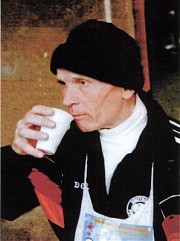
“Another incident happened in 1998. Before the race, a woman approached me and offered to run together. It was Anastasia Doinikova from Mirgorod, Poltava region. I agreed, as it’s more fun to run in a group. On the way, Nastya had some problems with her legs – cramps started. She asked me to give her a massage, as she wasn’t going to quit the race. So we moved on, alternating running with massage. Halfway through, medical students came to help, and I walked in circles for all thirty minutes so my muscles wouldn’t cool down. And what do you think? Around the 14th station of Chernomorka, we got lost. It was so dark that you couldn’t even see the trees. We started shouting – useless. Imagine how sad it felt: we knew the finish was nearby, but we couldn’t find it. In general, we “lost” more than an hour. But what’s interesting is that with a time of 17 hours and 5 minutes, Doinikova took 1st place in the women’s category! And eleven years later, I saw her on television. She was born in 1939, and in 2009, celebrating her 70th birthday, she climbed Elbrus with an instructor!
“Alexander Ivanovich, so, if it weren’t for the lost time on the route, your results would have been even higher?”
“Naturally, but the reasons for the decline in results are largely due to an injury. In 1985, while playing badminton with children, I “earned” an external ankle fracture, and, worst of all, a dislocation (the bone fork spread). Under general anesthesia, they compressed it. After the surgery, I participated in a 20-kilometer race and finished fourth, with a time of 1 hour 24 minutes. The following year, our mountain sports committee organized a marathon for the first time. My result of 3 hours 3 minutes was second. I was 48 years old then. Then I returned to the ‘hundred,’ which I ran in 13 hours 12 minutes. Oh, if it weren’t for vision problems (two years ago, I underwent a serious operation, and I was in the hospital for forty days…) I am 77 years old, and it’s hard to regain athletic form at this age, but thanks to good general physical fitness and running, I feel well. I just can’t see practically anything – according to the conclusion issued by the Filatov Institute on January 19, 2015, my vision in one eye is 0.01 percent, and in the other – 0.02. Otherwise, I have the strength and desire. Would you like me to give a couple of examples from our “old-timers'” practice?
“I’m looking forward to it.”
“Once, my friend, another veteran Petr Lotishko, and I caught up with a group of young guys. One of them joked: ‘You’re overtaking us, and we still have to give you our seats on the tram.’ How about that? Another funny incident happened to Petya. Three days before the ‘hundred,’ he decided to run to Sanzheyka and back as a training session – that’s about twenty kilometers from his house. He took his dog with him, which soon fell far behind – it got tired. Seeing such “abuse,” a passerby couldn’t help but say: “If you don’t spare yourself, at least spare the dog.”
“Yes, Alexander Ivanovich, you have enough stories for more than one publication.”
“I am very grateful to those who came up with the Glory Road race. First of all, to the journalists of ‘Vecherka’ (Valentina Cherevichenko specifically called the mayor of Ilyichevsk, Valery Yakovlevich Khmelnyuk, asking him to reward me for a prize-winning place, and I received a premium of 275 hryvnias from the mayor’s office), which has been supporting the ‘hundred’ for over forty years. I have always admired the work of the long-time director of the crossing, Sergey Ivanovich Miroshnichenko, the start coordinators Dmitry and Leonid Rzhepishevsky, and the master of sports in tourism Evgeny Stupnikov (I remember him as a young, fit guy).
“Taking this opportunity, I would like to ask you to announce through the newspaper that in 2013, at the start in Shevchenko Park, a girl from the Kotovsky settlement approached Yulia Privedenna from Moscow and me and asked to take a photo. After the finish, she accompanied me to the railway station. It was very cold, and we waited for transport to Ilyichevsk for about forty minutes. So she took a jacket out of her backpack and offered it to me to keep warm. She also helped stop the right bus, as my vision had already started to decline. I am very grateful to this wonderful girl for her help. But what troubles me is that four years have passed, and I still can’t give her the photograph (I contacted the Federation of Sports Tourism, but with no result). Perhaps my kind helper will read these lines and respond?”











