

The musical “Khanum” has undoubtedly become one of the hits of the Odessa Academic Theater of Musical Comedy named after M. Vodyanoy.
FURTHER, perhaps, one doesn’t need to continue? But no: as they say, prove it. Moreover, there are as many opinions as there are viewers. And if a viewer comes to a performance with certain expectations, with baggage for comparison… then, as they say, hide. Director Dmitry Belov did not “hide” from audience bias and announced his intentions in advance (see “VO” of March 2). Preceding the “debriefing,” we summarize: the result matches the declaration.
What does a director fear when undertaking a production of a popular work? Correct: comparison with eminent predecessors. With former theatrical blockbusters. Therefore, Dmitry Belov’s directive was: anything, as long as it’s different! So that they don’t say: “All sorts of people come here after Tovstonogov.” Once, Belov already showed on the stage of our Musical Comedy that he knows how to competently handle a plot of a timeless hit: he staged “Some Like It Hot” and wasn’t even ashamed to stylize the main character after Marilyn Monroe, putting on a “peroxide blonde” wig for her – as if to say, I don’t even think of competing, the classics are inviolable… but we’ll still play with it. And it turned out to be a charming, cheerful performance, and no one compares it with anyone or anything, people just enjoy themselves.
And now “Khanum” – the famous “Khanuma” with music by Gia Kancheli, whose melodies are well-known. The last stressed “a” in the title has been abolished, and in the performance, the heroine is called as she should be: Khanuma. This performance turned out to be cohesive and consistent as a spectacle. So stylistically cohesive that it allows us to judge the director: Dmitry Belov, in his race “away from Tovstonogov and Osherovsky,” managed not only to escape but to reveal who he himself, Belov, is as an artist. And he is, in my impression, a fervent “Americanist,” fascinated by the style of musical productions in Hollywood and Broadway, and he feels this style well. It is close to him. If there are any adjustments here, it’s perhaps due to material resources…
The drive of Odessa’s “Khanum” is completely Hollywood. You know, I even missed a touch of Eastern flavor in the choreography: the music, the melody is very Eastern, and the music leads and demands its own. However, after grumbling during the intermission, I eventually resigned myself. It’s not about my personal taste preferences, it’s about the director’s sense of style, and he undoubtedly has it in full order. Whatever style he chose, he implemented it in all its details.
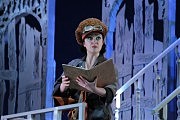
IMAGINE the Tbilisi diaspora… in New York. The Avlabari district, which translates to “suburb.” If it exists in Tbilisi, why not name a neighborhood of compact living in emigration the same way? And this emigration didn’t happen today. Why New York? Because the characters in the play have such “advanced” habits – progressive individuals live there. Although they also preserve their ancestral traditions in all their manifestations. Here’s a typical boisterous, restless family: Vano Pantiashvili (I watched the role of Honored Artist of Ukraine Sergey Lukashenko), whose years are his only wealth, plus a princely title; his unmarried sister Tekle (Honored Artist of Ukraine Tamara Tishchenko), who takes care of the prince; and the nephew, young Kote (Alexander Kabakov) – he has already realized that one cannot live by title alone and gives private lessons. The elder prince still dreams of improving his affairs in the old-fashioned way through a profitable marriage: you give me capital, I give you a family crest.
Two professional matchmakers compete to strike gold by finding a bride for the prince: Khanuma (People’s Artist of Ukraine Olga Oganezova) and Kabato (Alesya Perekalchuk)… but why retell the plot. We are talking about style. Khanuma here is such a triumphant figure that she immediately brings to mind Barbra Streisand’s cinematic entrance in “Hello, Dolly!” – this Georgian colleague of the American Dolly is exactly the same triumphant, carries herself so, and at the same time so captivatingly, in an Eastern way, feminine, that you might think she’d steal all of their Dolly’s clients.
And the young rich Armenian girl Sona, whom Kote falls in love with while giving her lessons, and towards whom Khanuma, according to the plot, develops sympathy, is played by Elizaveta Dyulger – a daring, uninhibited teenager ready for desperate adventures, a model of 1968: no longer demurely lowering her eyes in an Eastern way, she’s not someone you can mess with.
And Sara, Sona’s elderly grandmother, is a match for her granddaughter: constantly supervising, she indulges her granddaughter’s romance – a very modern, “advanced” grandmother (Denis Falyuta, a travesty role), who pilots a dirigible in the finale…
THE PLOT, abounding in intrigues, betrayals, mystifications, escapades – for example, the scene in the men’s bathhouse with a business visit to this male company by the cheerful, shameless Khanuma is presented very effectively and mischievously) – the actors play with selfless pleasure. The rivalry between Khanuma and Kabato is a clash of two characters, where the one who wins is based on insidious femininity and a sense of humor (Khanuma), not the one who burns with the temperament of an angry amazon (Kabato). Well, and everyone here is touchingly funny in their own way: Sona’s father, the nouveau riche Mikich (Denis Falyuta), the servant Timote (Ruslan Rudny), the shop assistant Akop (Sergey Milkov), whom the emancipated Khanuma also successfully managed to “matchmake” for herself. All the characters are involved in a colorful carnival swirl and will not let the viewer get bored for a moment.
The ensemble in the performance also corresponds to the “declaration of intent”: before us is a district dancing day after day. It dances from an abundance of life, from love, from sorrow. Dance is given as an expression of emotions and is staged purely in a Hollywood style. Yes, there are no Eastern steps in it – they’ve probably faded over the years of emigration – but the twist and shake here are absolutely “breaking” in the spirit of the “crazy 60s.” We are not on the Kura, we are on the Hudson! In fact, the entire style of the performance is “sixties.” And the extravagant attire of the townspeople, with Eastern nuances, precisely – well, everyone was a hippie back then, and “ethno” was in fashion, wasn’t it?
And the music, the hit music of Gia Kancheli… the creators of the performance promised many styles in their arrangements, and if we are to say what came out, it’s the most typical sympho-jazz of the 60s pop music. And it came out excellently. Even nostalgically. It turned out dizzying. And precisely as the musical genre demands: the music in it is not inserted numbers, as in operetta, not “accompaniment,” but the very fabric of the drama, it is inseparable from the development of the conflict and even provokes it.
The final song, performed by the choir, seems to be in Georgian, and it can even bring a happy tear. This is what Dmitry Belov’s performance is about: that happiness exists and is possible for you personally… if, of course, you are of sound mind.











