

Today, few remember that in 1949, at the height of Stalin’s “fight against rootless cosmopolitans” campaign, all “foreigners” were fired from the Black Sea Shipping Company – Bulgarians, Greeks, Poles, not to mention Jews.
These were all citizens of the Soviet Union, who grew up in Odessa, received their education here, fought against Nazi Germany, and were awarded combat orders and medals. Left without work, these sailors began to leave for Murmansk, where they could find employment on fishing vessels.
The Murmansk fishing fleet was constantly replenished with new vessels. They were built for the Soviet Union and countries that, after the end of World War II, were under the dictate of the USSR – the countries of the so-called “socialist camp”: Poland, the German Democratic Republic, Bulgaria, Czechoslovakia, and Hungary.
There was a shortage of captains, navigators, engineers, and even sailors for this rapidly growing fleet, which, in addition to trawlers that caught fish, included floating fish processing plants and refrigerators that delivered finished products to Murmansk. Therefore, the Odessa residents, upon arriving in Murmansk, despite their “foreignness,” were in high demand.
Sailing in the North is not easy. For half a year, there is polar night. And even in summer, during the white nights, when the sun does not set below the horizon, fog covers the sea, and if the watch navigator is distracted, the vessel can hit a floating ice floe. And to say nothing of the storms with icy winds that knock you off your feet, both in winter and summer!
But it is precisely there, in the Barents Sea and in the northern latitudes of the Atlantic, that valuable fish species are caught.
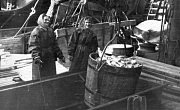
Many Odessa sailors passed through Murmansk, such as Captains V. Retinsky, M. Lander, V. Richter, B. Kisov, and others, who later became famous in the Black Sea and returned to Odessa after Stalin’s death. When the new head of the Soviet government, N. Khrushchev, exposed Stalin’s atrocities at the 20th Congress of the CPSU in February 1956, thousands of innocent “enemies of the people” were released from the Kolyma concentration camps, and all the Odessa “foreigners” were able to return to their hometown, regaining the right to work in the Black Sea Shipping Company.
And I am writing all this because I recently met an old friend, Boris Ginzburg, on Deribasovskaya Street, with whom I sailed in my youth on the passenger liner “Lvov.” Fired from the Black Sea Shipping Company due to his nationality, he also went to Murmansk in those years.
Boris has aged, as have I, but we recognized each other, hugged, and, going into a nearby cafe, of which there are countless on Deribasovskaya today, we each had a mug of beer and began to reminisce about the past.
When we sailed on the “Lvov,” we were nineteen years old. I was a motorman, and Boris was a sailor. The “Lvov” sailed from Odessa to Feodosia, with a stop in Sevastopol and Yalta. It sailed only during the day. At night, it stayed at sea because the lookout sailor posted on the bow might not notice a floating mine, of which there were plenty in the sea in those early post-war years.
One day, standing on the bow with binoculars in hand, Boris spotted such a mine and reported it to the bridge. This was on the approach to Sevastopol. The captain stopped the ship and sent an urgent telegram ashore. Soon, a minesweeper arrived from Sevastopol and, before our eyes, detonated the mine.
In the same year, 1949, on March 8, near Sevastopol, the motor ship “Anatoly Serov” was blown up by a floating mine. 49 crew members died. In Odessa, at the 2nd Christian Cemetery, a memorial with the names of all the deceased stands in their memory.
The “Lvov” was a Spanish ship. In 1937, when the Spanish Civil War was raging, the motor ship arrived in Odessa with Spanish children. It was then called “Ciudad de Zaragoza.” And the captain of the ship was a Spaniard named Mantilla.
For taking several hundred children, orphaned by the war, to the Soviet Union, saving them from the barbaric bombings by General Franco’s aviation during the Spanish Civil War, Franco posthumously sentenced Captain Mantilla to death.
Having heard this on the radio while still at sea, the captain, upon arriving in Odessa, requested political asylum from the Soviet government. The motor ship, remaining in Odessa, became part of the Black Sea Shipping Company and was renamed “Lvov.”
When Nazi Germany attacked the Soviet Union, the “Lvov” became a hospital ship. During the war, it evacuated thousands of wounded Red Army soldiers and commanders from Soviet cities besieged by the Nazis – Odessa, Sevastopol, Feodosia, and Novorossiysk. Despite constant raids by Nazi aviation, thanks to the captain’s skill, the “Lvov” remained afloat throughout the war. For its heroic voyages, the ship was awarded the Order of the Red Banner of Labor by decree of the Presidium of the Supreme Soviet of the USSR. And the captain was awarded the Order of Lenin.
But then came 1949, the year of the “fight against rootless cosmopolitans,” and Captain Mantilla, like many other foreigners living in the Soviet Union, was arrested. He was accused of espionage in favor of fascist Spain, ruled by General Franco, who had won the civil war. And the captain died of grief and sorrow in an Odessa prison.
The ship’s bell from the decommissioned “Lvov” was transferred to the Odessa Museum of the Maritime Fleet. And when I visited the museum, the first thing I did was go to this bell, on which time had not erased the old name of the motor ship engraved in Latin letters – “Ciudad de Zaragoza”…
This is what Boris and I remembered. We also recalled how once in Feodosia, as passengers were boarding, a girl slipped on the gangway and fell into the water, and Boris, being the watch sailor, immediately jumped after her and pulled her out of the water. And when the girl’s mother, in gratitude for saving her child, wanted to give Boris money, he was indignant: “What are you talking about!” But when Captain Mantilla, usually silent and laconic, firmly shook Boris’s hand for this act, Boris walked around all day like he was celebrating his birthday.
We also remembered how, under Soviet rule, there was only one beer bar on Deribasovskaya, where the first trolleybus route ran. And to have a mug of beer, which cost 22 kopecks, you had to stand in a long queue. And then Boris began to talk about his voyages on the fishing vessels of the Murmansk Trawling Fleet.
Upon arrival in Murmansk, after processing his documents at the Trawling Fleet Administration, he was assigned to a brand-new fishing trawler built in the German Democratic Republic, where the trawling master was a German named Dietrich Holz, who taught newcomers like Boris how to handle the trawl.
For Boris, who had survived the Nazi occupation of Odessa (his mother and grandmother died in the Odessa Ghetto, and he himself survived thanks to an Armenian neighbor who hid him in the closet of her apartment throughout the occupation), the word “German” was synonymous with evil.
But Holz, to Boris’s surprise, turned out to be a good-natured man who never shouted at the young sailors but patiently taught them fishing skills, often mispronouncing Russian words humorously.
Holz learned Russian in 1943 when he was captured near Stalingrad. Contrary to Goebbels’ propaganda, which claimed that captured Germans were immediately shot by the Russians, Holz, upon being captured, frostbitten and half-dead, found caring attention from Russian military doctors in the hospital barracks. They nursed him back to health. Together with other captured soldiers, he worked on the reconstruction of Stalingrad. In 1947, he returned to Germany with the first group of prisoners of war released from the USSR.
In his hometown of Warnemünde, on the Baltic Sea, where Holz had worked at a shipyard before the war, testing fishing vessels built by shipbuilders at sea, he returned to his beloved work. When Germany was divided into West and East, and the East, under the dictate of the USSR, became the German Democratic Republic, which included his city, the shipyard began building merchant and fishing vessels for the Soviet Union. It was then that Holz was offered a contract: to teach young Soviet fishermen in Murmansk how to operate German deck machinery and trawls. Thus, he found himself in Russia again.
When Holz’s contract ended and he was leaving for home, he recommended Boris, as the most resourceful and tireless sailor, for the position of trawling master.
“You won’t believe it, but I fell in love with the North,” Boris said, “its icy high shores, as if reaching into the blue Arctic sky, the Northern Lights, the white nights, and even the hoarse horns of ships in impenetrable fog. I fell in love with the guys with whom, in the polar darkness, under the whistling wind, in snow, in frost, I worked on the slippery, tilting deck, clinging to the railings so as not to be washed overboard. And I fell in love with the most exciting sight – the trawl haul!”
Cod, halibut, salmon, wolffish, flounder, perch, skates – all mixed together, quivering and crashing onto the deck. Seagulls cry and fight overhead. Sailors stand knee-deep in fish, paying no attention to it. Everyone is busy with the new trawl deployment. The winch groans, the trawler, having stopped to raise the trawl, moves forward slightly, the trawl cables tighten, and it goes back down to the depths.
And when you sail back to Murmansk through the Kola Bay, long before reaching the port, you take off your work clothes, run to the shower, shave, put on a clean shirt, a tie that you’ve gotten used to after months of rolling at sea, and impatiently wait for the fish-smelling pier to appear, where wives and children are waiting for the fishermen next to the border guards!
And then you go to “Arktika,” to the restaurant, where a stuffed polar bear stands full-height in the lobby. You greet it like an old acquaintance, shaking its paw, and enter the smoky hall, full of dancers, where it seems the restaurant orchestra is playing in your honor!
And then, from behind some table, Odessa residents who have also returned from the sea will surely call you over, pour you a shot, and you will raise a toast with them: “To Mother Odessa!”
This is the story I heard from my old friend, who worked in the North for almost ten years. After returning to Odessa, he sailed as a boatswain on the ships of the Black Sea Shipping Company until his retirement.
As for Murmansk, Boris said that besides the Odessa sailors, there were those in this northern city who, after graduating from the Odessa Water Transport Institute and being assigned to Murmansk, rose to high positions there. For example, the chief dispatcher of the Murmansk Shipping Company, the deputy head of the commercial port, and the chief engineer of the Murmansk Ship Repair Plant were all from Odessa.
And when, in December 1959, the world’s first nuclear icebreaker “Lenin,” built in Leningrad, joined the Murmansk Shipping Company, an Odessa native, Alexander Kalinovich Sledzyuk, was appointed chief engineer of the icebreaker. In 1963, for fulfilling government assignments in navigating convoys in the ice of the Arctic Ocean and for the accident-free operation of the icebreaker, he was awarded the high title of Hero of Socialist Labor. He died in 1985 and is buried in Odessa, at the Tairov Cemetery.
A bas-relief with his profile is installed on the facade of the Odessa Maritime School named after Alexander Marinesko, which Alexander Kalinovich Sledzyuk graduated from (he later graduated externally from the Odessa Higher Maritime School).
And when, in 1989, while sailing on the motor ship “Arkady Gaidar,” I was in Murmansk, I saw on the building of the Murmansk Maritime Shipping Company administration, among several memorial plaques with the names of famous polar captains, a memorial plaque immortalizing the memory of the chief engineer of the world’s first nuclear icebreaker “Lenin” – Hero of Socialist Labor Alexander Kalinovich Sledzyuk. So, as they say – “Know our own!”











