

A “round table” on “Features of the application of probation and preparation of pre-trial reports: their significance for courts” was held in Odesa. It was organized on the initiative of the EU Project “Support for Justice Reform in Ukraine”.
Judges from the Kyiv, Primorsky, Malinovsky, and Suvorovsky courts of the city, the Artsyz District Court, the Belgorod-Dnestrovsky City-District Court, and the Court of Appeal of Odesa Oblast, as well as representatives of the Association of Investigative Judges of Ukraine and the Council of Advocates of Odesa Oblast, participated in the discussion.
The Law of Ukraine “On Probation” was adopted by the Verkhovna Rada on February 5, 2015, and defines this concept as a system of supervisory and socio-educational measures applied by court decision and in accordance with the law to convicted persons, for the execution of certain types of criminal penalties not related to imprisonment, and for providing the court with information characterizing the accused.
EU Project Coordinator Dovidus Vitkauskas emphasized that the current exchange of views can influence the further course of judicial reform in Ukraine and its convergence with the European Union: “Probation is not only an institution but also one of the levers designed to improve the situation in prisons and the penitentiary system as a whole.” In European countries, this system contributes to reducing crime rates, protecting society, and socially adapting offenders. However, it must be emphasized that the main thing here is serious social work based on trust between the probation officer and the offender who is firmly determined to mend his ways.
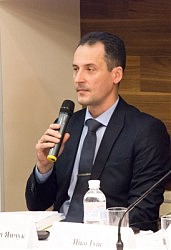
The Law of Ukraine “On Probation” provides for three types of probation: pre-trial, supervisory, and penitentiary. Probation is a new concept in legislation. Its implementation is just beginning, and one of the functions of probation bodies will be the preparation of pre-trial reports. This is written information collected by a service employee at the request of the court and characterizing the person being prosecuted: a socio-psychological profile, an assessment of the risk of re-offending, and a conclusion on the possibility of correcting the offender without imprisonment.
EU Project experts, along with colleagues and judges from the UK, the Netherlands, and Norway, familiarized Ukrainian servants of Themis with the practical experience of applying pre-trial reports.
Serhiy Chvankin, Chairman of the Kyiv District Court of Odesa, noted that the issue of probation is very important not only for the judicial system but also for the prosecution and advocacy: “Odesa is favorably disposed to innovations, so we will make every effort to ensure that probation is implemented and developed at a high level in our region. Judges want to improve, and the experience of foreign countries will help us in this.”
Oleg Yanchuk, Director of the Probation Department of the Ministry of Justice of Ukraine, delivered a report on “Probation in Ukraine: History and Modernity,” in which he detailed the process of its implementation and the main provisions of the current legislation. He also presented a model of the future service that will replace the criminal executive system.
Ihor Borshchov, a judge of the Kyiv District Court, noted certain shortcomings of the law and expressed his vision for further legislative changes. His proposals are: “Firstly, to involve a representative of the probation body at the pre-trial investigation stage, and to send the indictment to the court already with a pre-trial report. Secondly, to extend the scope of the Law to persons who have committed administrative offenses.”
“Round tables,” at which European and Ukrainian lawyers exchanged ideas on improving the institution of probation and the mechanism of its implementation, were also held in Kyiv and Kharkiv. The work is proceeding actively, as the process of implementing probation based on the currently existing criminal executive inspectorates is to be completed this year. The main tasks today are staffing, training personnel, and preparing the legislative framework. In cooperation with the Ministry of Justice, a model probation office will be created in Kharkiv, and it is also planned to identify a pilot court on the basis of which the work will be carried out.
For our country, implementing the experience of other countries is often difficult. By the way, according to statistics, in EU countries, there are about one hundred people in places of detention per hundred thousand population, in Russia up to five hundred, and in Ukraine up to three hundred. Keeping a prisoner in our country, given the imperfections of the punishment execution system, is often several times more expensive than a child in an orphanage, which is also confirmed by statistics. And in relation to juvenile offenders who have gone astray, the application of a system of re-education and supervision will probably be more humane in many cases.
In general, the concept of probation is new for our society. Given the current rise in crime and the decrease in detection rates, it may be perceived ambiguously by many. However, it works in Europe. So, maybe it will work for us too?











