

Much has been written about the tragedy of the “Admiral Nakhimov,” especially in the immediate aftermath. Some of it, however, was not always competent. Undoubtedly, the past thirty years is a sufficient period to draw the right conclusions about the causes of what happened.
So, former captain-mentor of the Black Sea Shipping Company’s Maritime Safety Service, Vadim Filippovich Demchenkov, decided to share his thoughts and conclusions. A few words about this man. After graduating from OVIMU, he worked on the motor ship “Bratstvo” from August 1965, becoming the captain of this vessel in 1974. Thirty years ago, in 1986, he came to work in the shipping company’s Maritime Safety Service. During the years of independence, he managed to sail for a decade on ships under a “convenient” flag. The former captain-mentor of the Black Sea Shipping Company’s Maritime Safety Service discusses the tragedy of the “Admiral Nakhimov” from a professional point of view:
“The catastrophe of thirty years ago was a result of both gross violations of the International Regulations for Preventing Collisions at Sea (COLREGs) and the human factor, which for a long time no one paid attention to, let alone took into account.
What wasn’t written about the causes of the collision! From comets to magnetic anomalies. About some phantom ships that Viktor Tkachenko, the captain of the dry cargo ship, mistook for the “Admiral Nakhimov.” It was claimed that the passenger liner was obliged to give way to the dry cargo ship going from the sea to the port, allegedly according to international rules. But there is no such thing, especially in international rules… And the traffic control post controller commands only what is within his area of responsibility. He could not order anything to a ship many miles away from the port, in this case, the dry cargo ship. He could only recommend.
One thing is certain: if the captain of the “Admiral Nakhimov,” Vadim Markov, had not panicked in the first minutes, but had acted collectedly and in accordance with one of the main rules for a captain – to always consider yourself closest to danger! – many lives could have been saved. However, perhaps he did not see the impending danger? Although he sent a sailor to General A. Krikunov’s cabin to warn of possible danger. But the head of the KGB for the Odessa region told the sailor – do not sow panic, if something serious happened, the captain would have called himself.
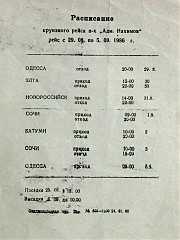
Here I would like to recall one point. In the fleet, passenger ships always had a privileged position. We, the dry cargo ship sailors, jokingly called them “white bone.” Without any malice, rather with respect. And we were always ready to give way to these white beauties with hundreds of passengers on board.
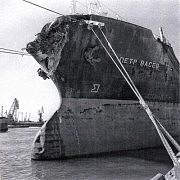
But then the “Pyotr Vasev,” under the command of Tkachenko, got in the way of the “passenger.” He was a man with great self-importance. Not very experienced and not very knowledgeable, who very reluctantly listened to others’ opinions, especially the opinions of his subordinates.
In our fleet life, encounters with passenger ships happened very often, and out of respect for them, we were always ready to give way, wait, or turn away. Slow down, change course. There were never any problems. And when Captain Tkachenko confirmed that they were letting the “Admiral Nakhimov” pass, Markov calmly left the bridge, especially since it was already open water.
However, as a knowledgeable and cautious captain (a captain must be cautious), Markov was obliged to keep the situation of divergence under control. After all, if he had stayed on the bridge for a few more minutes and waited for the “P. Vasev” to start its maneuver, or at least demanded reports from the watch officer on the executing of the maneuver by the yielding vessel, everything would have been different.
Here, psychology comes to the forefront. No one paid attention to the fact that the watch officer Chudnovsky was the same age as Captain Markov. He wasn’t even the chief mate, just the second mate. But he was the party organization secretary. It’s good to be an assistant of his rank at 30, but not at 56. He had long outgrown this position and hadn’t moved up.
Indeed, Chudnovsky committed a series of gross violations of COLREGs, yes, he is 100% to blame! But I am more than sure that he, like all navigators, crammed the aforementioned rules by points and articles from his cadet days. And if you asked him in a calm environment, he would clearly answer that rule No. 8, paragraph (b) states: “a series of small alterations of course and/or speed should be avoided.”
But Chudnovsky does exactly that! A series of small course alterations. And the most tragic and regrettable thing is that if he had done nothing, the dry cargo ship would have passed in front of the “Nakhimov.” But with several course alterations to the left, he created a collision trajectory, i.e., brought the vessel to the point of collision. Why did he do it? Because he was indecisive. And he constantly conflicted with the captain. They morally oppressed each other.
In one of the publications dedicated to the tragedy, it was written: “Chudnovsky was nervous.” Why should an assistant be nervous? If you have doubts, call the captain. Or act according to the rules. But out of fear, he begins to take rash, or rather, criminal actions. Any other watch officer, clearly aware of the measure of responsibility, would have called the captain more than once, reporting on the dubious actions, or rather, the inaction of the oncoming vessel. But here it’s different. It’s inconvenient to call, but there’s not enough courage to take decisive action as prescribed by the rules.
Now let’s look at the dry cargo ship’s bridge. Accident statistics show that the largest number of accidents occur with captains who have five years of experience. It seems like you’ve already caught God by the beard. And with Tkachenko’s character, this became dangerous. His performance review, as if in mockery, stated: “skillfully maneuvers in narrow passages and straits.” But I would like to ask: where did he learn this? As far as I know, in the USSR merchant marine, captains were not taught maneuvering or actions in extreme conditions.
When the watch officer finally literally pulled Captain Tkachenko away from the ARPA (Automatic Radar Plotting Aid, used to determine the risk of collision), the “Admiral Nakhimov” was 22 cable lengths away. This is very little. But it was still enough to prevent the collision with decisive action. Tkachenko panicked, and instead of immediately giving the command “full astern,” he began to gradually reduce speed, moving the engine telegraph through stages. Medium speed, slow speed, stop, and only then full astern, when there were only four cable lengths between the vessels. It was already impossible to prevent the collision…
Tkachenko was a “daredevil,” as his fellow navigators called him. He was in love with ARPA. With its help, the captain had already made risky maneuvers several times, passing other vessels at dangerous proximity. But he did not fully understand the principle of ARPA’s operation. This device needs three minutes to process data from an oncoming vessel. If the vessel changes course, ARPA will only show the new course and speed of the target after three minutes. But Tkachenko believed that ARPA showed a real-time picture.
So it turned out that ARPA showed him: the dry cargo ship would manage to cross the passenger vessel’s course ahead. Yes, the distance was small, but he had done it several times before. And it’s so tempting, without changing speed, to cross the oncoming vessel’s course, make a turn to the left to head for the recommended course, and you’re already in port. Before the end of the day, you’ll be at the pier. And this means fulfilling the plan, getting a bonus.
And then Captain Tkachenko falls into a catastrophic trap. On the “Admiral Nakhimov,” Chudnovsky makes small turns to the left every three minutes. On the “Pyotr Vasev,” ARPA doesn’t have time to process new data and continues to show outdated information. Tkachenko sees – there is a divergence! He can slip past the “Nakhimov” ahead. Tkachenko stubbornly insisted at the trial that according to ARPA readings, there was a divergence. He never realized his mistake. Although he promised to let the “passenger” pass, which means he had to reduce speed or change course. He does neither. The captain trusts ARPA, he stubbornly remains in his delusions, refusing to listen to the watch officer’s reports that the bearing to the oncoming vessel is not changing.
It turns out that on the “Admiral Nakhimov,” the assistant doesn’t dare to disturb the captain, making mistakes, while on the “Pyotr Vasev,” the watch officer persistently tries to draw Captain Tkachenko’s attention to the developing dangerous situation. Instead of tearing himself away from ARPA and visually confirming that the bearing to the oncoming vessel is not changing, Tkachenko dismisses the watch officer’s report. The second report from the watch officer enrages him, and he, as they say, “sent” the assistant away.
The “sent” subordinate still found the courage and literally grabbed Tkachenko by the sleeve, pulling him away from ARPA. The vessel was only 22 cable lengths away. Decisive and immediate action would have helped avoid the catastrophe. On training simulators, we ran through various situations. All of them ensured divergence. Dangerous, yes! With possible contact, yes! But there was no direct ramming blow to the side. Tkachenko begins to timidly and indecisively reduce the vessel’s speed. He had no idea how to act in extreme conditions. We were not taught this in the Black Sea Shipping Company. Writing “competently and skillfully maneuvers…” in a performance review is easier than creating a simulator to train captains to work in extreme conditions. In the late 80s, the issue of building a training complex on the Dry Estuary was being considered. But subsequent events buried not only the simulator idea but also the Black Sea Shipping Company itself.
In conclusion, I would like to say that there is nothing supernatural in this tragic catastrophe. There is only the human factor! And gross violations of COLREGs. In such extreme conditions, characters were sharply revealed. One saved loved ones at the cost of his life, another, having taken a place on a life raft, pushed away drowning people so they wouldn’t overload the raft. The captain of the Novorossiysk port, Georgy Popov, after the first report, ordered everyone to immediately proceed to the scene of the catastrophe. But the border post chief, with fast boats at his disposal, which could have covered those two miles to the drowning in two minutes, waited for orders from Moscow for half an hour. Then the naval sailors were “heroes,” saving those who were still afloat. And how many lives could they have saved if they hadn’t waited for those half an hour?!
They say the sea does not forgive mistakes. That’s for sure. And I would like to say to young captains: at sea, you must always do everything as if you are doing it for the first time. And only according to the rules.
Vadim DEMCHENKOV. Former captain-mentor of the Black Sea Shipping Company’s Maritime Safety Service
Afterword
In March 1987, a trial was held in Odessa for two captains – Vadim Markov and Viktor Tkachenko. Both were found guilty under Article 85 of the then Criminal Code (“violation of traffic safety and operation rules”), and in 1992, they were pardoned.
According to “Wikipedia,” Viktor Tkachenko, having changed his surname to his wife’s surname – Talior, moved to permanent residence in Israel. In September 2003, a yacht under the command of the former captain of “Pyotr Vasev” capsized. Viktor Talior died and was buried in Tel Aviv.
Captain Vadim Markov remained to live in Odessa and passed away on May 31, 2007.
The steamship “Admiral Nakhimov” still lies at a depth of 47 meters in Tsemesskaya Bay. Eroded by sea currents, it is leveling out, rising, creating a hazard to navigation. Every year, tons of stones are dumped onto the ship, trying to lay it on its side and sink it. But it shakes off these stones! As if unwilling to be a grave for those whose bodies were never recovered.
The dry cargo ship “Pyotr Vasev,” after repairs, was renamed, and in 2012, under the name “Jiajiaxin 1,” it was decommissioned and scrapped in Bangladesh.
Well, for those who were touched by the tragedy of the “Admiral Nakhimov” shipwreck to one degree or another, only the memory of the ship’s last voyage, which ended on August 31, 1986, remains…











