

After acting President of Brazil Michel Temer announced the opening of the Olympics, the main sporting spectacle of the four-year period officially began.
I cannot say with absolute certainty, but it seems that for the first time the Olympics were opened not by the head of state, but by an acting president (Dilma Rousseff was suspended from power by parliament less than a month before the Olympics), at least in my memory, nothing like this has happened. In principle, many things happened for the first time at the sports forum in Rio.
For the first time in the history of the Games, a refugee team is participating. Athletes, who marched under the IOC flag, took part in the parade of athletes. As soon as the athletes appeared in the Maracanã stadium, the stands literally exploded, enthusiastically welcoming the newcomers. No one except the hosts received such a warm welcome.
The Kosovo and South Sudan national teams became debutants of the Olympics.
In total, 206 participating countries are represented in Rio, which is a new Olympic record. In London, athletes from 204 countries competed.
Kenyan runner Kipchoge Keino became the first recipient of the “Olympic Laurel” award, established by the International Olympic Committee. The award is presented to athletes who have made the greatest contribution to the development of sports in the world.

The first Olympic gold medals for their countries were won by Vietnamese shooter Hoang Xuan Vinh (air pistol) and Kosovar judoka Majlinda Kelmendi.
The first world record was set even before the official opening of the Games. South Korean Kim Woo Jin set it in archery on Friday morning, August 5. In the qualifying competition, Jin scored 700 points, thus writing himself into the history of the Olympics and world sports.
Two more world records were set on the first day. Their authors are Briton Adam Peaty, who covered the 100m breaststroke in 57.55 seconds in the qualifiers, and Hungarian Katinka Hosszú, who won the 400m individual medley final. At the same time, the 27-year-old athlete surpassed the previous best achievement by 1.93 seconds – 4:26.36.
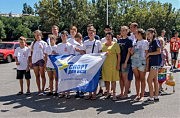
The first of the Odesa athletes to start in the Olympic battles was weightlifter Yulia Paratova. Her result was below expectations: 179 kg (85+94) and an overall 8th place. The very fact of her entry in the lightest weight category (up to 48 kg) was alarming, as Yulia won most of her titles in the weight category up to 53 kilograms. However, as it turned out, there was a reason for this. In an interview with the official website of the National Olympic Committee of Ukraine, the head coach of the women’s national team and Paratova’s personal coach, Yuriy Kuchinov, said that the athlete has had serious meniscus problems for more than three months. She cannot stand on both legs and is simply unable to lift very heavy weights. That’s why she was moved to a lighter weight category. The coach predicted that his student could realistically lift 88 kg in the snatch and 100-103 kg in the clean and jerk (which, as it turned out, would have brought a bronze medal). But something unforeseen happened: the athlete felt unwell. According to several news agencies, she even lost consciousness during the competition (this was probably due to the weight loss). “I generally thought she wouldn’t come out on the platform,” admitted Yu. Kuchinov. “But there’s nothing worse for an athlete than to give up.”
The champion of the 2016 Olympics was Thai weightlifter Sopita Tanasan, who showed a result of 200 kg (92 kg in the snatch + 108 kg in the clean and jerk). Silver was won by Indonesian Sri Wahyuni Agustiani – 192 kg (85+107).
3rd place was taken by Japanese Hiromi Miyake – 188 kg (81+107).
Of course, the 8th place of the athlete from Chernomorsk was disappointing. Oh, if only we could have predicted that this would be the best result for Ukrainian athletes in the first two days of the Games!
In the 1/8 finals, fencers Yana Shemyakina and Olena Kryvytska, as well as judoka Maryna Cherniak and the women’s archery team, were eliminated. In the very first bouts, judoka Georgiy Zantaria and boxer Denys Solonenko ended their performances in Rio. Natalia Kalnysh and Olena Kostevych (shooting) did not qualify for the finals. In the women’s road cycling group race, Anna Solovey took 36th place, and Andriy Hryvko – 41st (Denys Kostyuk and Andriy Khryphta even withdrew from the race).
In general, there is nothing to be proud of. Only the gymnasts, who reached the final stage of the competition, brought joy. We are also counting on the sabre fencers, led by the phenomenal Olha Kharlan; they competed for prize places on Monday night to Tuesday.
In Rio, the Ukrainian team is represented by a record small number of athletes, having won only 206 licenses. Nevertheless, the Infostrada website predicts 16th place for Ukraine with 25 medals. According to the website’s version, the USA will win the medal standings (88 medals), China will be second (71 medals), and Great Britain will complete the top three (56 medals).
In the previous publication dedicated to the Rio de Janeiro Olympics, the prize money promised by the state to Ukrainian athletes was mentioned ($125,000 for 1st place). Singapore leads in this regard ($745,000 for “gold”), Azerbaijan is second ($510,000), followed by Thailand ($314,000), Kazakhstan ($250,000), Malaysia ($249,000), Uzbekistan and Kyrgyzstan (both $200,000), Latvia ($190,000), Italy ($184,000), Belarus ($150,000). Traditionally, the USA will pay its athletes a “modest” $25,000 for a victory, while Croatia, Sweden, Norway, and Great Britain will not pay a penny.
The sad results of the first days testify to how difficult it is to earn Olympic money. The Olympic Games ended with fractures for Richie Porte (Australia), Vincenzo Nibali (Italy), and Sergio Henao (Colombia) as a result of falls in the road cycling group race.
First, Richie Porte was eliminated from the competition; he fell 35 km from the finish and suffered a fractured right shoulder blade. 12 km from the finish, Vincenzo Nibali and Sergio Henao, who had attacked from a breakaway, lost control on a descent. Nibali fell first, and Henao, who was riding behind him, also could not avoid falling. The Italian suffered a fractured collarbone, and the Colombian, according to the chief doctor of the national team, suffered a fracture (crack) of the iliac bone of the pelvis and a chest injury.
Dutch cyclist Annemiek van Vleuten was also involved in a serious accident. The 33-year-old athlete was fighting for victory with American Mara Abbott. Nine kilometers from the finish, they were more than forty seconds ahead of the pursuers. On one of the turns on the wet asphalt, van Vleuten lost control and fell at high speed, flying over the handlebars and landing on her back on the curb. There are no details yet about van Vleuten’s health condition, but such a fall, according to the British press, could have led to a spinal injury.
The vault performance ended terribly for French gymnast Ait Said. As reported by ABC, doctors diagnosed him with a double fracture of the tibia and a fracture of the fibula.
Against this backdrop, the robbery of the Portuguese Minister of Sports, Tiago Brandão, in the prestigious Rio de Janeiro district of Lagoa looks like a harmless adventure.
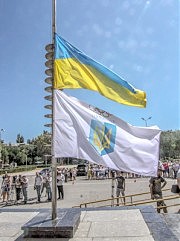
These are the not-so-comforting news coming from the capital of the XXXI Olympic Games so far. But we do not lose hope. There will be a celebration on our street, there definitely will be. This was spoken about at the solemn ceremony of raising the State Flag of Ukraine and the flag of the International Olympic Committee in Odesa by Olympic champions of past years Viktor Mykhalchuk, Yakov Zheleznyak, Mykola Avilov, Yuriy Belonog. Their opinions can be trusted.











