

Belgian director Xavier Seron said this, commenting on the black humor of his film “Death After Death,” awarded at OIFF-2016 with the prize for best director (see “VO” of July 26). Not only this film turned out to be marked by sorrow and a smile. Does it testify to “hopelessness”? What ghosts are roaming Europe today?..
ALMOST behind every film of the new “auteur cinema” looms the ghost of an outstanding predecessor. Everything has been done, done, done. That’s not the problem: all plots are stated in the Bible, Shakespeare took his good where he found it, and Pushkin did the same. But the examples that stand behind the latest arthouse endeavors offer such a depth of understanding of the theme and such a height of posing “eternal questions” that one must dare to engage in a dialogue. So, if Shakespeare touched upon something, then one should not write about it now? No, one should write and film. But what remains for a critic, who was not born yesterday, is to observe: how will the new author disentangle himself, what will he be able to captivate with?
The author of the festival film “The Fire Will Burn,” “sentenced” to the Grand Prix by audience vote, emerged from the cultural trap with dignity. The young director Chania Button was saved by… kindness. Soulful subtlety. The audience took a liking to the humane film, which once again reminded us that everyone has only one life, that it can suddenly end, and that it is wrong to waste it in pursuit of material comfort, for which one compromises and forgets that one is a human being, not a cog in a social mechanism, even if it is perfectly tuned for one’s own good, i.e., comfort. It makes sense to think hard about inedible things, to reconsider our careless attitude towards loved ones, and to realize that “there will always be a higher peak,” as two young heroines realize at the end of the film.
The plot was concocted, let’s be honest, dangerously. A journey with a funeral urn to scatter ashes in specific places according to a will, and adventures that await the characters, with simultaneous settling of scores… doesn’t it remind you of anything? Yes: Fellini, “And the Ship Sails On.” In Fellini’s film, the ashes of an opera diva are scattered near the Greek island of Erimo, where the entrance to Hades was believed to be; in Chania Button’s film, one of the heroines, to whom a doomed friend entrusts his ashes in a video will, is named Persephone…
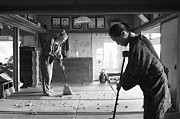
There are people, even those professionally involved in cinema, who do not perceive Fellini’s work at all. Well, that’s their business… As for me, rewatching “And the Ship Sails On” for the umpteenth time, I feel it again and again: magic! After watching “The Fire Will Burn,” it’s different: well, it’s a good film, with good wishes for the young. It’s unlikely to cause a revolution in consciousness.
THE IDEAS contained in Chania Button’s film are applicable to other festival films, both in competition and in other categories. The same film “Death After Death” by Xavier Seron. I love black humor. In essence, it is an attempt to exorcise death, a remnant of an ancient ritual of funeral laughter. The director himself admitted his intention to “tame death.”
In the film, dark humor sets the tone, but the author does not overdo it, does not descend into brutality, does not vulgarize anything. Actor Jean-Jacques Rosnen is magnificent, and it takes extraordinary courage to appear as such a loser – a hypochondriac hounded by a capricious, selfish mother, who imagines he has cancer. If he can be “loved,” it is with detached condescension: pitying, but not identifying with him. Clearly not a sex symbol. One must have the courage to portray such an anti-hero. This is acting talent, selfless talent! Plus, the amazing work of the young cinematographer Olivier Bundjing, who managed to reveal, to “paint” with light the almost icon-like texture of the main actor: looking at Rosnen in real life, you wouldn’t think so.
But the film left me with a certain dissatisfaction, a feeling of duality. The author set out to pose an existential problem: the inevitability of death and, in light of this, the question of the meaning or meaninglessness of existence. But he got too carried away with the private biographical case of his character: his relationship with his dominant mother. Jean-Jacques Rosnen’s character is kind, conscientious, so his mother sat on his head; the Oedipus complex has nothing to do with it. The problem for the film’s idea is that the existential problem as such does not arise from the relationship, whatever it may be, between mother and son, just as these relationships are not caused by this problem. The film ran on two different tracks – and the story, in my perception, went off the rails. As if someone slipped on the ice and involuntarily ended up in a split, straining their ligaments. The existential question is like that, an artist can easily break their neck on it. Ultimately, the private case prevails: one sympathizes with the touching hero of the film, and as for the fact that we all, in principle, will die, well, death is something that happens to others.
…I had hoped that the film “Greetings from Fukushima” by German director Doris Dörrie would be recognized. In my opinion, the acting award to the two main actresses, Rosalie Thomass and Kaori Momoi, is not enough. The film is kind, filled with humor, also sometimes black, and subtle observations that provoke thought. And most importantly: its issues are universal, all conflicts can be applied to oneself.
You watch how an elderly Japanese woman stubbornly tries to clear the rubble left at the site of her parents’ house after the tsunami; how a young German woman, who came to Japan after the Fukushima disaster as part of a volunteer organization, tries to help her… why, you ask, did she rush from comfortable Germany – such an altruist, right? Does it mean that the meaning of existence in comfort has become so blurred for her that she is not afraid of radiation? Or, on the contrary, did she flee headlong from social insecurity? You watch how they try together to give the ruin a semblance of a dwelling. How they dig up fragments, remnants of a normal, peaceful life – photographs, dear household items…
And you think: so, perhaps, in order for us to feel the taste of life, to appreciate the very possibility of living, we need a catastrophe? Do we need to lose our home to understand what a blessing it is – a home, even a poor one? Do we need to survive a cataclysm to find a true purpose, the meaning of life: creation – to build a new home on the site of a destroyed one…
And why? To live normally. That is, in comfort. And what is comfort for? What do we have to sacrifice in life for it? What restrictions and social conventions do we have to accept? (Here, also, watch the festival film “Toni Erdmann”). What a vicious circle!
And this clash of civilizations in the person of two accidental fellow travelers, a victim of a catastrophe and a volunteer, a Japanese woman and a European woman! Oh, “East is East, West is West,” and with so many tragicomic nuances!.. The victim does not feel like a victim – she secretly despises the rescuer as a stranger, as a barbarian, and even through Japanese politeness, this feeling of superiority breaks through. Added to this is the mimicking Japan in the film, this self-sufficient East, which has “masqueraded” to comfortably exist on the planet as the West, adopted American civilization – and deeply despises it. The heroine of the film is a geisha. This is a calling, this is for life, this is a proud embodiment of tradition, and this is… show business, as she herself soberly states: a gimmick for tourists. And the geisha’s daughter dances as an Amazon-samurai in a Broadway-style show. Globalization: if you want comfort, or simply to survive, follow the dress code…
Will civilizations on the planet get along? Or will the mental conflict – and conflict, as is known, is the engine of plot and progress – lead to a catastrophe?..
THE JURY’S FAVORITE, the “best film” – is the film “The Deal” by Romanian director Adrian Sitaru. Here is the universal harmony of political correctness! Firstly, a film from a post-socialist country that experienced totalitarianism. Secondly, the benevolent idea that the main actors Alina Grigore and Robi Urs explained to us at the press conference: do not judge, and you will not be judged. They say, one must understand the situation from within. The situation is sex between a brother and sister, twins, who, as I understood, are 15 years old according to the plot. The girl got pregnant. Abortion is murder. After long debates, the child is born safely, everyone rejoices.
Incest: that’s what scared them!.. How Europe lived sexually during its ancient adolescence and wild Renaissance youth, we are aware of. How the theme is reflected in European cinema – we are also informed. Young people, here’s my tip: the world cinema classic Luchino Visconti, “The Valley of the Eagles,” “Golden Lion” of the Venice Film Festival in 1965. I am not comparing, however: they are not even close. He is a classic for a reason. You can also be curious about Ingmar Bergman’s “The Silence,” 1963…
What is bad is different. Whether the play at the basis of the script is scribbled, or the script based on the play turned out to be weak, it is not good when instead of artistic research, one is offered propaganda: “Abortion is a crime, even if the child is the fruit of incest.” Well, it’s a family matter. And the film is not more than a propaganda poster in a health center. Who and what did it try to “understand from within”? What can be said about the characters, the brother and sister, other than that they are young, pretty, and attend dances? What are their characters, what, in the end, pushed them into each other’s arms – they weren’t raised locked up, were they?
They try to give us a justification – but a primitive one: psychoanalysis adapted for clerks. They say the twins’ mother hesitated whether to give birth or have an abortion. They say they were born uninvited and unwanted, with a prenatal trauma, so to speak, and were forced to love each other. But the process of “making love” is given “weighty, rough, visible,” unlike those old-fashioned Visconti films with their hints. It’s impossible to do otherwise now, or you’ll fall out of the mainstream.
The apogee of the impression was the snoring of a young viewer in the chair behind, during the exhaustingly long on-screen dialogue between the brother and sister about whether she should have an abortion. The dialogue ended, the viewer woke up. I’m not making anything up!
It is clear: the younger generation of Romanian artists has rushed to embrace “European values” with the zeal of neophytes, who, as is known, are more pious than the Ecumenical Patriarch and more infallible than the Pope of Rome. Tolerance – to the extreme. The film festival jury – the same. After all, the film “The Deal,” no matter how you look at it, does not shine with artistic merits, offers neither psychological depth nor formal innovations. And you talk about the past here – totalitarian censorship, political conjuncture.
…And, finally: whoever hopes that Europe will solve our problems, let them watch the film awarded the Palme d’Or at Cannes in 2016: Ken Loach’s “I, Daniel Blake.” Was this a bow from the jury to the filmmaker, who turned 80 that year? On such occasions, they usually award “for contribution to cinema.” And if they gave the “Branch” for such a film, then… something is not right in the United Kingdom either. A person turned into a part of a well-oiled social mechanism of selling labor for the purchase of comfort, once, like any part, wears out, and then… Actually, the sad story told by Ken Loach is a grotesque, pushing the situation to the extreme, but the director did not invent it out of thin air.
There will be no “European balls.” Europe has no time for our problems: it has plenty of its own. No one in the world cares about our problems. He who sets off on his own course does not try to hand over the helm to a stranger. The plots of European cinema are proof of this. “Find your own way”…











